Disclaimer: Information found on CryptoreNews is those of writers quoted. It does not represent the opinions of CryptoreNews on whether to sell, buy or hold any investments. You are advised to conduct your own research before making any investment decisions. Use provided information at your own risk.
CryptoreNews covers fintech, blockchain and Bitcoin bringing you the latest crypto news and analyses on the future of money.

Federal Reserve Denies Caitlin Long’s Crypto Bank’s Request for Master Account After Five-Year Effort

A U.S. appellate court has ruled against Custodia Bank, the Wyoming-based cryptocurrency-focused institution established by former Morgan Stanley executive Caitlin Long, in its ongoing struggle to secure direct access to the Federal Reserve’s payment system.
In a decision issued on Friday, the U.S. Court of Appeals for the Tenth Circuit upheld a prior ruling from the District of Wyoming that favored the Federal Reserve Board of Governors and the Federal Reserve Bank of Kansas City.
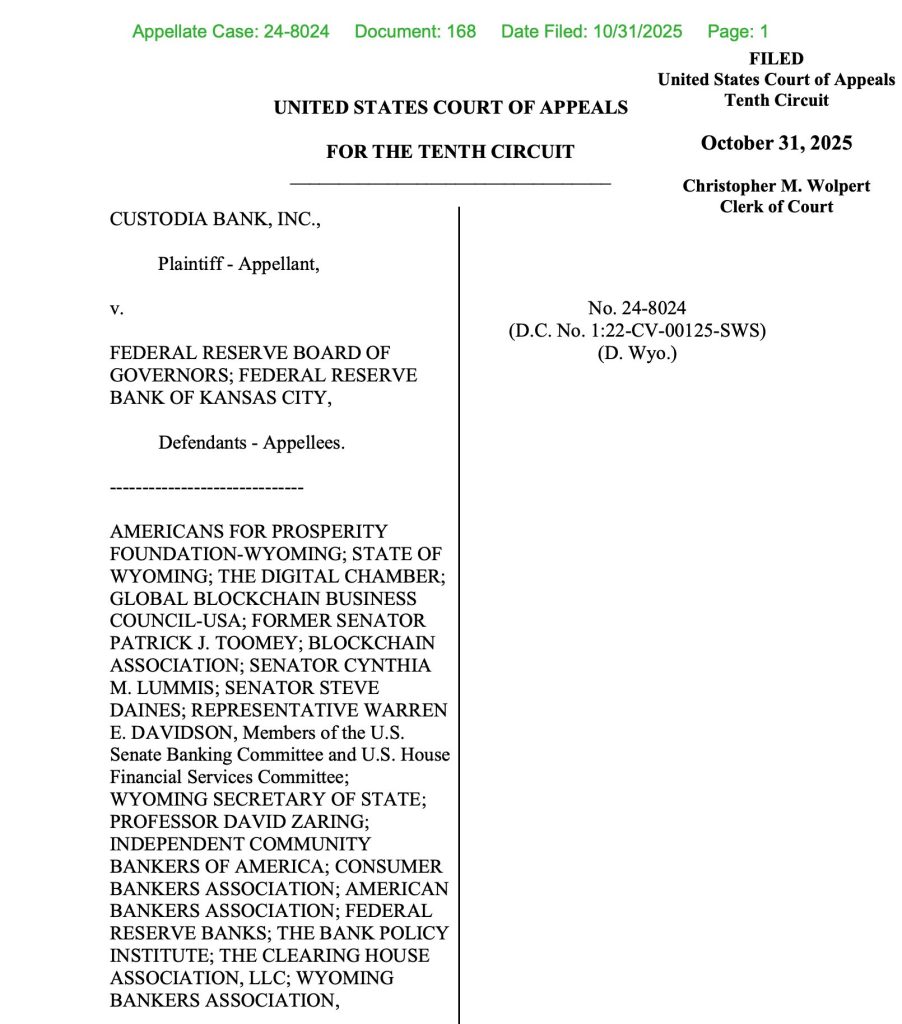 Source: Court Listener
Tenth Circuit Affirms Fed’s Decision to Deny Custodia’s Access to U.S. Payment System
This ruling represents the latest obstacle in Custodia’s five-year quest to obtain a Federal Reserve “master account,” which is essential for direct involvement in the U.S. banking system.
“This case is framed in 21st Century terms: cryptocurrency, digital assets, instant wire transfers, and master accounts,” the judges noted in their opinion.
“However, this issue is not new. Courts have examined the legality of our nation’s central bank and interpreted the relevant statutes since its inception.”
The three-judge panel, consisting of Circuit Judges Tymkovich, Ebel, and Rossman, supported the lower court’s finding that the Federal Reserve acted within its jurisdiction when it rejected Custodia’s application.
The ruling effectively upholds the central bank’s decision, affirming that the Fed possesses broad authority in determining which financial institutions can access its payment systems.
Custodia, formerly known as Avanti Bank, initially submitted its application for a master account in October 2020 after obtaining a special-purpose depository institution (SPDI) charter from the state of Wyoming.
The application, which is typically processed within a week, remained unresolved for over 19 months.
In January 2023, the Federal Reserve Bank of Kansas City officially denied the request, citing “safety and soundness” concerns related to the bank’s emphasis on digital assets.
U.S. digital asset-focused bank Custodia has initiated legal action against the FED Board of Governors and the Federal Reserve Bank of Kansas City over the “unlawful” delay of its application for a master account with the FED.
Read morehttps://t.co/8rpBp5piaM
— Cryptonews.com (@cryptonews) September 23, 2022
 https://t.co/8rpBp5piaM
The Fed contended that Custodia’s business model was overly reliant on volatile cryptocurrency markets and lacked adequate measures to mitigate illicit finance risks.
It also highlighted the bank’s limited experience in conventional risk management and the potential systemic risks of granting direct access to a crypto-focused institution.
Custodia filed a lawsuit against the Federal Reserve in June 2022, alleging an “unlawful delay” and asserting that eligible institutions are entitled to a master account under federal law.
After the Wyoming court ruled in favor of the Fed in March 2024, Custodia appealed, claiming that the decision granted the central bank excessive authority over market access.
Judge Rules Against Digital Asset Bank Custodia’s Attempt for Federal Reserve Master Account
Custodia Bank has been denied a U.S. Federal Reserve master account by the United States District Court for the District of Wyoming. #CryptoNewshttps://t.co/lHtNJ69ZdW— Cryptonews.com (@cryptonews) March 31, 2024
Friday’s ruling reaffirmed the lower court’s stance, delivering another setback to Long’s efforts to incorporate crypto banking into the U.S. financial framework.
In a statement shared on X following the ruling, Custodia indicated it was “actively considering” requesting a rehearing.
Statement of @custodiabank: pic.twitter.com/6U0FPzaKCm
— Custodia Bank
(@custodiabank) October 31, 2025
 (@custodiabank) October 31, 2025
Related Posts
“While we were hoping for a favorable outcome at the Tenth Circuit today, we received the next significant development — a strong dissent,” the company stated, referencing a partial dissent that raised constitutional concerns regarding the Federal Reserve’s authority.
Why Won’t the Fed Grant Crypto Firms a Master Account?
A Federal Reserve master account would have enabled Custodia to connect directly to essential U.S. payment systems such as Fedwire and the Automated Clearing House (ACH).
This access allows banks to settle transactions, maintain reserves, and engage directly in monetary policy operations, advantages currently restricted to regulated depository institutions.
Cryptocurrency-focused firms have long sought similar access to enhance efficiency and lessen dependence on intermediary banks.
However, the Federal Reserve has yet to approve any master account applications from crypto-native institutions.
The central bank has consistently cited the sector’s high volatility, potential for fraud, and inadequate consumer protection as reasons for caution.
 Source: Congress
Custodia’s situation has become a central point in the broader discussion regarding how traditional banking regulations should apply to cryptocurrency firms.
Custodia Bank CEO @CaitlinLong_ has criticized the U.S. government’s inaction on crypto debanking since Trump returned to office. #Trump #Regulationhttps://t.co/iSH4RxoinL
— Cryptonews.com (@cryptonews) March 2, 2025
 Custodia Bank CEO @CaitlinLong_ has criticized the U.S. government’s inaction on crypto debanking since Trump returned to office. #Trump #Regulationhttps://t.co/iSH4RxoinL
Long has accused the Fed of applying double standards, claiming that large traditional banks receive preferential treatment while smaller innovators face “debanking.”
In April, Long criticized the Federal Reserve for upholding restrictions that prevent banks from directly holding cryptocurrency or issuing stablecoins on public blockchains like Ethereum.
Caitlin Long asserts that the U.S. Federal Reserve has concealed its anti-crypto position with superficial rule relaxations while safeguarding big-bank stablecoins and obstructing genuine crypto advancement.#Caitlin Long #USFed.https://t.co/6kALn4okMF
— Cryptonews.com (@cryptonews) April 28, 2025
She contended that the Fed continues to favor private blockchain systems controlled by major banks, resulting in a competitive disadvantage.
Earlier this year, Custodia announced the launch of “Avit,” a tokenized U.S. dollar stablecoin issued in collaboration with Vantage Bank on Ethereum.
@custodiabank and @Vantage_Bank have revealed the launch of the first-ever U.S. bank-issued stablecoin deployed on blockchain.#Custodia #Stablecoinhttps://t.co/Y7VyUBlr2i
— Cryptonews.com (@cryptonews) March 26, 2025
 @custodiabank and @Vantage_Bank have revealed the launch of the first-ever U.S. bank-issued stablecoin deployed on blockchain.#Custodia #Stablecoinhttps://t.co/Y7VyUBlr2i
The initiative, supported by on-demand deposits held within the banking system, was characterized as the first U.S. bank-issued stablecoin launched on a public blockchain.
Long stated that the project demonstrated that banks could “tokenize demand deposits on a permissionless blockchain in a regulatorily compliant manner.”
Despite these initiatives, federal regulators have maintained a cautious approach.
Speaking in March, Long remarked that under the current administration, no significant changes have been made to regulations categorizing digital asset exposure as “unsafe and unsound” for banks.
The post Fed Crushes Caitlin Long’s Crypto Bank’s 5-Year Bid for Master Account appeared first on Cryptonews.
