Disclaimer: Information found on CryptoreNews is those of writers quoted. It does not represent the opinions of CryptoreNews on whether to sell, buy or hold any investments. You are advised to conduct your own research before making any investment decisions. Use provided information at your own risk.
CryptoreNews covers fintech, blockchain and Bitcoin bringing you the latest crypto news and analyses on the future of money.

Fed Rate Cut Probability Rises to 97% Following CPI Report of 3% – Positive Implications for BTC?

The Consumer Price Index (CPI) in the United States increased to 3.0% year-over-year in September, falling short of economists’ forecasts of 3.1% and marking the first instance of inflation reaching or surpassing 3% since January.
This unexpectedly lower reading surprised many, leading to a spike in the likelihood of a 25-basis-point rate cut by the Federal Reserve in October, which surged to 97% on Polymarket right after the data was released.
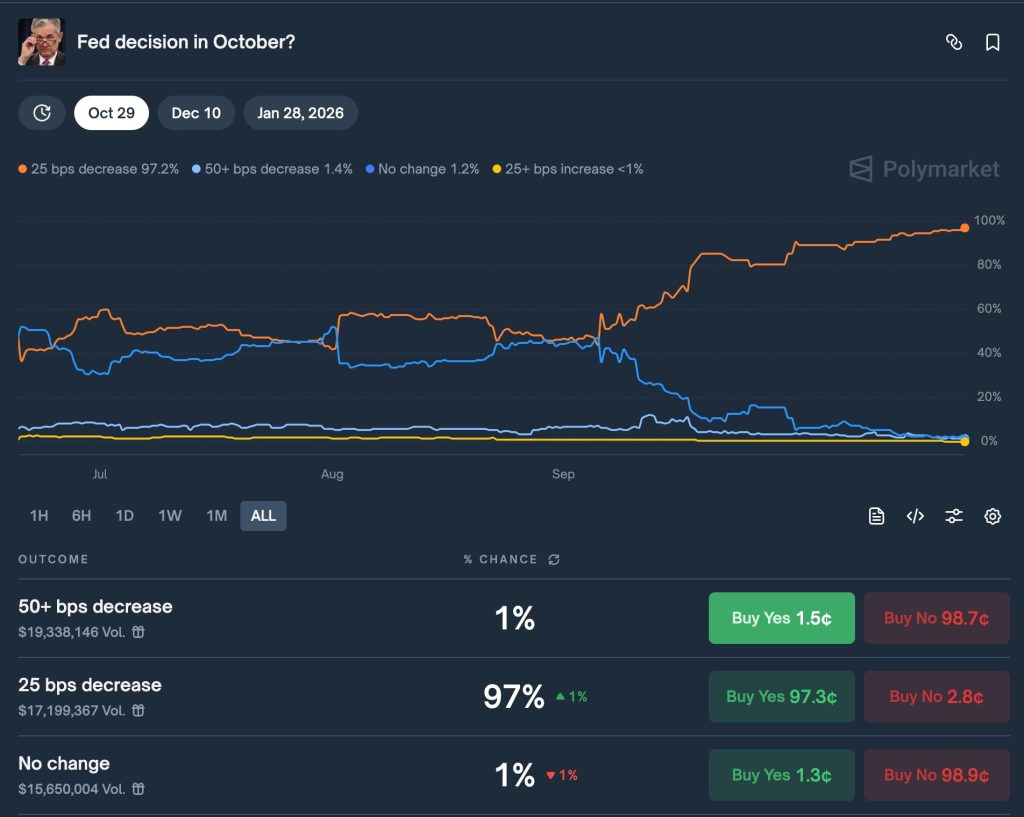 Source: Polymarket
Bitcoin reacted by rising back above $111,000.
Inflation Data Exceeds Expectations Across All Metrics
The increase in inflation for September was mainly attributed to higher gas and food prices, with tariffs also playing a role, as noted by market analysts.
Nonetheless, the monthly rise of just 0.3% was significantly lower than the anticipated 0.4%. In contrast, the core CPI, which excludes food and energy, slightly decreased to 3.0% annually, with a monthly increase of only 0.2% compared to expectations of 0.3%.
 Source: BLS
The softer-than-expected results across all inflation metrics, coupled with recent instability in the labor market, have led market participants to anticipate a 25 to 50 basis point rate cut at the upcoming Federal Reserve policy meeting.
In an interview with Cryptonews, Farzam Ehsani, co-founder and CEO of VALR, discussed how the macroeconomic landscape could favor Bitcoin in the future.
“If the U.S. CPI figures come in weak and trade discussions yield positive outcomes, investors may shift from pure protection to growth engagement,” Ehsani stated.
“This transition would enhance Bitcoin’s relative attractiveness as it encompasses both narratives—a safeguard during downturns and an investment opportunity when conditions stabilize.”
He mentioned that positive macro developments could pave the way for a potential rally towards $130,000-$132,000 in Q1 2026.
However, he warned that “Bitcoin’s ascent is not assured” due to its dual nature as both a store of value and a risk asset.
Market Participants Prepare for Fed Shift
An anonymous trader, boasting a reported 100% win rate, initiated long positions in Bitcoin and Ethereum valued at $155 million immediately following the CPI announcement.
Pre-market stock trading indicated a strong appetite for risk, with Nasdaq futures rising 0.83% and S&P futures increasing 0.57%, suggesting that broader market participants view the data as favorable for risk assets.
Related Posts
$BTC is back above $111,000 level.
Today’s CPI print was lower than expected, and it resulted in an initial pump.
Pre-market stock trading insights:Nasdaq futures is up 0.83%
S&P futures is up 0.57%
pic.twitter.com/HgRFEkK25y
— Ted (@TedPillows) October 24, 2025
 S&P futures is up 0.57%
 Crypto analysts, including Michael van de Poppe, indicated that lower-than-expected inflation figures could propel Bitcoin to a new all-time high within the next 30 days.
Simultaneously, the Global M2 money supply continues to account for more than half of Bitcoin’s price variance, according to VanEck analysis, which they assert is “reaffirming Bitcoin’s role as an anti-money-printing asset.”
 Source: VanEck
Bitcoin futures open interest reached $52 billion before a wave of liquidations led to an 18% price drop in early October.
However, VanEck analysts view this as a standard mid-cycle pullback rather than the onset of a prolonged bear market, noting that leverage metrics have returned to normal levels at the 61st percentile.
Additionally, they observe increasing correlations between blockchain network revenues and token prices, along with ongoing corporate Bitcoin accumulation, as indicators of growing institutional integration of digital assets into traditional investment frameworks.
Bitcoin Technical Analysis: Will Historical MACD Pattern Repeat or Break?
Analyst Ali Martinez noted that Bitcoin’s monthly MACD indicator displays concerning historical trends, with each previous bearish cross on the monthly timeframe corresponding to average price declines of around 70% based on four instances since 2012.
Every time the MACD has crossed bearish on the monthly chart, Bitcoin $BTC has seen an average price drop of around -70%. pic.twitter.com/Vr12Rp6BHw
— Ali (@ali_charts) October 24, 2025
These declines included an 80.46% drop in February 2012, a 73.23% decline around March 2018, a 60.20% correction in December 2019, and a 70.77% fall around September 2021.
However, these bearish crosses occurred following significant bull-market peaks and acted as lagging confirmations of trend changes rather than predictive alerts.
The current price of approximately $110,000 indicates about a 12% decrease from recent highs near $126,000.
This suggests that if a bearish MACD cross occurs, it would confirm the already apparent weakness rather than serve as a warning.
The monetary policy environment, with imminent rate cuts, contrasts sharply with previous bearish MACD periods that took place during Fed tightening cycles.
At present, extended consolidation between $95,000 and $120,000 seems most probable in the near term as markets process competing influences.
Nonetheless, a breakout above $120,000 on sustained volume could expedite movement toward the $130,000-$132,000 range by Q1 2026 if macroeconomic conditions remain favorable.
The post Fed Rate Cut Odds Jump to 97% as CPI Comes in Cool at 3% – Bullish for BTC? appeared first on Cryptonews.
