Disclaimer: Information found on CryptoreNews is those of writers quoted. It does not represent the opinions of CryptoreNews on whether to sell, buy or hold any investments. You are advised to conduct your own research before making any investment decisions. Use provided information at your own risk.
CryptoreNews covers fintech, blockchain and Bitcoin bringing you the latest crypto news and analyses on the future of money.


An LDO holder has filed a class-action lawsuit against the governing entity of the liquid staking protocol Lido, as stated in a complaint submitted to a San Francisco United States District Court on Dec. 17. The lawsuit contends that Lido’s LDO token qualifies as an unregistered security and asserts that the Lido decentralized autonomous organization (Lido DAO) is responsible for the plaintiffs’ losses stemming from the token’s price drop.
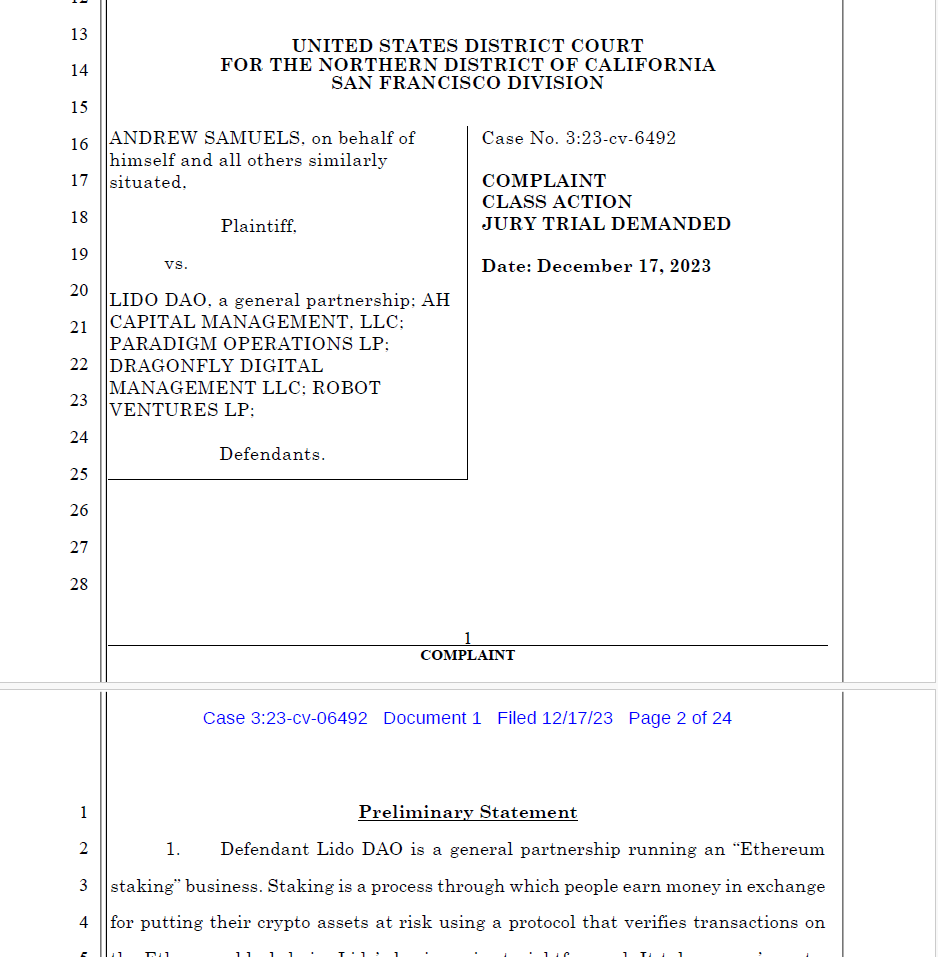 The complaint filed against Lido DAO on Dec. 17. Source: CourtListener
Lido operates as a liquid staking protocol that enables users to delegate their Ether (ETH) to a network of validators, earning staking rewards while also possessing a derivative token known as stETH, which can be utilized in various applications. Governance is managed by LDO holders, who collectively constitute Lido DAO.
The lawsuit was initiated by Andrew Samuels, a resident of Solano County, California, as indicated in the document. The defendants include Lido DAO, along with venture capital firms Paradigm, AH Capital Management, Dragonfly Digital Management, and the investment management firm Robert Ventures. The document claims that 64% of LDO tokens “are allocated to the founders and early investors like [these defendants],” thus rendering “ordinary investors like Plaintiffs unable to exert any significant influence on governance matters.”
Related Posts
The filing states that Lido DAO originated as a “general partnership” comprised of institutional investors. However, it later opted to create a potential “exit” opportunity. To enable this, it chose to offer LDO tokens to the public by persuading centralized exchanges to list them on their platforms. Following the listing, plaintiff Samuels and “thousands of other investors” acquired the tokens. Subsequently, the price declined, resulting in losses for these investors, according to the document. It asserts that these firms are accountable for the resulting losses.
Related: LidoDAO launches official version of wstETH on Base
Citing U.S. Securities and Exchange Commission Chair Gary Gensler, the document argues that LDO is a security due to the existence of “a group in the middle [between the tokens and investors], and the public is anticipating profits based on that group.”
Cointelegraph reached out to representatives of Lido DAO but did not receive a response prior to publication.
Data from the blockchain analytics platform DefiLlama indicates that Lido holds the largest total value locked of any liquid staking derivative, with over $19 billion in cryptocurrency secured within its contracts. The Lido governance token achieved an all-time high during the previous bull market, reaching $6.41 per coin on Aug. 20, 2021. It is currently valued at $2.08 per coin.
