Disclaimer: Information found on CryptoreNews is those of writers quoted. It does not represent the opinions of CryptoreNews on whether to sell, buy or hold any investments. You are advised to conduct your own research before making any investment decisions. Use provided information at your own risk.
CryptoreNews covers fintech, blockchain and Bitcoin bringing you the latest crypto news and analyses on the future of money.


When Bitcoin fell below $78,000 on January 30, 2026, it was accompanied by a downturn in copper, gold, silver, and platinum, with the base metal decreasing nearly 4% from its peak of over $14,500 per ton just a few hours prior.
This coordinated selloff reinforced suspicions that Bitcoin is increasingly acting like a macro risk asset, moving in tandem with traditional economic indicators during times of heightened uncertainty.
Copper, often referred to as “Dr. Copper” for its ability to gauge economic health, has experienced a volatile surge over the past few days.
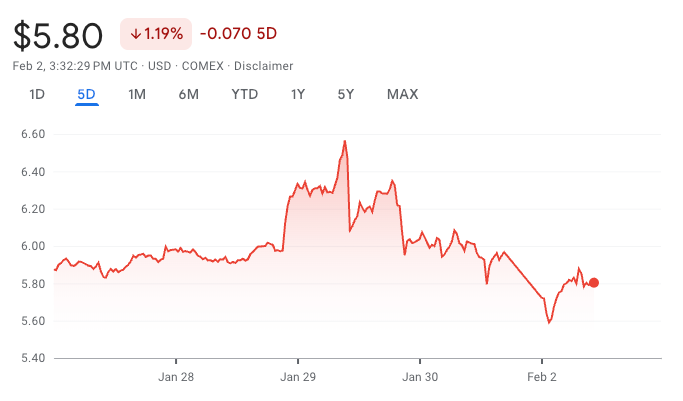 Source: Google Finance
After reaching record highs close to $6.50 per pound in late January 2026, the metal sharply declined to approximately $5.92 per pound on January 31.
Bitcoin’s path has been equally tumultuous, dropping from its all-time high of $126,173 in October 2025 to current levels around $77,000-$78,000, marking a decline of about 40%.
Both assets are confronted with similar macroeconomic challenges.
Understanding Dr. Copper’s Economic Signal
Copper’s status as an economic barometer arises from its widespread use in industrial operations.
Its demand in sectors such as construction, infrastructure, electric vehicles, and AI data centers serves as a reliable reflection of actual economic growth.
JPMorgan predicts that the demand for copper from data centers alone could soar to 475,000 tons in 2026, a significant increase from 110,000 tons in 2025, fueled by the expansion of AI infrastructure.
However, despite these long-term supportive trends, copper’s recent fluctuations demonstrate how swiftly macroeconomic anxieties can overshadow fundamental demand.
In a discussion with Cryptonews, Vasily Shilov, CBDO at the crypto exchange aggregator SwapSpace, cites geopolitical tensions as a significant influencing factor.
“Concerns regarding the situation with Iran were the primary news impact weighing on the market,” Shilov elaborates, noting that “political factors are exerting pressure: trade threats directed at Canada, South Korea, and Cuba, aggressive rhetoric towards Iran, and the Federal Reserve’s decision to maintain rates unchanged with no indication of imminent easing.”
Bitcoin’s Changing Correlation
Bitcoin’s association with copper has significantly transformed.
During the pandemic, research from Poland’s Institute of Nuclear Physics documented new correlations between cryptocurrencies and commodities, including copper, which had not existed prior to COVID-19.
In December 2022, Bitcoin’s correlation with copper surged to 0.84, indicating that the digital asset was trading more like a risk-oriented commodity than a safe haven.
Analysts have monitored the copper-gold ratio as a leading indicator for Bitcoin price fluctuations.
Crypto analyst Lark Davis has noted that Bitcoin price surges have historically occurred when the copper-gold ratio’s relative strength index re-evaluates its lower range.
Every time the RSI on the Copper/Gold ratio rebounded from such a low level, a Bitcoin surge followed.
Will history repeat itself? pic.twitter.com/tnuyaRhZXn— Lark Davis (@LarkDavis) December 30, 2025
Nonetheless, late 2025 highlighted the volatility of this relationship.
Related Posts
During what analysts referred to as “metal season,” copper appreciated by over 40% while Bitcoin experienced a decline of about 6%, illustrating that the correlation can completely break down.
Current Market Dynamics
The synchronized selloff on January 30 illustrates how both assets now react to shared triggers.
For copper, volatility reflects speculative positioning surrounding potential U.S. tariffs on refined copper imports, weakened Chinese demand (down 8% year-over-year in Q4 2025), and pre-emptive inventory buildup in the U.S.
Bitcoin faces similar pressures. “The influx of new capital into BTC has virtually halted,” Shilov notes, adding that market participants increasingly anticipate “a prolonged sideways trend rather than a swift V-shaped recovery.”
According to SwapSpace data, on-chain metrics reveal that Bitcoin transfer volumes to exchanges have decreased to around $10 billion monthly, compared to $50-80 billion during previous price peaks, indicating that the drop is due to weak demand rather than panic selling.
This weakness also extends to institutional investors. Research from Galaxy indicates that the average Bitcoin ETF investor is currently at a loss, with the collective cost basis of U.S. spot Bitcoin ETFs around $87,830, significantly above Bitcoin’s current price of approximately $76,000-$78,000.
Bitcoin has dipped below the average cost basis of U.S. spot Bitcoin ETFs, leaving the typical ETF buyer at a loss.#Bitcoin #ETFshttps://t.co/S0drvztxlH
— Cryptonews.com (@cryptonews) February 2, 2026
 Bitcoin has dipped below the average cost basis of U.S. spot Bitcoin ETFs, leaving the typical ETF buyer at a loss.#Bitcoin #ETFshttps://t.co/S0drvztxlH
U.S.-listed Bitcoin ETFs experienced approximately $2.8 billion in net redemptions over the past two weeks, marking their second and third-largest weekly outflows on record.
The tokenized metals market provided clear evidence of interconnection. On January 30, crypto exchanges witnessed around $120 million in liquidations across tokenized copper, gold, and silver products as leveraged positions encountered margin calls.
In fact, crypto, excluding metals, saw even greater liquidations, exceeding $2.5 billion in leveraged long positions.
The Critical Caveat
Despite these correlations, using copper as a predictive tool for Bitcoin would be misguided.
Copper is influenced by specific factors (such as mining disruptions at Indonesia’s Grasberg mine, production challenges in Chile, and utilization rates at Chinese smelters) that have no direct correlation with cryptocurrency demand.
A 2024 study modeling Bitcoin against commodity futures found that these relationships are dependent on market regimes, shifting with changing conditions.
What It Means Now
The current landscape indicates Bitcoin is trading less like “digital gold” and more like what one Goldman Sachs analyst described in 2021 as “digital copper,” a pro-risk, growth-sensitive asset that flourishes during economic growth but struggles during periods of uncertainty.
As Shilov points out, prevailing sentiment echoes fears of a collapse similar to that of 2022, though he notes that “the market often acts contrary to the expectations of the majority.”
Historical trends, such as the nearly 50% drop in Bitcoin in July 2021 before reversing to new all-time highs, suggest that corrections can lay the groundwork for future rallies.
For the time being, both copper and Bitcoin are faced with the same question: do current prices reflect true demand destruction or temporary positioning before clearer macroeconomic indicators emerge?
Copper at least benefits from structural tailwinds stemming from electrification and AI infrastructure. Bitcoin’s future trajectory hinges on whether risk appetite returns and whether, this time, Dr. Copper’s insights prove to be accurate.
The post Dr. Copper Meets Bitcoin – When the Economy’s Metal and Crypto Move Together appeared first on Cryptonews.
