Disclaimer: Information found on CryptoreNews is those of writers quoted. It does not represent the opinions of CryptoreNews on whether to sell, buy or hold any investments. You are advised to conduct your own research before making any investment decisions. Use provided information at your own risk.
CryptoreNews covers fintech, blockchain and Bitcoin bringing you the latest crypto news and analyses on the future of money.


Delaware is revising its banking regulations for the first time since 1981 to encompass the regulated stablecoin sector, raising the question of whether Delaware crypto could become a significant player.
Senate Bill 19, introduced on Monday, suggests a tailored licensing system that categorizes stablecoin issuers more as financial entities rather than technology startups, placing them under the direct oversight of the State Bank Commissioner.
This initiative serves as a strategic response. Following the departure of major industry participants like Coinbase to Texas last year, Delaware is utilizing its reputation as the global incorporation hub to establish a new benchmark for digital assets. The message to the industry is unmistakable: the state is moving beyond mere corporate friendliness and is actively developing regulatory frameworks.
Key Takeaways:
- Legislative Scope: Senate Bill 19 establishes a distinct licensing framework for issuers in accordance with the Delaware Payment Stablecoin Act.
- Market Friction: This initiative seeks to reverse the migration of crypto companies prompted by dissatisfaction with the Chancery Court.
- Federal Alignment: The bill’s definitions align with the federal GENIUS Act to ensure future regulatory coherence.
How the Delaware Payment Stablecoin Act Functions
Senate Bill 19 is not merely symbolic; it represents a comprehensive banking framework.
By placing stablecoin issuers under the jurisdiction of the State Bank Commissioner, the legislation enforces stringent reserve auditing and solvency requirements. This no longer exists in a gray area of money transmission laws; it establishes institutional-grade infrastructure with substantial authority.
The bill intentionally incorporates language from the federal GENIUS Act. This is a strategic choice. Issuers licensed in Delaware will not face obsolescence when federal guidelines are finalized in Washington. The frameworks are intended to be compatible.
NEW: DELAWARE BILL MANDATES 1:1 RESERVES FOR STABLECOIN ISSUERS
Delaware has introduced new legislation to regulate stablecoins. The bill places issuers under a state banking framework.
The proposed law necessitates full reserve backing. Each issued stablecoin must be matched… pic.twitter.com/IaZ2AkG5ZF— BSCN (@BSCNews) March 24, 2026
The distinction is evident. You are either a licensed, bank-grade issuer in Delaware or you are navigating the regulatory landscape without guidance. This differentiation is precisely what institutional investors require to begin holding substantial stablecoin reserves with assurance.
Related Posts
The political context surrounding the bill is also significant. Coinbase relocated to Texas last year due to concerns with Delaware’s Chancery Court. Governor Matt Meyer’s administration is utilizing this bill to halt the outflow. A customized regulatory environment is Delaware’s strategy to reclaim the jobs and tax revenue it has been losing.
The implications for liquidity are straightforward. Compliant, state-chartered stablecoins present lower counterparty risk. If Delaware-licensed stablecoins are regarded as superior collateral, DeFi protocols and exchanges may begin to favor them over offshore options. Historically, regulatory clarity has preceded liquidity growth.
However, the increased barrier to entry accompanies this development. The banking framework stipulations imply capital requirements that may eliminate smaller algorithmic and under-collateralized projects. Circle and Paxos stand to gain. Others may face challenges.
The stablecoin market was already trending toward a winner-takes-all scenario. Delaware has simply expedited this process.
Delaware Crypto Aspirations: State Action Preempts Federal Stalemate
Delaware is taking advantage of a federal power vacuum. As the dispute over SEC oversight continues to hinder comprehensive national legislation, states are advancing to capture the market. By aligning its definitions with the proposed federal GENIUS Act at this stage, Delaware is positioning its license to potentially function as a passport under future federal regulations.
This exerts pressure on Congress. If Delaware establishes an effective, high-volume banking framework for stablecoins, it sets an unofficial national standard.
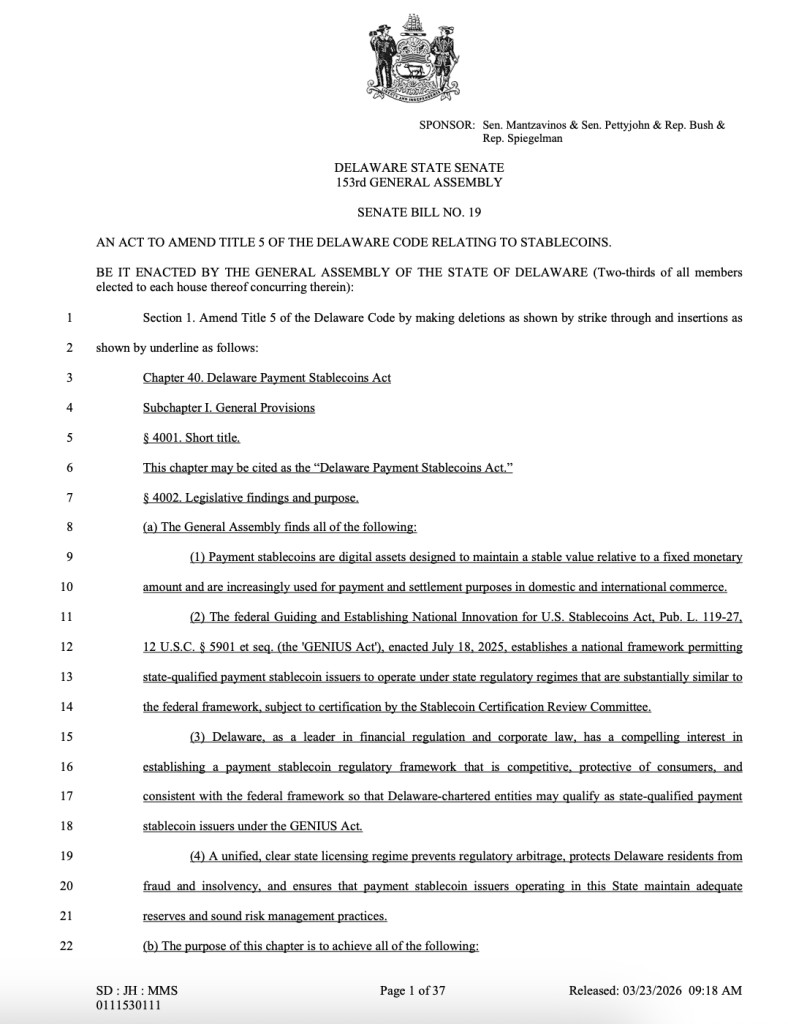
The official statement from Senate Democrats highlights “democratizing financial services,” but the underlying message is regulatory arbitrage. Delaware aims to be the jurisdiction that defines what a compliant digital dollar should look like before the Federal Reserve intervenes.
Delaware has built its legacy on corporate law. Now it is wagering that it can create a similar protective barrier around digital dollars. The state is not awaiting approval from Washington; it is crafting the regulations itself.
Discover: The best new crypto in the world
The post Delaware Moves to Regulate Stablecoins Under Banking Framework appeared first on Cryptonews.
