Disclaimer: Information found on CryptoreNews is those of writers quoted. It does not represent the opinions of CryptoreNews on whether to sell, buy or hold any investments. You are advised to conduct your own research before making any investment decisions. Use provided information at your own risk.
CryptoreNews covers fintech, blockchain and Bitcoin bringing you the latest crypto news and analyses on the future of money.


The adoption of stablecoins is experiencing significant growth. Research from the firm rwa.xyz indicates that the number of addresses holding both dollar-pegged and crypto-pegged stablecoins has risen by 15% in 2024, marking the highest increase recorded to date.
Further analysis by blockchain research company Chainalysis has revealed the increasing significance of stablecoins within the overall on-chain transaction landscape. The “Crypto Spring Report” from Chainalysis highlighted that stablecoins are evolving into a genuine global asset.
4/ Stablecoins provide anyone with internet access a pathway to the USD, creating new avenues for financial inclusion. The U.S. leads in purchases, but global interest remains robust, with over $40 billion acquired in March alone across various countries and regions. pic.twitter.com/AyOxVypS9j
— Chainalysis (@chainalysis) April 25, 2024
Stablecoins Are Gaining Significance
Kim Grauer, Director of Research at Chainalysis, informed Cryptonews that analyzing fiat stablecoin purchases across different nations clearly demonstrates the increasing relevance of stablecoins.
“With a diverse array of countries and regions—particularly the EU, Turkey, and Thailand—accounting for over $30 billion in purchases in January 2024 alone, along with a substantial share of all on-chain transaction volume, it is difficult to overlook the significance of stablecoins,” Grauer stated.
Grauer noted that stablecoins—cryptocurrencies whose values are tied to an external reference, such as the U.S. dollar—have recently constituted over half of all on-chain transaction volume.
“This data was gathered from the on-chain information that Chainalysis processes,” Grauer added.
Andrew O’Neill, Managing Director and Co-Chair of S&P Global’s Digital Assets Research Lab, also expressed his belief in the rising importance of stablecoins.
“Money does not move as swiftly as information,” O’Neill remarked. “On-chain capabilities can address this issue, and currently, stablecoins have emerged in the absence of other instruments like central bank digital currencies.”
Stablecoin Applications Propel Adoption
O’Neill further mentioned that recent insights from credit rating agency S&P Global indicate that stablecoins could become a fundamental component of financial markets’ blockchain integration by acting as a digital currency for entirely on-chain transactions.
“The BUIDL fund from investment group Blackrock serves as a recent example,” he noted. “This tokenized fund, which operates on the Ethereum blockchain and invests in U.S. treasuries, features a liquidity pool denominated in the USDC stablecoin, allowing investors to redeem share tokens through a smart contract instantly.”
Stablecoins are indeed establishing themselves as a vital link between traditional finance and the cryptocurrency sector. Current data suggests that the stablecoin market is valued at approximately $150 billion and is projected to surpass $2.8 trillion by 2028.
I’m delulu for a bull case
If we all think about it hard enough, maybe we can manifest it
Naur… let the numbers show you
1. Stablecoins are at an ATH since the bear of June 2022
Yes, they’re not at an ATH in general. Don’t come for me.But this is a healthy indicator… pic.twitter.com/gMI8OwvMfy
— Beba
(@Web3Wand) April 26, 2024

 (@Web3Wand) April 26, 2024
The competitive landscape of the stablecoin market has also intensified. For instance, Ripple, the issuer of XRP, recently revealed plans to introduce a stablecoin backed by the United States dollar.
A representative from Ripple informed Cryptonews that launching a reliable USD-backed stablecoin on the XRP Ledger will create additional use cases, liquidity, and opportunities for developers.
“Ripple intends to utilize the stablecoin in its own payment solution to offer customers the optimal payment experience, considering factors such as region, time constraints, and associated fees,” the representative stated.
The representative further noted that integrating the new stablecoin with XRP will enhance crypto liquidity to meet the rising demand for cross-border payments.
“This will facilitate essential on/off ramps and support global scalability,” the representative added. “Ripple’s payment solution has already processed over $50 billion in total volume and has payout capabilities in 80 markets, covering more than 90% of the daily FX market.”
Stablecoins Facilitate Access to U.S. Dollars
This is significant, as stablecoin applications like this also enhance dollar dominance by broadening access. Research from S&P Global indicates that the majority of USD-pegged stablecoins are actually issued outside the U.S.
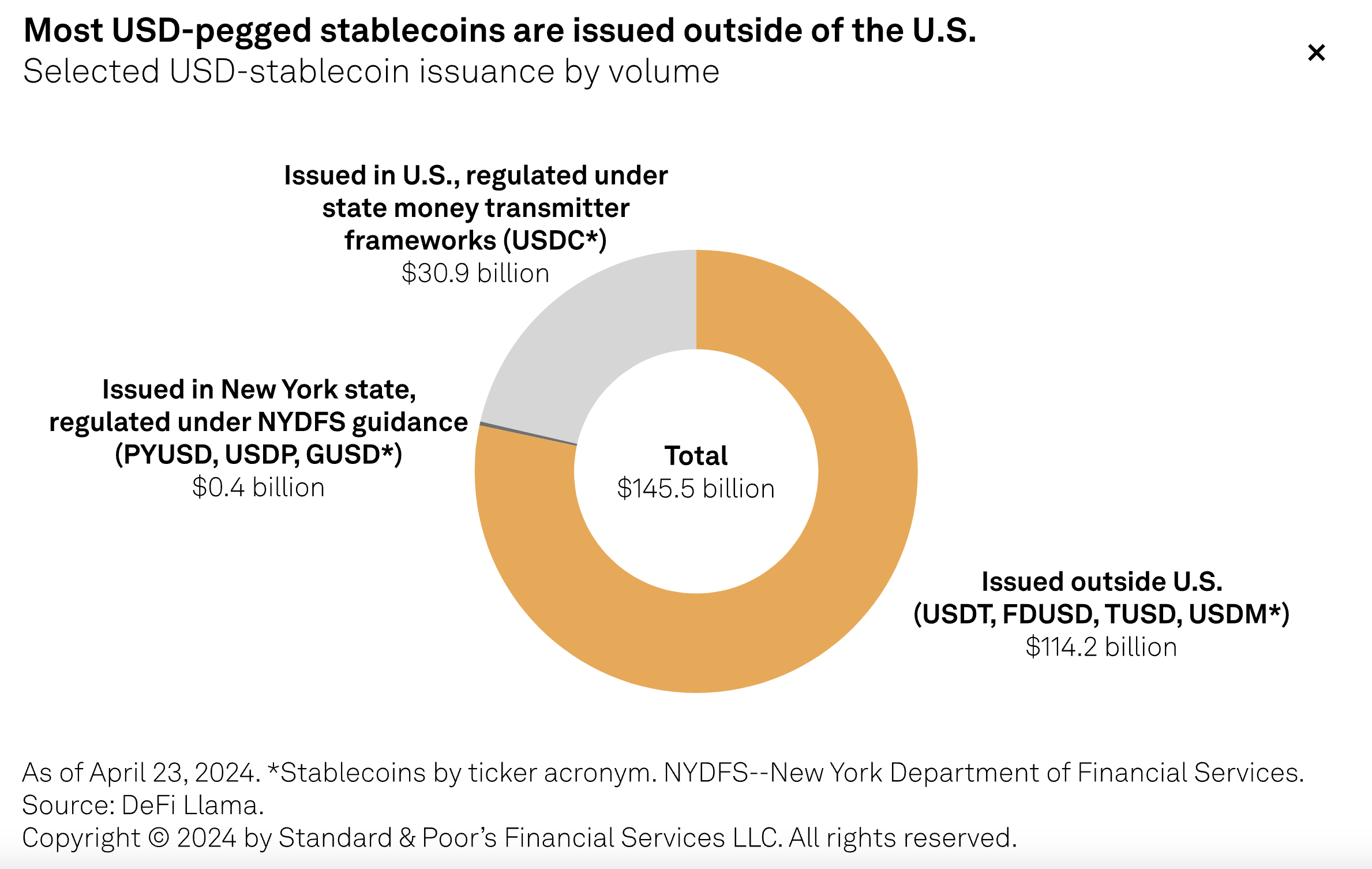
“An increasing number of stablecoin applications are associated with cross-border payments and on/off ramping in relation to crypto,” O’Neill stated.
Related Posts
To illustrate this, O’Neill pointed out that PayPal’s stablecoin, PYUSD, is frequently utilized to facilitate payments and cross-border transactions in Latin America and the Caribbean.
“Another aspect of stablecoins is remittances,” O’Neill added. “Tether is widely used to send U.S. dollars to family and friends in emerging markets.”
It is also noteworthy that data from CoinGecko indicates that U.S. Dollar-backed stablecoins account for a 98.9% share of the stablecoin market.
David Pope, Commissioner of The Wyoming Stable Token Commission, informed Cryptonews that the global demand for dollars remains robust, and stablecoins streamline and expedite the transfer of ownership of those dollars.
“This is why stablecoins are evolving into a genuine global asset class,” Pope stated.
Increased Attention on Stablecoin Legislation
The rising demand for stablecoins has prompted lawmakers to concentrate on stablecoin legislation.
In an announcement on April 17, U.S. Senators Kirsten Gillibrand and Cynthia Lummis introduced legislation aimed at establishing a regulatory framework for payment stablecoins.
“Enacting a regulatory framework for stablecoins is essential for preserving the U.S. dollar’s dominance, fostering responsible innovation, safeguarding consumers, and combating money laundering and illicit finance,” Senator Gillibrand emphasized.
The Lummis-Gillibrand Payment Stablecoin Act also states it would “protect consumers by mandating stablecoin issuers to maintain one-to-one reserves and prohibiting unbacked, algorithmic stablecoins.”
S&P Global Says US Stablecoin Adoption Could Soar Following New Rules
S&P Global highlighted how the Lummis-Gillibrand Payment Stablecoin Act could lead to a surge in U.S. stablecoin adoption due to the regulatory framework boosting confidence. The act aims to provide a… pic.twitter.com/LAynaDNfCt
— Maira.Cruz.Gomes (@Mairetinha) April 25, 2024
In addition to The Lummis-Gillibrand Payment Stablecoin Act, U.S. House Financial Services Committee ranking member Representative Maxine Waters suggested in an April 24 interview with Bloomberg that lawmakers are making progress toward passing stablecoin legislation.
During the interview, she mentioned that she had been collaborating “very well together” with committee chair Patrick McHenry on legislation concerning stablecoins and clawbacks for banks.
Stablecoin Legislation May Accelerate Adoption
While such legislation would likely ban algorithmic stablecoins like TerraUSD (UST)—which lost its peg to the U.S. dollar in 2022—O’Neill believes that the approval of a stablecoin bill in the U.S. would expedite institutional blockchain innovation.
“A clear federal framework would provide greater assurance for institutions utilizing stablecoins,” he stated. “This may also encourage banks to issue stablecoins themselves, potentially bringing banks into the stablecoin market.”
A representative from Ripple also expressed that now is the appropriate time for clear and definitive regulations regarding stablecoins.
“The U.S. must assert its leadership to offer businesses and banks the certainty needed to move forward,” the representative stated. “Without this, the U.S. risks losing technological innovation and user benefits to other countries.”
They added that Ripple is currently assessing how this legislation might affect its operations, but noted that “It’s evident that a stablecoin bill represents a significant advancement.”
Despite this, Chainalysis Head of North America Policy Jason Somensatto informed Cryptonews that Chainalysis believes the enactment of such legislation will have minimal impact on stablecoin adoption in the U.S.
Somensatto stated that stablecoin adoption is flourishing globally, even in the absence of a dedicated stablecoin regulatory framework in the U.S.
“This is likely due to the use case of stablecoins,” he remarked. “By providing anyone with internet access the stability of the U.S. dollar, stablecoins are an essential solution for individuals in countries experiencing currency instability, both for safeguarding savings and facilitating commerce.”
Given this, Somensatto believes stablecoins will continue to grow as a global asset, irrespective of regulations.
“While major cryptocurrencies like Bitcoin and Ether often dominate the news and offer gains that stablecoins do not, stablecoins have surpassed all other types of cryptocurrencies in terms of usage, accounting for over half of all transaction volume in recent months,” Somensatto noted.
The post Data Indicates Stablecoins Are Becoming A Global Asset Class appeared first on Cryptonews.
