Disclaimer: Information found on CryptoreNews is those of writers quoted. It does not represent the opinions of CryptoreNews on whether to sell, buy or hold any investments. You are advised to conduct your own research before making any investment decisions. Use provided information at your own risk.
CryptoreNews covers fintech, blockchain and Bitcoin bringing you the latest crypto news and analyses on the future of money.


The United States government shutdown has reached its 38th day, marking the longest duration in history, as the Senate gears up for a pivotal vote on a new funding bill that could influence when Washington resumes operations.
The political stalemate has stalled advancements on significant legislative priorities, including the long-awaited crypto market structure bill referred to as the CLARITY Act.
Extended Shutdown Threatens 2% GDP Decline as Senate Readies Key Vote
The Senate is anticipated to vote this week on a Republican-supported proposal aimed at ending the shutdown and financing several federal agencies for the remainder of the fiscal year.
This proposal requires 60 votes to progress, and while Republican leaders have shown cautious optimism, there is still uncertainty regarding whether sufficient Democratic support will be secured.
“I always hope and expect that we will have enough Democrats to move forward, but I’m not certain; we’ll see,” Senate Majority Leader John Thune informed reporters.
The deadlock, which commenced on October 1 after lawmakers failed to reach a budget agreement, arises from disputes over healthcare subsidies linked to the Affordable Care Act.
Democrats are insisting on an extension of expiring tax credits that assist approximately 24 million Americans in affording insurance, while Republicans contend that these matters should be negotiated separately once the government reopens.
US Government Shutdown So Far:
1. 42 million individuals face interruptions in SNAP
2. 3.5 million people have experienced airfare disruptions
3. 750,000 employees furloughed
4. 5,000 flights expected to be canceled daily
5. $15 billion in US GDP lost weekly
6. $10 billion of SNAP…— Zarar Khan (@DrZarar01) November 7, 2025
With around 1.4 million federal employees impacted, including 700,000 furloughed since early October, the economic and social consequences of the shutdown are intensifying. Federal employees have missed several paychecks, and agencies ranging from the Federal Aviation Administration (FAA) to the USDA are reducing services.
Trump – No Snap Benefits Until Government Re-Opens. pic.twitter.com/yu1DwYAFOE
— Ryan (Emperador Maximiliano) (@EmpMaximiliano) November 4, 2025
A Rhode Island court ruled on Thursday that the Trump administration must restore full funding for the SNAP program after it had been reduced to partial payments.
The administration has appealed this ruling, asserting that funding decisions should await congressional action. Nearly 42 million Americans rely on the program, which incurs costs exceeding $8 billion each month.
Economists caution that the extended shutdown could cause enduring harm to the U.S. economy.
It turns out this shutdown is extremely costly, averaging around $15 billion weekly. Unlike previous shutdowns, 650,000 furloughed workers may not receive back pay, food assistance is reduced, small businesses are lacking their loans, and some economic damage could be irreversible if it continues through the holiday season. pic.twitter.com/OImZwWDXTV
— Tahra Hoops (@TahraHoops) November 5, 2025
Related Posts
The Congressional Budget Office estimates that the standoff could reduce fourth-quarter GDP growth by as much as two percentage points, costing between $10 billion and $30 billion weekly.
Small businesses dependent on federal contracts and loans are running low on funds, and consumer spending is declining as millions of workers remain unpaid.
How Long Can Crypto Wait While Washington Sleeps?
The shutdown has also immobilized Washington’s regulatory framework. Agencies responsible for overseeing financial markets, such as the Securities and Exchange Commission (SEC) and the Commodity Futures Trading Commission (CFTC), are functioning with minimal staff.
Reviews of pending applications, including various proposals for crypto exchange-traded funds (ETFs), have been put on hold.
Noteworthy: Due to the majority of SEC staff being furloughed because of the government shutdown, they will NOT be available to review or respond to Fails-to-Deliver (FTD) related inquiries or compliance ISSUES unless designated as EMERGENCY functions.
pic.twitter.com/5cDqudANAs
— Reese Politics (@ReesePolitics) November 3, 2025
The impasse has effectively halted legislative progress on digital assets. The bipartisan CLARITY Act, intended to clarify how cryptocurrencies and stablecoins are regulated across federal agencies, had seen renewed activity in late October.
Senators John Boozman and Cory Booker indicated that their committees were working “daily” to finalize their section of the bill and anticipated a vote before Thanksgiving. However, with the government shutdown now in its sixth week, that timeline is at risk.
Coinbase CEO Brian Armstrong stated to CNBC that approximately 90% of the bill’s issues had already been addressed and that Thanksgiving had been suggested as a potential target for completion.
The market repercussions have extended beyond Capitol Hill. The liquidity crunch caused by the shutdown, worsened by the U.S. Treasury General Account hoarding funds while agencies remain closed, has heavily impacted risk assets.
Bitcoin has declined from recent peaks, testing long-term support levels as investors navigate diminished market liquidity and uncertainty surrounding fiscal policy.
Meanwhile, prediction markets reflect increasing skepticism regarding a swift resolution to the shutdown.
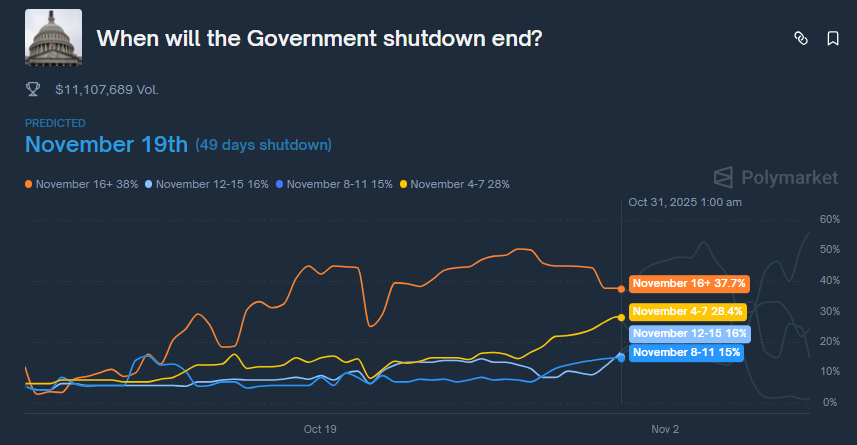 Source: Polymarket
Data from the decentralized platform Polymarket indicates that traders assign a 59% probability that the shutdown will extend beyond November 16, with only a 13% chance of reopening before mid-month.
The post Crypto Bill Held Hostage by 38-Day Government Shutdown as Senate Prepares Critical Vote appeared first on Cryptonews.
