Disclaimer: Information found on CryptoreNews is those of writers quoted. It does not represent the opinions of CryptoreNews on whether to sell, buy or hold any investments. You are advised to conduct your own research before making any investment decisions. Use provided information at your own risk.
CryptoreNews covers fintech, blockchain and Bitcoin bringing you the latest crypto news and analyses on the future of money.


Crypto.com has formally submitted an application to the U.S. Office of the Comptroller of the Currency (OCC) for a National Trust Bank Charter, a strategic move that could position the company among a select group of cryptocurrency firms aiming for federal acknowledgment in the banking sector.
This application signifies a significant advancement in the exchange’s ongoing initiative to broaden its regulated financial services presence in the United States.
Crypto.com Joins a Growing List of Firms Pursuing a Federal Charter
In its announcement, Crypto.com indicated that the charter would enable it to enhance its custody and staking technology while providing services across various blockchains, including its proprietary Cronos network.
The company highlighted that a federal license would establish it as a reliable custody option for digital asset treasuries, exchange-traded funds (ETFs), and institutional investors, all under the supervision of a U.S. federal regulator.
https://t.co/vCNztATkNg has filed a National Trust Bank Charter application with the @USOCC.
Read morehttps://t.co/4ZK05VeKiv pic.twitter.com/kLd45IpeEe
— Crypto.com (@cryptocom) October 24, 2025
“Since our inception, our priority has been to develop the Crypto.com product and service portfolio through regulated and secure offerings,” stated Kris Marszalek, the firm’s co-founder and CEO.
Marszalek characterized the recent filing as a logical advancement in Crypto.com’s objective to create secure, compliant, and institutionally accommodating crypto infrastructure.
Crypto.com now finds itself among a distinguished group of companies, including Coinbase, Circle, Paxos, Stripe, Ripple, Sony, and others that have made similar applications.
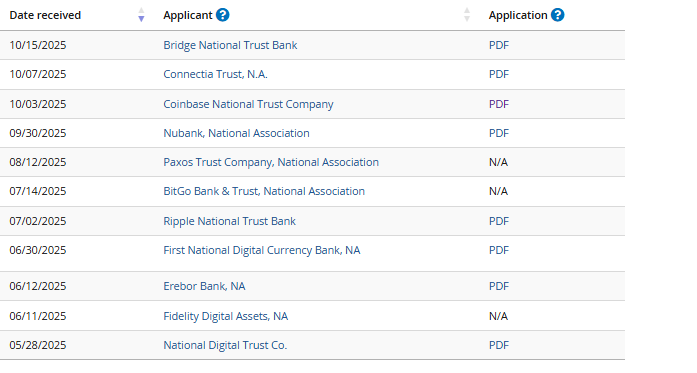 Source: OCC
Currently, Anchorage Digital Bank is the sole entity possessing a federal trust charter. The firm obtained its license in 2021 but encountered compliance issues that resulted in a temporary cease-and-desist order in 2022, which was subsequently lifted this August.
Why Are Crypto Companies Racing to Secure National Bank Charters?
The OCC, functioning as an independent bureau within the U.S. Treasury, is the exclusive agency authorized to issue national bank charters.
These licenses permit companies to provide banking and fiduciary services across all 50 states under a unified legal framework.
For digital asset firms, a federal charter is regarded as a pathway to legitimacy, granting access to Federal Reserve payment systems, including Fedwire, and circumventing complex state-by-state regulations.
A National Trust Bank Charter, in contrast to a conventional banking license, permits firms to engage in fiduciary activities, such as asset custody and investment management, but restricts them from accepting demand deposits or issuing general-purpose loans.
This arrangement keeps them outside the Bank Holding Company Act, avoiding Federal Reserve oversight while remaining under the OCC’s jurisdiction.
Related Posts
The increase in the number of crypto firms pursuing this license can be attributed to the current leadership of the OCC, which has demonstrated a renewed willingness to engage with digital asset activities.
Under Comptroller Jonathan Gould, a former blockchain executive appointed earlier this year, the agency has released new guidance permitting national banks to buy, sell, and custody crypto for clients, provided they adhere to stringent safety and risk standards.
The US Senate has confirmed former crypto exec Jonathan Gould as OCC chief in a 50–45 vote, naming him the first permanent head since 2020.#OCC #JonathanGould https://t.co/ipM7YhaG8B
— Cryptonews.com (@cryptonews) July 11, 2025
Recently, the OCC granted conditional approval to Erebor Bank, a digital-first institution supported by Peter Thiel and Palmer Luckey, indicating that regulators are once again open to exploring responsible crypto banking models.
Gould has publicly asserted that the OCC “does not impose blanket barriers” on banks engaging in digital asset activities, marking a shift from the regulator’s previously cautious approach following the 2023 failures of several crypto-friendly banks.
OCC chief @USComptroller tells bankers any stablecoin deposit flight “would not happen overnight” as digital currency market tops $302B—up from $205B in Januaryhttps://t.co/gsLXoG40Fg
— Cryptonews.com (@cryptonews) October 21, 2025
 OCC chief @USComptroller tells bankers any stablecoin deposit flight “would not happen overnight” as digital currency market tops $302B—up from $205B in Januaryhttps://t.co/gsLXoG40Fg
This week, he also dismissed concerns that stablecoins could lead to sudden banking crises, stating that the risk of significant deposit runs is “overstated.”
Path to Federal Charters Narrows as Banking Groups Urge OCC to Halt Crypto Applications
Nevertheless, the journey to obtaining a federal charter is far from simple. The OCC has received over 16 applications from fintech and crypto firms seeking national trust status, yet only one has been approved thus far.
Many applications have stalled due to lobbying from traditional banking organizations, which contend that crypto companies do not yet fulfill the fiduciary standards expected of national trust banks.
In July, the American Bankers Association (ABA), along with other banking and credit union associations, sent a letter requesting the OCC to suspend crypto-related charter approvals.
 Source: ABA website
The group raised concerns regarding the limited transparency in applications from firms like Ripple and Circle, arguing that many crypto businesses primarily provide custody and staking services rather than traditional fiduciary responsibilities such as estate or trust management.
The letter cautioned that endorsing such applications would signify “a fundamental departure” from the OCC’s chartering framework and could undermine the safeguards that support the U.S. banking system.
Regulatory caution also arises from broader issues related to anti-money laundering (AML) compliance and risk transparency.
The OCC has maintained that applicants must exhibit strong governance, capital adequacy, and internal controls before receiving approval.
While the agency has become more receptive under Gould’s leadership, approvals continue to be slow as regulators evaluate new supervisory models for digital asset institutions.
The post Crypto.com Wants a National Trust Bank License – What Would a Federal License Really Change? appeared first on Cryptonews.
