Disclaimer: Information found on CryptoreNews is those of writers quoted. It does not represent the opinions of CryptoreNews on whether to sell, buy or hold any investments. You are advised to conduct your own research before making any investment decisions. Use provided information at your own risk.
CryptoreNews covers fintech, blockchain and Bitcoin bringing you the latest crypto news and analyses on the future of money.


Critics have expressed discontent regarding the South Korean regulators’ decision on Upbit sanctions, labeling the imposed penalty on the cryptocurrency exchange as “ineffective.”
Consultants have been discussing the situation following the Financial Intelligence Unit (FIU) imposing a three-month business suspension on Dunamu, the operator of the Upbit exchange.
Upbit Sanctions Under Scrutiny
The FIU’s decision was prompted by disclosures that Upbit “facilitated a total of 44,948 digital asset transfer transactions” involving “19 unreported, foreign-based digital asset business operators.”
According to Seoul Daily and Newsway, the FIU’s directive means that new Upbit users will be unable to transfer or receive cryptocurrency in their wallets for the entire three-month duration.
The FIU will also follow up with fines, which will be determined at a later date. Dunamu CEO Lee Seok-woo received a disciplinary warning, while the company’s compliance and transaction reporting leaders have been required to resign.
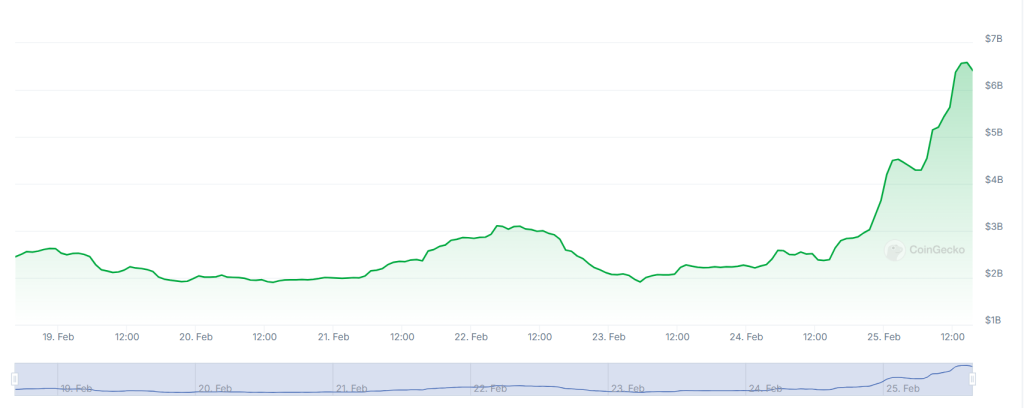 Trading volumes on the Upbit crypto exchange over the past seven days. (Source: CoinGecko)
Additionally, another eight employees faced “disciplinary action.”
However, several unnamed figures within the cryptocurrency industry argued that this action would merely enable Upbit to enhance its profit margins and “solidify its status as a monopoly.”
The critics contended that the sanctions would be “ineffective” as they only prevent new users from transferring their cryptocurrency to external wallets or other exchanges.
@Official_Upbit faces billions in fines for over 700,000 KYC violations as South Korea tightens its crypto rules.#Upbit #FSChttps://t.co/SZzYlT4ted
— Cryptonews.com (@cryptonews) February 18, 2025
 @Official_Upbit faces billions in fines for over 700,000 KYC violations as South Korea tightens its crypto rules.#Upbit #FSChttps://t.co/SZzYlT4ted
Could Sanctions Backfire?
The measures do not prevent Upbit from onboarding new customers, nor do they restrict their activities, as long as they only buy or sell tokens on the Upbit platform.
The sanctions also permit new Upbit users to conduct fiat KRW transactions, meaning clients “can withdraw KRW and utilize it on another exchange.”
Consequently, they noted, “given that Upbit holds over 70% of the domestic market share,” the sanctions “are unlikely to prompt clients” to abandon their Upbit accounts for a competing platform.
The experts added that since most cryptocurrency exchange users prioritize “convenience” above all, “clients who trade digital assets are significantly less likely” to go through the hassle of transferring their funds off the Upbit platform.
As such, they continued, the sanctions would likely end up benefiting Upbit rather than harming it.
The specialists indicated that the measures would ultimately serve as “a means to retain Upbit users on the platform, rather than a punishment.”
Related Posts
 The headquarters of the South Korean Financial Intelligence Unit (FIU). (Source: News Tomato/YouTube/Screenshot)
Fines to Follow
The sanctions are also unlikely to financially impact Upbit, the critics asserted. They explained that compelling new users to remain on the Upbit platform would enable the exchange to continue profiting from transaction fees.
Moreover, the critics suggested that the restrictions could lead to artificial discrepancies in coin values on domestic platforms.
They advocated for “symbolic fines” instead of “ineffective sanctions or disciplinary measures.” One of the unnamed insiders remarked:
“Restricting transfers will only reinforce Upbit’s monopoly status. Ultimately, questions will likely arise regarding the FIU’s sanctions.”
Nonetheless, the FIU may indeed impose substantial fines. A representative for the regulator indicated that the FIU has not yet reached a “final decision” regarding fines.
The regulator stated that it would announce the fines following “upcoming disciplinary hearing discussions.”
In South Korea, self-service kiosks have been proliferating. They take coffee orders at cafes, process meal selections at restaurants, and manage ticketing at movie theaters. However, one machine has recently sparked debate by automating something some believe is more traditional: the…
— The Korea Herald 코리아헤럴드 (@TheKoreaHerald) February 25, 2025
FIU Warnings
The agency noted that it had previously instructed Upbit to block transfers to platforms such as MEXC and KuCoin, and “had informed” Upbit about the “necessity to comply with the regulation.”
The FIU conducted several “on-site inspections” at Upbit in August, September, and October 11.
Pictet plans to acquire more South Korean shares once a planned resumption of short-selling in the country allows it to hedge its long equity positions https://t.co/XM3uOGwadJ
— Bloomberg (@business) February 25, 2025
The regulator determined that thousands of the aforementioned transactions breached anti-money laundering regulations.
The FIU also pointed out that Dunamu permitted clients who “submitted IDs that were difficult to verify,” including “blurry images,” to execute transactions.
It also discovered that Upbit allowed 5,785 clients “whose left address fields or entered incorrect information” to pass its Know Your Customer (KYC) protocols.
Earlier this month, the National Tax Service announced it was initiating an investigation into Upbit over suspected tax infractions.
The post Critics Rage at South Korean Regulators’ Upbit Sanctions Verdict appeared first on Cryptonews.
