Disclaimer: Information found on CryptoreNews is those of writers quoted. It does not represent the opinions of CryptoreNews on whether to sell, buy or hold any investments. You are advised to conduct your own research before making any investment decisions. Use provided information at your own risk.
CryptoreNews covers fintech, blockchain and Bitcoin bringing you the latest crypto news and analyses on the future of money.


Key Takeaways:
- Donald Trump intends to implement tariffs ranging from 60% to 100% on all imports from China.
- This policy change may conflict with the president-elect’s endorsement of Bitcoin.
- The initiative will also increase the cost of mining equipment for operators in the United States.
Bitcoin (BTC) miners in the U.S. could experience a significant rise in the cost of mining hardware if Donald Trump follows through with his proposed tariffs on major foreign trade partners, as indicated by market analysts.
The policy alteration also poses a risk of contradicting the president-elect’s recent support for Bitcoin and the broader cryptocurrency sector, according to analysts. Trump has branded himself as the “Crypto President,” making substantial commitments to back the industry.
The billionaire has asserted that on his first day in office in January, he would impose tariffs of 60% to 100% on all goods from China to compel the nation to address the production of the addictive substance fentanyl.
Trump has also announced plans to impose a 25% tariff on goods from Canada and Mexico, along with 10% to 20% on imports from other countries. He is insisting that these nations take action against illegal immigration and drug trafficking into the U.S.
“All I want to do is to have a level, fast, but fair playing field,” Trump stated during his campaign.
Analysts express concern that if enacted, the tariffs—especially those aimed at China—could result in increased prices for Bitcoin mining equipment in the U.S. compared to regions like Russia.
“The proposed tariffs…could greatly affect the U.S. crypto mining industry, which heavily depends on imported mining equipment and semiconductors,” remarked Phillip Lord, president of the Bitcoin payments platform Oobit.
In an interview with Cryptonews, Lord noted that the elevated duties on Chinese imports would lead to a substantial rise in the “cost of establishing and upgrading mining operations in America.”
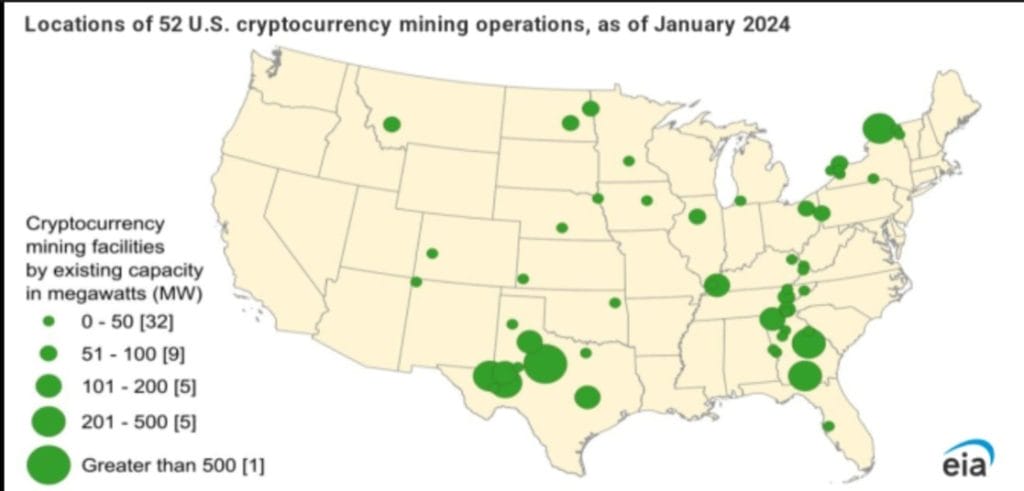 Source: U.S. Energy Information Administration
Tariffs Will Hit US Leadership in Bitcoin Mining
China is the leading producer of application-specific integrated circuits, or ASICs—specialized equipment utilized in BTC mining. Mining involves generating new coins by employing powerful computers to solve intricate mathematical problems continuously.
Miners play a crucial role in maintaining the security of the Bitcoin network. ASIC miners are vital for BTC mining. These devices gained popularity through the Chinese company Bitmain Technologies Ltd and its Antminer product line. Bitmain is often referred to as the Google of Bitcoin mining hardware.
As reported by Bloomberg, the Beijing-based company holds a 90% share of the market for computers used in Bitcoin mining. Bitmain’s influence is so significant that it can dictate global prices simply by adjusting the output of its mining devices, according to the report.
However, the company has faced ongoing shareholder disputes involving co-founders Jihan Wu and Micree Zhan. Wu was ultimately compelled to resign from his position as Bitmain CEO and chairman in 2021.
Other prominent Chinese manufacturers of crypto ASICs and mining hardware include Canaan, Ebang International Holdings, MicroBT, and ARM Group Holdings.
Meanwhile, the U.S. stands as the largest crypto mining center, accounting for up to 38% of the Bitcoin network’s total “hash rate”—or processing power.
The country has surpassed China, which previously controlled over 75% of the hash rate before authorities imposed restrictions on crypto in 2021.
Data from Cambridge University indicates that China’s share of global Bitcoin mining capacity fell to zero in July and August 2021 following a ban on crypto mining within its borders.
As of December 18, however, China constituted approximately 21% of the total Bitcoin mining market, according to The Chain Bulletin.
 A Bitcoin mining operation
A Double-Edged Sword
General Kenobi, business development manager at the Bitcoin mining pool Demand, informed Cryptonews that Donald Trump’s proposed tariffs on China “will certainly raise the cost of all ASICs from all manufacturers.”
He explained that this is due to the absence of competitive ASIC manufacturers based in the U.S.
Kenobi mentioned that if tariffs render mining devices imported from China prohibitively expensive, American Bitcoin miners could consider switching to ASICs produced by Bitmain in Thailand or Indonesia, where the company has additional manufacturing facilities.
He stated:
“Depending on how Trump’s administration enforces the tariffs, and if any loopholes are left available to exploit, miners might be able to mitigate the worst effects from the tariffs.”
Related Posts
The uncertainty surrounding Trump’s tariffs complicates the ability of any U.S.-based Bitcoin miner to foresee their complete impact. Lord, the president of Oobit, emphasized that this unpredictability is a double-edged sword.
While tariffs will inevitably increase costs for mining hardware, they also present significant challenges for the industry’s expansion, he noted.
For instance, higher costs could accelerate the domestic production of mining rigs, according to Lord. However, he acknowledges that this “would require time and substantial investment” to establish.
Additionally, rising costs could lead to “consolidation” within the sector—an outcome that benefits “larger operators with established infrastructure” over “new entrants facing elevated startup expenses.”
Lord explained that such a scenario creates an “interesting dynamic,” where existing American miners “gain from reduced competition, as higher equipment costs would elevate barriers to entry,” adding:
“This could potentially enhance the position of established American mining operations in the global hash rate distribution, albeit at the expense of diminished industry growth and innovation.”
Is Trump Contradicting Himself with Stiffer Tariffs?
Trump has transitioned from a crypto skeptic to an advocate in just three years. In June 2021, the former U.S. president labeled Bitcoin a “scam against the dollar.” Today, he is making significant commitments regarding the digital asset.
One such commitment is to double the energy supply available to Bitcoin miners in the U.S., which currently accounts for 2.6% of total electricity consumption annually, according to the Cambridge Centre for Alternative Finance.
“We’ll be releasing people from certain ridiculous requirements, and using fossil fuel to generate electricity,” Trump stated while appealing to crypto investors at the Nashville Bitcoin conference in July.
“We’ll be utilizing nuclear power [and] we’ll be doing it in an environmentally friendly manner,” he added.
However, analysts argue that his proposed tariffs could further complicate the ability of local miners to acquire advanced, energy-efficient mining rigs from overseas.
Kenobi, the executive from the Demand Bitcoin mining pool, suggested that given the pro-crypto administration Trump is assembling, “it wouldn’t be unreasonable to envision certain exceptions to these new tariffs for the mining sector.”
He indicated that such a measure “would restore competitiveness” in the American Bitcoin mining landscape.
Kenobi believes that Trump could even provide miners with subsidies to counter threats from Russia and Iran—both of which seem to be actively promoting mining activities—in a “hash rate war.”
Coherent Strategy
Oobit’s Lord stated that the apparent inconsistency between Trump’s support for Bitcoin and his protectionist trade policies “reveals a coherent strategy aimed at reshaping the U.S. crypto industry.”
He noted that Trump seems to be pursuing a dual approach. One strategy involves utilizing tariffs to encourage local manufacturing while simultaneously “creating a more favorable regulatory environment for crypto operations and innovation.”
“This could lead to a restructuring of the global crypto industry, with more vertically integrated U.S.-based operations,” Lord told Cryptonews.
The other strategy pertains to the appointment of crypto-friendly officials such as Paul Atkins as SEC Chair and David Sacks as AI and Crypto Czar.
Lord, a seasoned investment banker who transitioned into Web3 and crypto, remarked that this move indicates “a clear intention” by the president-elect to establish “a comprehensive federal framework supportive of crypto development.”
He elaborated:
“The regulatory clarity, combined with the potential establishment of a strategic U.S. Bitcoin reserve, could mitigate many of the short-term negative impacts of the tariffs… [It] could foster a more resilient and self-sufficient American crypto sector in the long run.”
There are still over two million Bitcoins yet to be mined, and American miners are increasing their investments in the sector.
For instance, Jack Dorsey’s payments firm Block has announced plans to invest further in its Bitcoin mining initiative following Trump’s electoral victory.
In the context of U.S.-China trade tensions, Bitmain recently revealed the launch of its new production line in the United States.
The company characterized the move as “strategic,” aimed at providing “faster response times and more efficient services” to its North American clientele.
The post Could Trump’s Tariffs Contradict His Pro-Bitcoin Stance? appeared first on Cryptonews.
