Disclaimer: Information found on CryptoreNews is those of writers quoted. It does not represent the opinions of CryptoreNews on whether to sell, buy or hold any investments. You are advised to conduct your own research before making any investment decisions. Use provided information at your own risk.
CryptoreNews covers fintech, blockchain and Bitcoin bringing you the latest crypto news and analyses on the future of money.


One of the major creators of censorship-resistant blocks on Ethereum has reversed its stance, declaring it will begin censoring OFAC-sanctioned blocks across all of its MEV relays to adhere to local regulations.
The company, bloXroute Labs — which has generated at least 400,000 Ethereum blocks through its two primary Maximal Extraction Value (MEV) relays — announced this policy shift on Dec. 18 via a post on X (formerly Twitter), stating:
“Effective immediately, all bloXroute relays will reject block bids if they contain OFAC transactions.”
An “OFAC transaction,” as defined by bloXroute Labs, refers to any transaction involving a wallet that has been sanctioned by the United States Office of Foreign Asset Control, or OFAC.
All of bloXroute Labs’ relays will be impacted, including the “bloXroute Max Profit” relay, which is the second largest censorship-resistant MEV relay, having produced over 380,000 blocks since the Ethereum Merge on Sept. 15, 2022, according to data provided to Cointelegraph by Australian blockchain development firm Labrys.
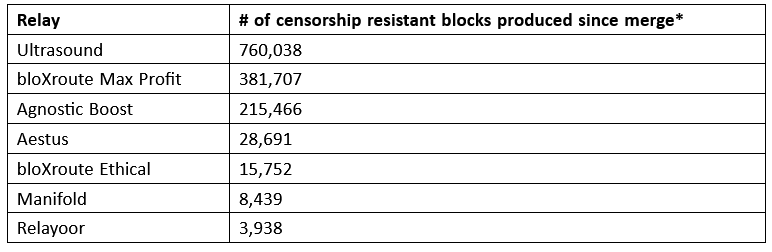 Number of censorship-resistant blocks produced by the relays since the Ethereum Merge. Note the table below is Labrys’ best estimate based on data from MEV Watch. Please be aware that there is a margin of error with this data due to multiple relays submitting the same blocks in some cases. Source: Labrys
Despite this development, bloXroute Labs maintains its commitment to preserving Ethereum’s decentralized and permissionless nature while operating within legal frameworks.
Nevertheless, some members of the Ethereum community argue that these stricter compliance measures are restricting avenues to credible neutrality on Ethereum.
This “sets a troubling precedent for the industry,” Labrys CEO Lachlan Feeney told Cointelegraph.
“Similar to the internet, censorship should be avoided [at the protocol level], and instead, rules and regulations are more appropriately applied at the application level,” Feeney elaborated.
Related Posts
Considering Ethereum serves as a global infrastructure, Feeney expressed concern that additional countries may impose their own sanctions, potentially making it “impossible” to create a block that aligns with all regulatory frameworks worldwide:
“What occurs when China or Russia seeks to sanction transactions? Should these sanctions also be enforced, even if they target legitimate U.S. businesses?”
Approximately 36% of blocks are currently censored due to containing OFAC-sanctioned transactions, according to MEVWatch.info, a decrease from a peak of 78% on Nov. 20. It has generally remained around 30-40% since March.
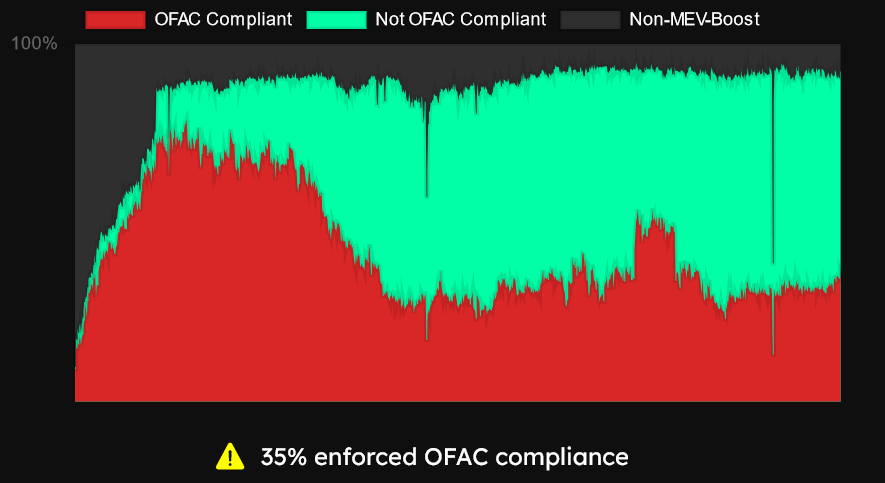 Post-Merge OFAC compliant blocks day-to-day since Sept. 15, 2022. Source: MEVWatch.info
MEV relays are utilized by validators to extract value from a blockchain network by adding, removing, or altering the order of transactions within a block. Since MEV profits frequently come at the expense of regular users, MEV-Boost relays were introduced to mitigate that impact.
Related: Flashbots builds over 82% relay blocks, adding to Ethereum centralization
Censorship on Ethereum became a significant issue following its transition to proof-of-stake on Sept. 15, 2022. A month prior, the United States Office of Foreign Asset Control began sanctioning specific wallet addresses associated with criminal activities and transactions from cryptocurrency mixers, such as Tornado Cash.
This situation has pressured many MEV relays globally to choose between maintaining Ethereum’s credible neutrality or adhering to local laws.
Feeney indicated that he is uncertain whether bloXroute was compelled into compliance, but he is confident that the decision was not made lightly — as the firm recognized that it would diminish the win-rate of their relays.
Magazine: Ethereum restaking: Blockchain innovation or dangerous house of cards?
