Disclaimer: Information found on CryptoreNews is those of writers quoted. It does not represent the opinions of CryptoreNews on whether to sell, buy or hold any investments. You are advised to conduct your own research before making any investment decisions. Use provided information at your own risk.
CryptoreNews covers fintech, blockchain and Bitcoin bringing you the latest crypto news and analyses on the future of money.

Coinbase Publishes Public Guide on the Digital Asset Listing Procedure in Effort to Enhance Transparency

Coinbase has released an extensive guide outlining its digital asset listing procedure, underscoring that applications are free and based on merit, following earlier allegations of charging millions in listing fees.
CEO Brian Armstrong introduced the transparency initiative in response to ongoing conflicts with projects asserting that the exchange required significant payments for token listings.
This guide is published as Coinbase faces challenges with decreasing revenues and trading volumes.
Results for the second quarter revealed $1.5 billion in revenue, falling short of analyst predictions of $1.59 billion, while consumer trading volume decreased by 45% to $43 billion. Net income fell sharply to $33.2 million from $294.4 million in Q2 2024.
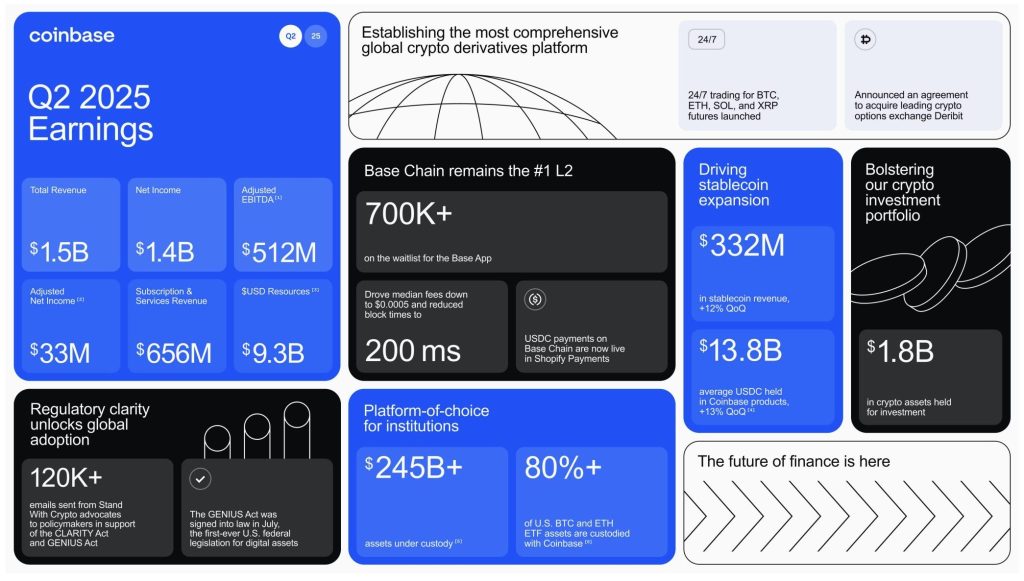 Source: Coinbase
Coinbase’s stock declined by 9.2% in after-hours trading following the Q2 results, although it has risen nearly 50% year-to-date.
XRP has emerged as an unexpected source of revenue, contributing 13% of consumer transaction revenue, compared to Ethereum’s 12% for the second consecutive quarter.
Detailed Process Addresses Fee Controversy
The listing guide describes a five-step evaluation process, which includes application submission, business assessment, and core reviews that cover legal, compliance, and technical security aspects.
Coinbase highlights that listings provide projects with access to substantial liquidity and a worldwide customer base within a reliable regulatory framework.
The exchange tackles common obstacles, such as securities risk evaluations based on public statements and marketing materials.
According to the guidelines, projects that emphasize token utility and governance rights experience smoother reviews compared to those that promise speculative returns or “moon” scenarios.
The average due diligence period lasts one week, with trading enabled within two weeks of approval, although timelines can vary significantly based on asset complexity.
Tokens on supported networks, including Ethereum, Base, Solana, Arbitrum, Optimism, Polygon, and Avalanche, receive prioritized processing compared to new blockchain integrations.
We receive numerous inquiries regarding how and why assets are listed on Coinbase. To enhance transparency, we created a guide explaining the entire process.
TL;DR: listings are free and merit-based. Each asset is assessed against the same criteria.
Link in replies. pic.twitter.com/HmqQDt6085— Brian Armstrong (@brian_armstrong) September 12, 2025
The guide aligns with Coinbase’s strategic shift towards becoming an “everything exchange” that supports millions of tokens through decentralized exchange integration.
Since then, Armstrong has revealed intentions to remove intensive listing barriers that have restricted asset additions.
As part of the guidelines, the exchange’s phased market launch process includes transfer-only periods, limit order auctions, and full trading states aimed at safeguarding market integrity during the introduction of new assets.
Related Posts
This new transparency guideline notably follows several allegations of misconduct.
In November 2024, TRON founder Justin Sun contested Armstrong’s claims of free listings, alleging that Coinbase sought 500 million TRX valued at $80 million along with a $250 million Bitcoin deposit in Coinbase Custody.
Sun pointed out that Binance listed TRON without fees, while Sonic Labs co-founder Andre Cronje also reported similar experiences with Coinbase requesting $30-300 million.
Revenue Pressures Drive New Monetization Strategies Amid Market Challenges
Last month, Coinbase implemented a 0.1% fee on USDC-to-USD conversions exceeding $5 million within 30-day periods starting August 13. This marked the first monetization of previously free stablecoin off-ramping services.
The adjustment addresses competitive disadvantages arising from Tether’s existing redemption fees that made USDC the most economical option for large-scale fiat conversions.
The fee implementation sparked user backlash, drawing comparisons between Coinbase and traditional banking institutions.
CEO Armstrong defended the move as essential to mitigate arbitrage opportunities where users exchanged USDT for USDC before converting to USD, which reduced USDC supply while maintaining USDT circulation.
@Coinbase is seeking support from the bond market following a disappointing second-quarter earnings report that led to a sell-off in its stock. #Coinbase #Coinhttps://t.co/QAMu3x06KO
— Cryptonews.com (@cryptonews) August 5, 2025
 @Coinbase is seeking support from the bond market following a disappointing second-quarter earnings report that led to a sell-off in its stock. #Coinbase #Coinhttps://t.co/QAMu3x06KO
In light of disappointing Q2 results, Coinbase also announced a $2 billion offering of convertible senior notes, divided between 2029 and 2032 maturities.
Proceeds will be used for capped call transactions to limit share dilution and support corporate needs, including working capital, acquisitions, and debt repurchases.
During Q2, the company acquired 2,509 Bitcoin valued at $222 million, raising its total holdings to 11,776 BTC and positioning it among the top 10 public holders, ahead of Tesla.
However, the accumulation of Bitcoin could not counteract the broader revenue declines impacting overall performance.
Coinbase continues to diversify its revenue streams through prediction markets, tokenized stocks, and derivatives for U.S. users.
The exchange obtained a European MiCA license through Luxembourg’s financial regulator while pursuing partnerships, including Chase Ultimate Rewards point transfers to crypto wallets.
Despite financial hurdles, TIME also recognized Coinbase as one of the 100 Most Influential Companies of 2025, describing it as a “disruptor” for influencing U.S. digital asset policies and suggesting it could become the central hub for American crypto trading.
The regulatory environment supporting Coinbase’s transparency initiative includes the SEC’s Project Crypto initiative, which seeks to facilitate on-chain financial markets, and the GENIUS Act, which establishes frameworks for payment stablecoins.
The post Coinbase Releases Public Guide to Digital Asset Listing Process Amid Transparency Push appeared first on Cryptonews.
