Disclaimer: Information found on CryptoreNews is those of writers quoted. It does not represent the opinions of CryptoreNews on whether to sell, buy or hold any investments. You are advised to conduct your own research before making any investment decisions. Use provided information at your own risk.
CryptoreNews covers fintech, blockchain and Bitcoin bringing you the latest crypto news and analyses on the future of money.


Nine cryptocurrencies are now traded within a single, financially settled futures contract on CME Group’s platform, with Bitcoin and Ethereum collectively accounting for 86.29% of the basket. The Nasdaq CME Crypto Index (NCI) and its micro-sized counterpart offer institutions a mechanism to hedge or gain exposure to a nine-asset crypto portfolio through a single trade, eliminating the need to manage separate spot positions.
CME’s published contract specifications describe NCI futures and Micro NCI futures (MCI) as financially settled against the Nasdaq CME Crypto Settlement Price Index. This means there is no delivery of underlying tokens and no custody chain to manage at expiry. This structure is the key advantage: a desk seeking crypto-market exposure or a hedge against a multi-token portfolio no longer needs nine separate futures legs or nine distinct spot wallets to achieve it.
CME positions these contracts as tools for portfolio hedging, macro overlays, and directional exposure across the crypto market. Because the index settles financially rather than physically, a fund holding long spot positions in Bitcoin, Ethereum, and several altcoins can offset that book with a single short position in NCI futures, rather than stacking hedges across separate crypto futures markets for each asset.
The operational pitch is straightforward: fewer legs, one margin account, and one settlement price. This also places the product in the same regulated lane as CME’s existing single-asset Bitcoin and Ether futures, providing institutions with a familiar clearing and margining framework instead of a bespoke basket built from nine separate spot custody relationships.
The Basket Is Still a Bitcoin Trade
The Nasdaq CME Crypto Index is designed to be dynamic, broadly representative of the market, and readily trackable by investors, according to Nasdaq’s index methodology. Constituent selection is drawn from a list of Core Exchanges, including Coinbase, Kraken, Gemini, and LMAX Digital, and Core Custodians such as Coinbase, Fidelity, and BitGo.

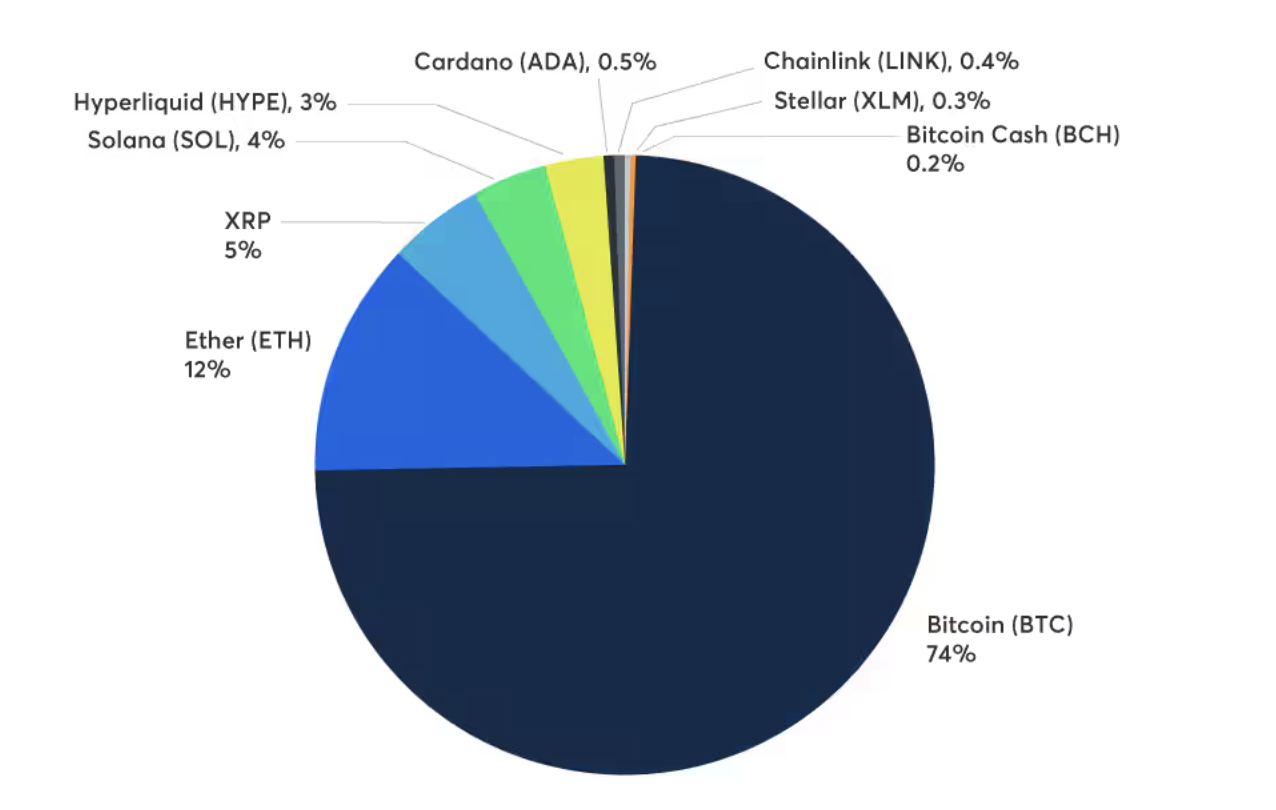
The index is free-float market-cap weighted and undergoes quarterly rebalancing and reconstitution, which is why its composition and weights shift over time rather than remaining fixed at launch. As of the September 1 snapshot, the basket held nine assets in the following order:
Related Posts
This distribution reveals the reality: nine-asset breadth on paper translates into an 86.29% combined weighting toward Bitcoin and Ethereum. The remaining seven tokens, including Hyperliquid (HYPE), which has drawn attention amid broader derivatives activity, account for the remaining 13.71%.
Consequently, a trader buying NCI futures for diversification is, in practice, buying a leveraged Bitcoin position with a thin Ethereum and altcoin garnish.
What the CME Crypto Structure Solves?
The single-trade design genuinely removes friction. Managing nine separate spot positions across nine wallets and multiple custodians is operationally expensive and introduces counterparty risk at every leg.
Collapsing into one CME-cleared futures contract standardizes margin, settlement, and reporting under a framework that already handles single-asset Bitcoin and Ether futures.
What it does not solve is correlation. Bitcoin and Ether tend to move together during broad risk-on and risk-off swings. With the two combining for well over four-fifths of NCI’s weight, the index’s volatility profile will track Bitcoin far more closely than any equal-weighted crypto basket would.
For traders seeking a hedge against a genuinely diversified altcoin book, rather than a compact wrapper for BTC and ETH exposure, the nine-asset label overstates how much the contract actually diversifies away idiosyncratic token risk.
Nasdaq’s methodology also means the composition described here is a snapshot, not a fixed allocation. Quarterly rebalancing and reconstitution can add or drop constituents and shift weights as market capitalization and liquidity change. Therefore, a desk building a hedge around today’s 74.47% Bitcoin weighting should expect that number to move by the next quarterly reset.
For now, the index remains a Bitcoin and Ethereum product with a long tail attached, and CME’s futures wrapper makes that concentrated exposure easier to trade, not necessarily easier to diversify.
The post CME Nine-Asset Crypto Basket Is 86.29% Bitcoin and Ethereum appeared first on Cryptonews.
