Disclaimer: Information found on CryptoreNews is those of writers quoted. It does not represent the opinions of CryptoreNews on whether to sell, buy or hold any investments. You are advised to conduct your own research before making any investment decisions. Use provided information at your own risk.
CryptoreNews covers fintech, blockchain and Bitcoin bringing you the latest crypto news and analyses on the future of money.


The CLARITY Act cleared the Senate Banking Committee with a comfortable 15-9 bipartisan margin, but it now faces a 75% probability of failing before reaching a final vote.
This assessment comes from Jaret Seiberg, an analyst at TD Cowen Washington Research Group, in an August 10 policy note. The analysis reframes the CLARITY Act from a near-certain legislative victory into a genuine coin-flip proposition as September approaches.
This development adds complexity to the CLARITY Act’s trajectory, as Kalshi bettors have been wagering on the bill’s passage by July 1, 2027. That market increased by 2% overnight and currently stands at 35%.
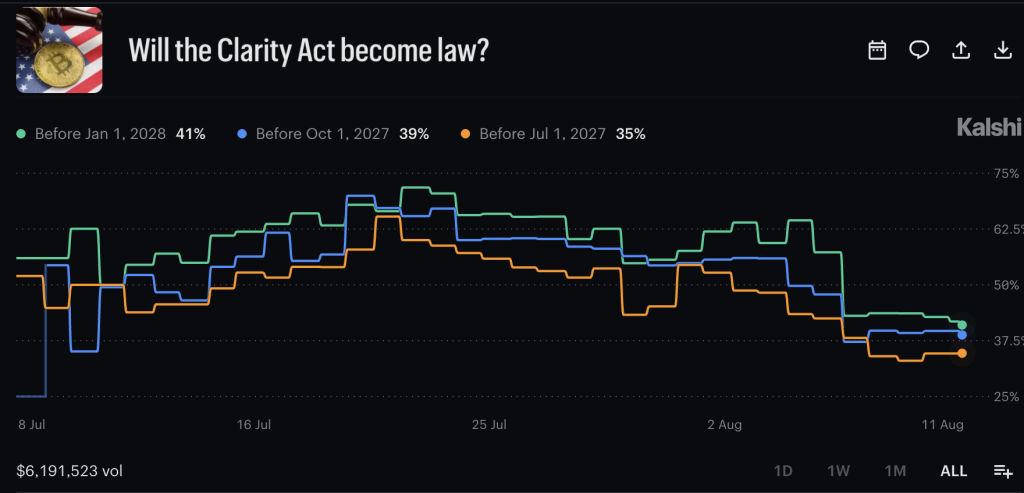
SOURCE: Kalshi
Current Status of the CLARITY Act
The Digital Asset Market Clarity Act (H.R. 3633) seeks to divide federal oversight of digital assets between the Securities and Exchange Commission (SEC) and the Commodity Futures Trading Commission (CFTC). Under the proposal, digital commodities would fall under CFTC jurisdiction, while investment-contract assets would remain with the SEC.
Senator Cynthia Lummis (R-WY) released updated text on July 22, emphasizing the urgency of the legislation and calling it “the last real chance…to get this right.”
Senate Agriculture Committee Chairman John Boozman (R-AR) noted that the bill establishes a clear regulatory framework for digital commodities. Meanwhile, Banking Committee Chairman Tim Scott (R-SC) highlighted its role in protecting retail investors and preventing illicit finance. Despite previous momentum, including the 15-9 committee vote, progress has stalled in the Senate.
BREAKING:
SEC is set to begin its first major crypto rulemaking process this week as the Senate has failed to pass the Clarity Act before the August recess.
The SEC will meet on August 14 to propose “Regulation Crypto.”
The proposal could create a legal path for certain… pic.twitter.com/Z0R4fIdYPp— Bull Theory (@BullTheoryio) August 11, 2026
 SEC is set to begin its first major crypto rulemaking process this week as the Senate has failed to pass the Clarity Act before the August recess.
Why TD Cowen Predicts Failure
Seiberg’s estimate of a 75% failure rate, reported by Bitcoin.com News, follows Senate Majority Leader John Thune’s filing for cloture on August 8. Although an initial cloture vote is scheduled for 2:15 p.m. ET on September 15, this does not guarantee the completion of the legislative process. Three potential failure scenarios include:
- The motion clears the 60-vote threshold, but Democrats block further cloture due to unresolved amendments.
- The scheduled vote does not occur because Republicans avoid contentious issues.
- The vote passes, but no amendments or subsequent motions occur, leaving the bill stalled.
Related Posts
With Republicans holding 53 seats, at least seven Democrats or independents must support the motion for it to pass. Disputes over stablecoin yield, anti-money-laundering provisions, and regulatory authority remain unresolved.
The 25% Path to Enactment
TD Cowen’s case for enactment is not zero, and the firm’s language is precise: the bill is not dead, but the path forward is more difficult. The most plausible route to passage involves the initial cloture motion clearing 60 votes.
Subsequently, Democrats would receive a floor vote on their preferred ethics compromise. If that amendment fails on a simple majority, crypto-friendly Democrats could then support final passage, having registered their objection on record.
A less likely scenario involves the White House cutting its own ethics deal with Democrats to unlock enough votes outright. There is also a lame-duck scenario, but it only exists if Republicans hold both chambers past the midterms, which would push any resolution well beyond this fall’s trading calendar.
For traders pricing in a near-term regulatory catalyst, this detail is critical: even the optimistic case does not deliver crypto regulation clarity on a September timeline.
Market Implications of a Stalled Senate Vote
Assets most tied to the SEC/CFTC market-structure outcome have already priced in the delay. XRP, which stands to benefit directly from a codified digital-commodity classification under CFTC oversight, has seen ETF inflows soften alongside the postponed timeline.
This dynamic has been covered in detail, linked to weaker XRP ETF inflows amid CLARITY Act uncertainty. This pattern has repeated after each procedural setback, including the immediate price reaction documented when the Senate vote was previously postponed.
That reaction function is instructive for September 15. A clean cloture pass with visible follow-through, amendment votes, and a real path to final passage would be read as a genuine de-risking event for market-structure-sensitive tokens.
Conversely, a cloture vote that either does not happen or produces no subsequent action would confirm the bill’s drift toward TD Cowen’s base case, and assets that had priced in regulatory tailwinds would likely give back those gains.
The post CLARITY Act Vote Faces Procedural Hurdles, Not Guaranteed Passage appeared first on Cryptonews.
