Disclaimer: Information found on CryptoreNews is those of writers quoted. It does not represent the opinions of CryptoreNews on whether to sell, buy or hold any investments. You are advised to conduct your own research before making any investment decisions. Use provided information at your own risk.
CryptoreNews covers fintech, blockchain and Bitcoin bringing you the latest crypto news and analyses on the future of money.


There is widespread discussion regarding the Citrini Research report that caused a market downturn yesterday. Hidden within its extensive 7,000 words is a significant buy signal for Solana and Ethereum Layer 2s.
The report, titled The 2028 Global Intelligence Crisis, is a fictional narrative that examines a future scenario where AI disruption results in what it refers to as a “negative feedback loop with no natural brake.”
JUNE 2028.
The S&P has decreased by 38% from its peak. Unemployment has just reached 10.2%. Private credit is deteriorating. Prime mortgages are faltering. AI has not only met expectations but has surpassed them.
What transpired?https://t.co/JzzwCrbJgS— Citrini (@Citrini7) February 22, 2026
In summary, AI is poised to displace white-collar jobs at an unprecedented pace. This should have been apparent, yet it took until 2028 for the realization to occur…
“It should have been evident from the start that a single GPU cluster in North Dakota producing the output previously associated with 10,000 white-collar workers in midtown Manhattan represents more of an economic pandemic than a solution. The velocity of money stagnated. The human-centric consumer economy, which constituted 70% of GDP at the time, declined. We likely could have recognized this sooner if we had simply inquired about how much money machines allocate for discretionary purchases. (Hint: it’s zero.)
“As AI capabilities advanced, companies required fewer employees, leading to increased white-collar layoffs, reduced spending by displaced workers, and margin pressures that compelled firms to invest more in AI, further enhancing AI capabilities…”
This is what that looks like in a schematic form:
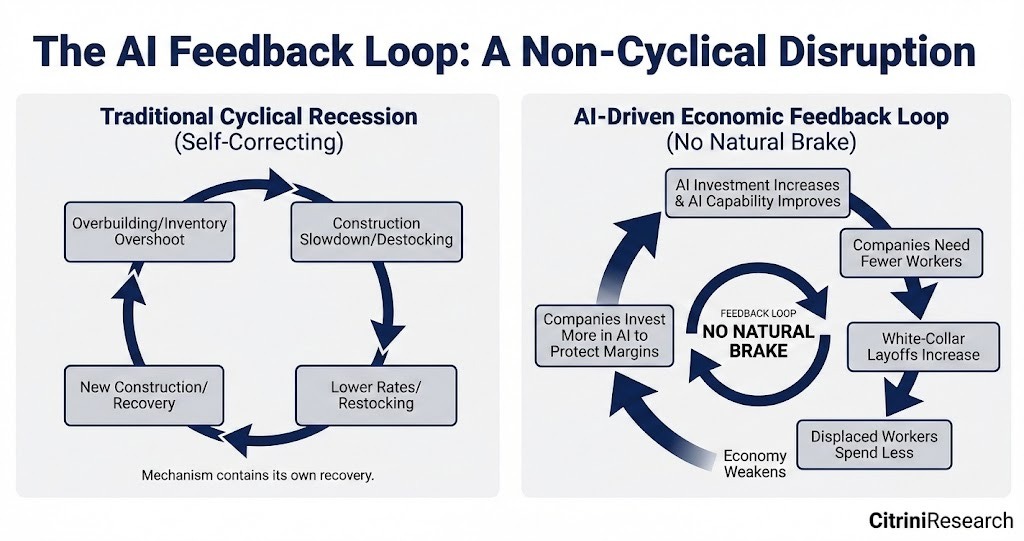
Entering an era of abundant intelligence
There is no self-correction as one would typically expect in a cyclical recession.
The process generally unfolds as follows: construction (or other economic activities) slows down, interest rates decrease, enabling businesses to resume expanding output, until overproduction occurs again, and so forth.
In the AI doom loop, AI progresses, fewer workers are necessary, reduced workforce leads to diminished spending, the economy contracts, companies invest in more AI to safeguard margins, AI improves further, and the cycle continues – there is no natural pause.
Initially, we believed it was a sector-specific issue. I’m not involved in Software-as-a-Service (SaaS), so there seemed to be no cause for concern. However, it extends beyond software. Much further. It was a reassuring thought that AI would herald an era of creative destruction, akin to previous technological disruptions.
Indeed, AI will eliminate jobs, but, as in the past, new roles and previously unimagined industries would arise to take their place.
The issue is, according to Citrini’s scenario, AI represents a narrative of human intelligence displacement. The entire white-collar workforce is at risk. This is the outcome of abundant intelligence.
The authors of the Citrini report remind us that advanced economies like the US are service-oriented. The report clarifies this for better understanding:
“The US economy is predominantly a white-collar services economy. White-collar workers accounted for 50% of employment and generated approximately 75% of discretionary consumer spending. The businesses and jobs that AI was consuming were not peripheral to the US economy; they constituted the US economy.”
Regrettably for everyone – whether white collar, blue collar, or otherwise – machines do not make purchases.
AI agents eliminate intermediation – farewell credit cards, welcome stablecoins
The report presents a compelling argument for how consumer agents will bring an end to the era of intermediation.
Related Posts
AI agents function autonomously on behalf of their human owners, enabling them to effortlessly locate the best flight or hotel available, as they never tire, do not find tasks tedious, and do not require sleep.
SIGNIFICANT WARNING: AI COULD DRIVE THE GLOBAL ECONOMY INTO A RECESSION THIS DECADE.
This will not occur due to an AI bubble burst, but rather as AI continues to grow and improve.
This scenario is outlined by Citrini in their report, and here’s why it warrants attention:
Currently, AI is… pic.twitter.com/FIu9PsZA2X— Crypto Rover (@cryptorover) February 23, 2026
 SIGNIFICANT WARNING: AI COULD DRIVE THE GLOBAL ECONOMY INTO A RECESSION THIS DECADE.
The reliance of companies on our complacency or inertia is coming to an end. With the addition of ‘vibe coding,’ a new wave of startups can quickly develop delivery service applications to compete with DoorDash and others, or automate workflows in a tailored manner that outperforms existing solutions like Monday. Fees are being reduced to nearly zero across the board.
Then there are the banks. Why incur fees from Mastercard and Amex when one can utilize a stablecoin operating on a low-fee blockchain such as Solana, or an Ethereum Layer 2 like Base, Arbitrum, Optimism, or Polygon?
“Once agents managed the transaction, they sought larger paperclips.
“There was only so much price-matching and aggregation possible. The most effective way to consistently save users money (especially as agents began transacting with one another) was to eliminate fees. In machine-to-machine commerce, the 2-3% card interchange rate became an obvious target.
“Agents sought faster and cheaper alternatives to cards. Most opted for stablecoins via Solana or Ethereum L2s, where settlement was nearly instantaneous and transaction costs were mere fractions of a penny.”
What agentic AI will achieve for stablecoins could also be applied to cross-border payment systems like Ripple’s XRP Ledger, although it is not mentioned in this report.
Coinbase has already started testing a protocol that enables AI agents to execute payments on-chain.
The narrative of tokenization, disintermediation, and agentic AI to alleviate bear market concerns
The crypto sector has been searching for a “new” narrative to dispel the gloom of the bear market. It has been hiding in plain sight: tokenization, disintermediation, and Agentic AI.
Will this resolve the issue of an economy lacking sufficient workers receiving wages and salaries to stimulate the consumption that businesses rely on?
Likely not, but as the report suggests, there is time to devise a solution for that. Taxing the hyperscaler ‘robber barons’ is proposed, but this is unlikely to be well-received by the data center magnates.
Disruption is on the horizon in payments, as in other areas, and all stakeholders – investors, companies, and consumers – must begin to contemplate the implications.
Consumer behavior is already evolving. Chargebacks911, a global leader in dispute resolution and chargeback prevention, is alerting merchants and payment firms that agentic commerce will transform disputes, as AI systems transition from recommending purchases to executing them. Chargebacks are payment reversals initiated by a cardholder’s bank.
Historically, most chargebacks fell into three categories: fraud, merchant error, or buyer’s remorse. Transactions initiated by agents introduce a fourth scenario. The purchase is technically authorized, but the outcome does not align with the customer’s expectations.
“The payments industry has always regarded the click as the signal of intent,” states Monica Eaton, founder and CEO of Chargebacks911.
“Agentic commerce eliminates the click. Thus, we need a new method to demonstrate intent when a human was not directly involved.”
Monitor your bank account closely, and welcome to the future.

Report co-author Alap Shah elaborates on the concepts presented in the report, such as AI-induced ‘ghost GDP,’ where value accumulates on the balance sheets of hyperscalers but does not manifest in the “human-centric consumer economy”:
The post Solana, Ethereum L2s (and XRP?) Just Got a Huge Buy Signal From Citrini Research appeared first on Cryptonews.
