Disclaimer: Information found on CryptoreNews is those of writers quoted. It does not represent the opinions of CryptoreNews on whether to sell, buy or hold any investments. You are advised to conduct your own research before making any investment decisions. Use provided information at your own risk.
CryptoreNews covers fintech, blockchain and Bitcoin bringing you the latest crypto news and analyses on the future of money.

Citi Supports Stablecoin Company BVNK After Earlier Resistance to Cryptocurrency Payment Systems

Citigroup has made an investment in stablecoin infrastructure firm BVNK through its venture capital division, Citi Ventures, marking a significant shift from the bank’s earlier warnings regarding the risks of deposit flight associated with yield-bearing stablecoins.
BVNK’s primary technology functions as a payments rail that enables global stablecoin transactions, permitting users to transfer funds between fiat currencies and cryptocurrencies.
US Regulatory Clarity Fuels Stablecoin Infrastructure Expansion
As reported by CNBC, the company chose not to reveal the amount of Citi’s investment or its current valuation.
Nonetheless, co-founder Chris Harmse confirmed that the valuation surpasses the $750 million publicly stated during its previous funding round.
BVNK, which also receives support from Coinbase and Tiger Global, operates in a competitive environment alongside new entrants such as Alchemy Pay and TripleA, as well as established companies like Ripple competing for the cross-border digital currency market.
Harmse noted that the company is gaining traction, especially in the United States, which has emerged as its fastest-growing market over the last 12 to 18 months following the enactment of the GENIUS Act earlier this year.
This legislation has provided regulatory clarity for the stablecoin sector, fostering what the industry perceives as a more advantageous environment.
The investment coincides with CEO Jane Fraser’s confirmation in July that Citigroup is contemplating the issuance of its own stablecoin and the development of custodial services for cryptocurrency assets.
Fraser stated that the bank intends to offer “the advantages of advancements in stablecoin and digital assets to our clients in a secure and sound manner by modernizing our own infrastructure.”
Banking Sector Divided Over Stablecoin Competition
This backing comes just months after Citigroup analyst Ronit Ghose cautioned in August that interest payments on stablecoins could lead to a deposit flight reminiscent of the 1980s from traditional banks.
Ghose drew comparisons to the late 1970s and early 1980s when money market funds surged from $4 billion to $235 billion in just seven years, siphoning deposits from banks with strictly regulated deposit rates.
Prominent U.S. banking associations, including the American Bankers Association and Bank Policy Institute, have lobbied Congress to address what they termed a “loophole” in the GENIUS Act that permits crypto exchanges and related businesses to offer yields on third-party stablecoins.
The associations referenced Treasury estimates indicating that yield-bearing stablecoins could lead to as much as $6.6 trillion in deposit outflows, fundamentally altering how banks finance loans.
Conversely, crypto industry organizations have countered these concerns.
Related Posts
Coinbase Chief Legal Officer Paul Grewal dismissed the banking lobby’s initiatives, labeling it an “unrestrained effort to avoid competition.”
This was no loophole and you know it. 376 Democrats and Republicans in the House and Senate rejected your unrestrained effort to avoid competition. So did one President. It’s time to move on. https://t.co/CGCGxDqKNa
— paulgrewal.eth (@iampaulgrewal) August 13, 2025
Simultaneously, the Crypto Council for Innovation contended that limiting stablecoin yields would “tilt the playing field in favor of legacy institutions” and restrict consumer options.
Just last month, research from Coinbase indicated no significant correlation between stablecoin adoption and deposit flight for community banks over the past five years.
The apparent inconsistency between Ghose’s warnings and Citi’s investment may stem from a simultaneous apprehension and acceptance of stablecoin technology.
Fraser highlighted during the bank’s July earnings call that “digital assets represent the next phase in the broader digitization of payments, financing, and liquidity” and that the bank’s focus continues to be on fulfilling client requirements.
Wall Street Accelerates Digital Asset Integration
JPMorgan Chase also introduced its own stablecoin-like token named JPMD this year, following its earlier allowance for clients to purchase bitcoin.
Bank of New York Mellon is currently testing tokenized deposits, while HSBC has also rolled out a tokenized deposit service, as traditional financial institutions strive to incorporate blockchain technology.
In the past 30 days alone, stablecoins have facilitated over $5 trillion in transactions, according to Visa, while the total market capitalization of stablecoins has surpassed $300 billion according to DefiLlama data.
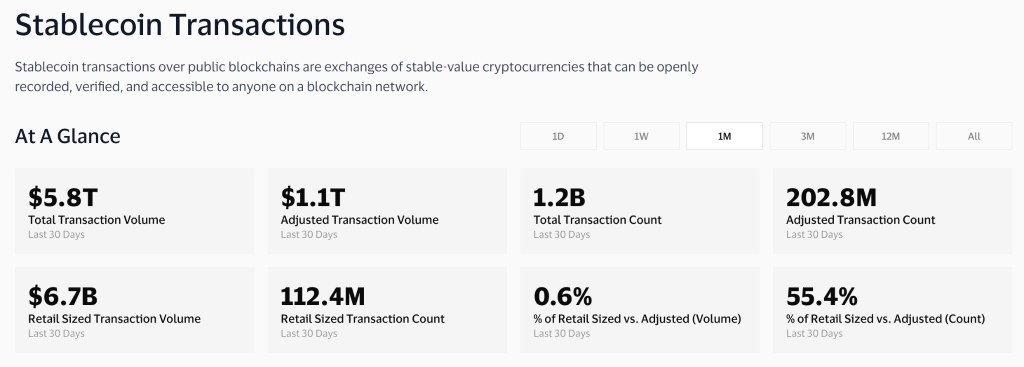 Source: VisaOnchainAnalytics
The assets have transformed from instruments for swiftly trading in and out of cryptocurrencies like Bitcoin to potential infrastructure for cross-border transactions due to their speed, low cost, and 24/7 settlement capabilities.
Treasury Secretary Scott Bessent recently voiced support for stablecoin adoption, asserting that “stablecoins will broaden dollar access for billions worldwide and lead to increased demand for U.S. Treasuries” as backing assets.
Implementing the GENIUS Act is essential to securing American leadership in digital assets.
Stablecoins will expand dollar access for billions across the globe and lead to a surge in demand for U.S. Treasuries, which back stablecoins.
It’s a win-win-win for everyone involved:… https://t.co/p5nRQpBfnw— Treasury Secretary Scott Bessent (@SecScottBessent) August 18, 2025
Regarding this latest investment, Harmse stated that BVNK has “dipped in and out of profitability” as the company focused on growth, but is on track to achieve profitability next year.
He remarked that “U.S. banks of Citi’s scale, due to the GENIUS Act, are leveraging their influence to invest in leading businesses in the sector to ensure they remain at the forefront of this technological transformation in payments.”
The post Citi Backs Stablecoin Firm BVNK Despite Previously Opposing Crypto Payment Rails appeared first on Cryptonews.
