Disclaimer: Information found on CryptoreNews is those of writers quoted. It does not represent the opinions of CryptoreNews on whether to sell, buy or hold any investments. You are advised to conduct your own research before making any investment decisions. Use provided information at your own risk.
CryptoreNews covers fintech, blockchain and Bitcoin bringing you the latest crypto news and analyses on the future of money.


The NEAR Foundation, a non-profit entity backing the Layer 1 NEAR Protocol, introduced chain signatures on its mainnet on August 8.
As per an official statement, these chain signatures enable users to sign transactions across various blockchains directly from their NEAR accounts, thereby removing the necessity for conventional cross-chain bridges.
The 2 Types of Users
Crypto enthusiasts and the general public.
Crypto enthusiasts seek a fluid experience across chains, while everyday users aim to resolve issues or enjoy themselves without concern for the underlying technology.
Chain Signatures empower developers to craft experiences… pic.twitter.com/WuFHqsvoNV
— NEAR Protocol (@NEARProtocol) August 9, 2024
At present, NEAR’s chain signatures are compatible with Bitcoin (BTC), Ethereum (ETH), including EVM-compatible chains, Dogecoin (DOGE), Ripple (XRP), Cosmos (ATOM), and Polkadot (DOT), among others, with intentions to broaden compatibility to Solana (SOL) and additional chains in the future.
How Chain Signatures Work
Chain signatures provide an innovative method for cross-chain interactions. They associate NEAR account addresses with other blockchains through a technique known as additive key derivation. This method produces multiple subkeys from a single master key, facilitating the management of various blockchain accounts.
When a user initiates a cross-chain transaction, a smart contract on the NEAR blockchain requests a signature for the transaction on the designated blockchain. This request is executed by a multi-party computation (MPC) service.
This service, initially safeguarded by eight validators including Pagoda, Luganodes, The Lifted Initiative, InfStones, Staking4All, Node.Monster, Black Sand Technologies, and Aurora, functions in a decentralized manner, ensuring that no single entity can jeopardize user funds.
Related Posts
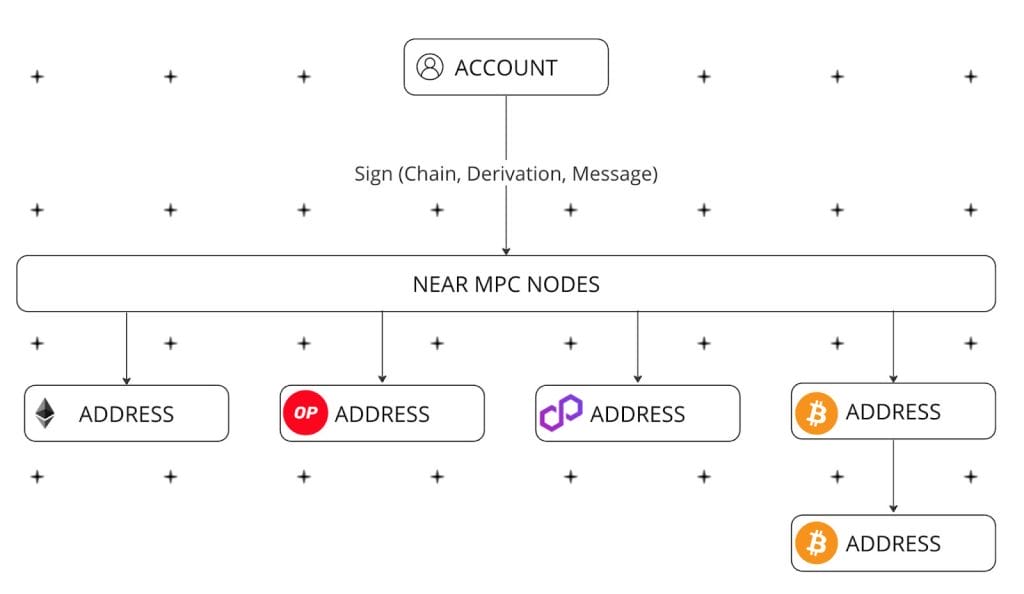 Chain signatures allow the signing of any transaction on various blockchains directly from NEAR accounts. Source: NEAR protocol
Benefits of Chain Signatures
By allowing users to engage with multiple chains through a single account, NEAR aims to foster the development of cross-chain decentralized applications (DApps) and the establishment of omnichain tokens. The organization views this advancement as a significant move towards a more interconnected blockchain ecosystem, lowering barriers to entry, liquidity, and usability.
“Chain signatures is a transformative innovation that realizes chain abstraction,” stated Illia Polosukhin, CEO of the NEAR Foundation. “Previously, we faced fragmented liquidity in DeFi; now there will be a unified DeFi layer for all chains.” According to Polosukhin, wallets, addresses, bridging, and token gas fees are rendered unnecessary.
“Instead, all of DeFi is reachable from wherever users currently are. This is feasible because smart contracts can now sign transactions for any blockchain, including Bitcoin,” Polosukhin added. “This unlocks a completely new design space for financial applications in Web3, benefiting degens and also paving the way for new user demographics.”
Chain signatures are a fundamental element of NEAR’s broader strategy to achieve chain abstraction, a concept aimed at creating a cohesive user experience across various blockchain networks. By simplifying the complexities of interacting with multiple chains, NEAR aspires to make decentralized finance more accessible to a larger audience.
NEAR continues to be the second most utilized blockchain, based on daily active users, with 1.95 million, just behind TRON at 2.1 million, according to VanEck’s July 2024 report. Just over a year ago, NEAR had only 67k daily active users.
The majority of NEAR’s user base is believed to be user-generated rather than bot-created, as NEAR’s activity is linked to a discount shopping application called Kai Kai, which operates in Taiwan.
The post Chain Signatures Go Live on NEAR Protocol, Expand Cross-Chain Possibilities appeared first on Cryptonews.
