Disclaimer: Information found on CryptoreNews is those of writers quoted. It does not represent the opinions of CryptoreNews on whether to sell, buy or hold any investments. You are advised to conduct your own research before making any investment decisions. Use provided information at your own risk.
CryptoreNews covers fintech, blockchain and Bitcoin bringing you the latest crypto news and analyses on the future of money.


The U.S. Commodity Futures Trading Commission (CFTC) has introduced a significant enhancement to its market oversight systems by implementing Nasdaq’s sophisticated Market Surveillance platform. This upgrade aims to improve the detection of fraud, insider trading, and manipulation within derivatives and digital asset markets.
The system became operational on August 27, 2025, under the guidance of Acting Chair Caroline D. Pham, replacing the CFTC’s outdated monitoring infrastructure from the 1990s.
CFTC Aims to Evolve into a ‘21st Century Regulator’ With Nasdaq Market Surveillance
This upgrade comes at a crucial time for U.S. regulators as Congress considers the Financial Innovation and Technology for the 21st Century Act, which could broaden the CFTC’s authority over spot digital asset markets.
I stated my intention to modernize and transform @CFTC to uphold market integrity across both traditional finance and crypto. I’m pleased to announce we have achieved this with @Nasdaq’s advanced market surveillance technology utilized by over 20 international regulators and 50 exchanges globally.… pic.twitter.com/7rJnxjdAJf
— Caroline D. Pham (@CarolineDPham) August 27, 2025
In her announcement, Pham indicated that this technology represents a significant advancement toward establishing the CFTC as a “21st century regulator.”
“As our markets continue to develop and incorporate new technologies, it is essential for the CFTC to remain proactive,” Pham remarked.
She further noted that “Nasdaq Market Surveillance will, for the first time, equip the CFTC with automated alerts and cross-market analytics that will enhance our ability to safeguard markets from fraud, manipulation, and abuse. This will enable our personnel to detect unusual or disruptive trading activities more effectively and respond more swiftly.”
This initiative comes as the CFTC encounters increasing pressure to enhance its oversight of the rapidly expanding digital asset sector.
The agency, which has historically overseen derivatives related to commodities, currencies, and fixed income, has assumed a more significant role in regulating crypto markets amid efforts in Washington to address regulatory gaps.
A recent report from the White House urged Congress to provide the CFTC with explicit authority over spot markets for non-security digital assets, emphasizing the necessity for modern surveillance tools.
Notably, Nasdaq Market Surveillance is already in use by over 50 exchanges and 20 international regulators, making it the most prevalent surveillance technology in global markets.
The platform offers regulators integrated monitoring across various asset classes, real-time data analysis, and automated alerts capable of identifying potential insider trading, wash trading, and other market abuses.
Its scalable design allows regulators to manage periods of extreme volatility, while access to comprehensive order book data facilitates detailed trade-by-trade analysis.
Tal Cohen, President at Nasdaq, stated that the collaboration with the CFTC highlights the significance of advanced monitoring tools in a swiftly changing market.
“Contemporary financial markets require surveillance technology that can adapt to rapid regulatory changes and emerging asset classes,” he remarked. “We are proud to collaborate with the CFTC and support their mission to enhance the integrity, resilience, and vibrancy of U.S. derivatives markets.”
Related Posts
Simultaneously, concerns regarding manipulation in crypto markets are escalating. A recent Chainalysis report estimated that wash trading on certain blockchain networks accounted for as much as $2.57 billion in volume, with a limited number of participants responsible for the majority of the activity.
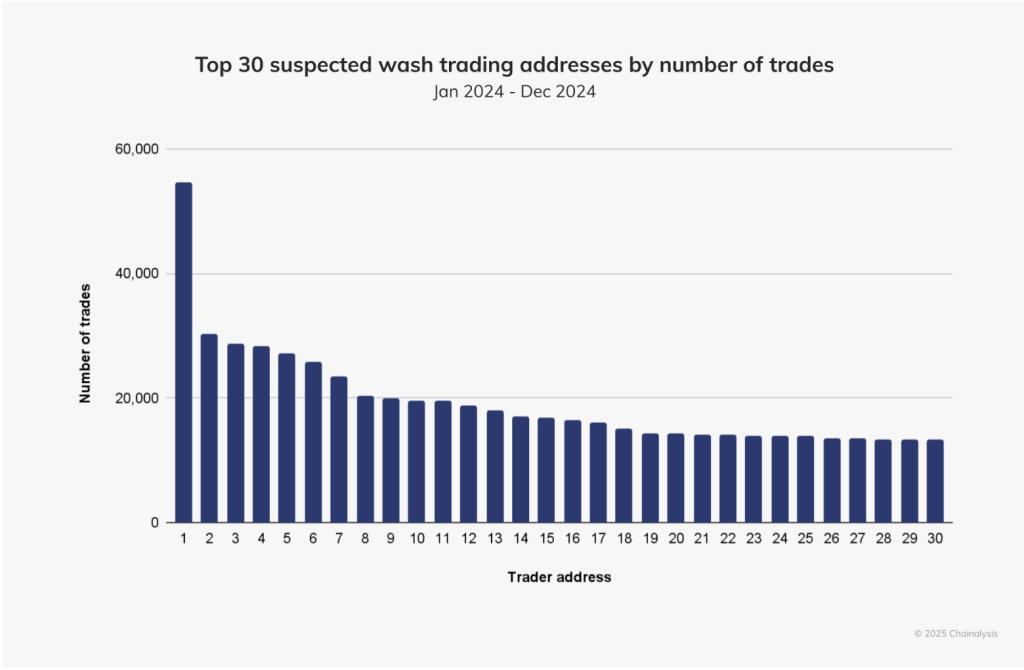 Source: Chainalysis
Pump-and-dump schemes have also increased, driven by meme coins and low-cost trading on new blockchains.
Researchers cautioned that such activities are frequently associated with pump-and-dump schemes, where token creators artificially inflate volumes to attract investors before liquidating their holdings.
The urgency for enhanced surveillance has also been underscored by the rapidity of illicit activities. A Global Ledger study revealed that crypto criminals could transfer stolen funds within four seconds of an attack, significantly outpacing the detection systems of major exchanges.
In some instances, laundering was completed in under three minutes, well before any public disclosures occurred.
U.S. Regulators Advance Crypto Oversight Amid Increasing Hacks
The U.S. Treasury Department and the Commodity Futures Trading Commission (CFTC) are intensifying efforts to establish new protections for digital assets, as crypto-related crimes continue to surpass detection capabilities.
On August 19, the Treasury initiated a 60-day public comment period under the recently enacted GENIUS Act, seeking feedback on tools such as artificial intelligence, blockchain monitoring, digital identity verification, and APIs to assist financial institutions in combating money laundering.
This initiative follows a spike in crypto crime, with $3 billion stolen across 119 incidents in the first half of 2025 alone. Treasury Secretary Scott Bessent described the GENIUS Act as “essential” for securing U.S. digital asset leadership and expanding regulated dollar-based stablecoins globally.
Recent statistics illustrate the challenges faced by regulators. According to blockchain analytics firm Global Ledger, hackers can transfer stolen funds in as little as four seconds, approximately 75 times faster than the response of exchange alert systems.
 Source: Global Ledger
In more than two-thirds of cases, assets were moved before the incidents became public, with some laundered in under three minutes.
In parallel with the Treasury’s initiatives, the CFTC has initiated a “crypto sprint” to advance spot crypto regulation. Acting Chair Caroline Pham stated that the four-phase initiative, running concurrently with the SEC’s Project Crypto, aims to establish immediate federal-level trading of digital assets.
Public comments are due by October 20, with final regulations anticipated in the program’s concluding phase. This effort builds on an August 5 proposal to permit spot crypto trading on federally registered exchanges, part of recommendations from the President’s Working Group on Digital Asset Markets.
However, the CFTC faces uncertainty at the leadership level. Commissioner Kristin Johnson will resign on September 3, leaving Pham as the sole member of the typically five-person agency. Pham is also expected to depart once President Trump’s nominee Brian Quintenz is confirmed, with reports connecting her to crypto payments firm MoonPay.
The post CFTC Adopts Nasdaq Tool to Hunt Insider Trading in Crypto appeared first on Cryptonews.
