Disclaimer: Information found on CryptoreNews is those of writers quoted. It does not represent the opinions of CryptoreNews on whether to sell, buy or hold any investments. You are advised to conduct your own research before making any investment decisions. Use provided information at your own risk.
CryptoreNews covers fintech, blockchain and Bitcoin bringing you the latest crypto news and analyses on the future of money.


The Cardano Foundation, in partnership with the Crypto Carbon Ratings Institute (CCRI), has introduced a series of sustainability metrics aimed at meeting the Markets in Crypto-Assets (MiCA) regulation within the European Union.
This initiative reflects Cardano’s dedication to transparency, sustainability, and adherence to regulations among comparable service providers, establishing a new standard for the wider crypto sector in the EU.
Cardano’s Sustainability Report Aligns with MiCA Regulations
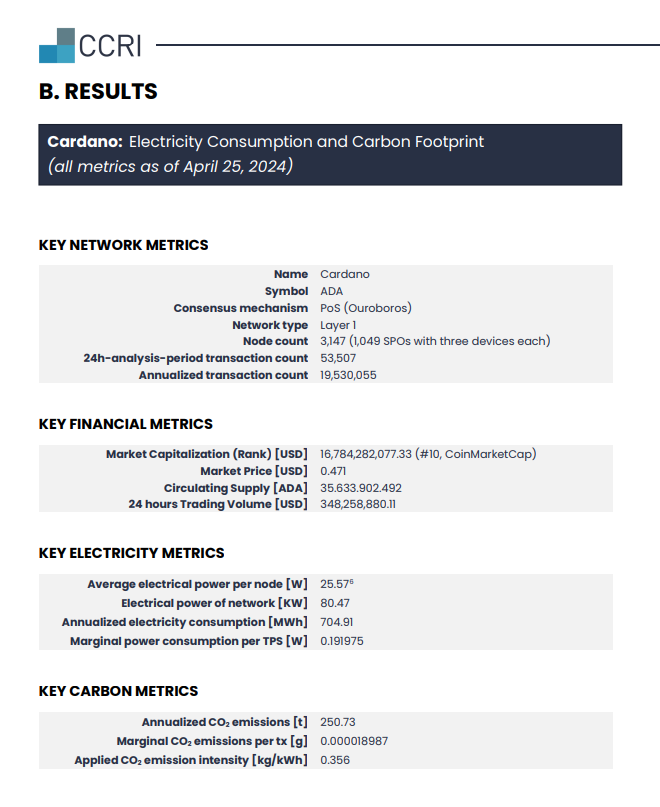 The CCRI Report on Cardano Blockchain Source: carbon-ratings.com
On July 2, the Crypto Carbon Ratings Institute (CCRI) published an extensive report on Cardano, aligning with the Markets in Crypto-Assets (MiCA) requirements, which mandate that crypto asset issuers and service providers disclose sustainability metrics. This compliance is consistent with MiCA’s Article 6 (1) and Article 66 (5), which require comprehensive environmental impact data from both token issuers and crypto-asset service providers.
The Cardano Foundation, which manages the ADA cryptocurrency, worked alongside CCRI to ensure thorough blockchain monitoring and data gathering. The CCRI report highlights Cardano’s commitment to sustainability through its implementation of an energy-efficient consensus mechanism.
Unlike energy-intensive Proof of Work (PoW) systems such as Bitcoin, Cardano operates with considerably lower energy consumption. As of May 2024, the network’s total annualized electricity usage is reported at 704.91 MWh. The report states:
“Cardano employs an energy-efficient consensus protocol. In comparison to Proof of Work (PoW)-based protocols such as Bitcoin, Cardano consumes significantly less electricity.”
Key metrics emphasized in the report include not only electricity usage but also the carbon footprint of the Cardano network and the marginal power demand per transaction per second. These metrics align with the draft regulatory technical standards (RTS) established by the European Securities and Markets Authority (ESMA) under the MiCA framework.
“In addition to electricity consumption and carbon footprint, we provide sustainability metrics in line with the draft regulatory technical standards (RTS) provided by the European Securities and Markets Authority (ESMA) in the second consultation package of the Markets in Crypto-Asset (MiCA) regulation.”
Related Posts
The ESMA’s second consultation package on MiCA, released on October 5, 2023, details ten mandatory indicators for climate and environmental impacts, addressing energy consumption, greenhouse gas emissions, waste generation, and natural resource use. CCRI’s compliance with these standards guarantees transparency and adherence to regulatory obligations.
Frederik Gregaard, CEO of the Cardano Foundation, highlighted the significance of these initiatives. He stated:
“By developing MiCA-compliant sustainability indicators, we aim to ensure adherence to the upcoming EU regulations and set a benchmark for the crypto industry. With the MiCA regulations partially coming into effect this week, the industry is now on a six-month countdown to implement crucial ESG binding requirements.”
Gregaard underscored the importance of such initiatives in fostering trust with regulators, investors, and users, thereby promoting the sustainable adoption of blockchain technology. He emphasized that this initiative illustrates how blockchain networks can address environmental, social, and governance (ESG) issues while ensuring transparency and efficiency.
MiCA’s Impact on Service Providers
The initial phase of MiCA regulations concentrates on stablecoins. In December, further regulations affecting crypto asset service providers will be introduced, impacting ecosystems such as Cardano.
This trend is mirrored by other providers, such as Circle, which, as of July 1, has become the first global stablecoin issuer to secure an Electronic Money Institution (EMI) license under the MiCA regulatory framework. This license allows Circle to issue its USDC and EURC stablecoins in Europe, positioning the company to capture a significant share of the European market.
In a similar vein, Bitstamp announced on June 26 that it would delist Euro Tether (EURT), Tether’s euro-pegged stablecoin, in response to the MiCA regulation in the European Union. Despite EURT’s notable market cap decline from a peak of $236 million to approximately $33 million, regulatory pressures have also influenced Bitstamp’s decision.
Likewise, Binance, the largest cryptocurrency exchange by trading volume, has limited the availability of certain stablecoins in the EU to comply with the MiCA regulation. Consequently, several existing stablecoins may encounter restrictions. Binance intends to allow users holding “unauthorized” stablecoins to convert them into other digital assets such as Bitcoin, Ether, regulated stablecoins, or fiat currency.
MiCA, effective from June 30, 2024, aims to establish a unified regulatory framework for crypto assets in the EU. Issuers of fiat-backed stablecoins must implement stringent safeguarding measures and ensure full backing by liquid reserves. This regulation stipulates that only stablecoins issued by regulated entities will be available to the public.
The post Cardano Foundation Release Sustainability Indicators to Comply with EU MiCA Regulations appeared first on Cryptonews.
