Disclaimer: Information found on CryptoreNews is those of writers quoted. It does not represent the opinions of CryptoreNews on whether to sell, buy or hold any investments. You are advised to conduct your own research before making any investment decisions. Use provided information at your own risk.
CryptoreNews covers fintech, blockchain and Bitcoin bringing you the latest crypto news and analyses on the future of money.


Key Takeaways:
- A Kremlin advisor asserts that the U.S. will “reset” its $37 trillion debt by converting it into stablecoins, a notion that experts argue is neither lawful nor technically viable.
- Analysts indicate that while stablecoins could broaden U.S. financial influence, they cannot eliminate existing liabilities without causing a default.
- This warning reflects Russia’s heightened concern regarding America’s increasing dominance in crypto finance and the emergence of a new battleground in the U.S.-Russia “coin wars.”
U.S. President Donald Trump’s campaign pledge to eliminate America’s $37 trillion debt using Bitcoin was ridiculed by both supporters and opponents as mere political theatrics. However, in Russia, a formidable adversary, this rhetoric has prompted serious caution.
Anton Kobyakov, a senior advisor to Russian President Vladimir Putin, recently accused the U.S. of positioning itself as a regulator over crypto and gold markets to counteract waning confidence in the dollar. He claims that Washington will leverage this authority to diminish its debt by transitioning it into stablecoins.
“Consider their debt – $35 trillion,” Kobyakov stated to attendees at the Eastern Economic Forum in Vladivostok earlier this month. The U.S. will reset its debt at the expense of the world by “pushing everyone into the cryptocurrency cloud.”
America’s debt has since surged to $37 trillion. Trump had previously proposed a Strategic Bitcoin Reserve, aiming to utilize profits from the reserve to reduce federal debt.
However, Putin’s advisor mentioned that the reset would occur through stablecoins – a category of cryptocurrency linked to a fiat currency like the dollar for stability.
“Over time, as a portion of the U.S. government debt is converted into stablecoins, the U.S. will devalue this debt. In other words, they have a $35 trillion debt, they push it into the cryptocurrency cloud, devalue it, and start anew,” Kobyakov explained.
The Kremlin strategist did not elaborate on how transferring the debt to stablecoins would result in devaluation.
Russia has just articulated the underlying aspect of the U.S. plan for Stablecoins and Bitcoin OUT LOUD for the world.
AND realized they can’t take any action against it.
The next step is the race to accumulate first – and not be victimized by it. pic.twitter.com/3PwNPGH096— BRITISH HODL
(@BritishHodl) September 8, 2025


Stablecoins Can’t ‘Magically’ Erase US Debt
Dispelling conspiracy theories and exaggerations, crypto analysts contend that transferring U.S. debt into stablecoins may not be technically achievable.
“Migrating even a small portion of $37 trillion of U.S. debt onto stablecoin platforms isn’t merely a switch you can flip,” Kony Kwong, CEO of GAIB, a company developing the economic layer for artificial intelligence on-chain, told Cryptonews.
He stated that the notion of utilizing stablecoins to “magically devalue” U.S. debt is impractical.
“Treasuries are legal contracts, and you can’t simply re-label obligations without triggering default or explicit policy changes.”
While new issuances can be gradually and incrementally tokenized, Kony asserts that employing stablecoins to shortchange global creditors would exceed the boundaries of legal feasibility.
Symbiotic chief operating officer Jill Friedman, who is also a lawyer, noted that the rise of stablecoins like Tether’s USDT and Circle’s USDC is likely to enhance global access to U.S. dollars.
However, merely manipulating stablecoins to eliminate America’s debt is beyond federal authority, she argues. Kobyakov’s assertion may represent Russia’s compensatory response to Trump’s vulnerabilities in a soft conflict that has predominantly favored the latter.
Related Posts
To begin with, the U.S. government does not possess stablecoins.
“It’s crucial to remember that U.S. dollar stablecoins are not issued by the government or central bank but by private entities and financial institutions,” Friedman tells Cryptonews. “The largest USD stablecoin is Tether, which is not based in the U.S. and has a market cap of $172 billion.”
The U.S. does have the option to create its own sovereign stablecoin. As Kony explains:
“If the U.S. were to launch a sovereign, Treasury-backed dollar token, it would likely become the default within regulated systems (i.e., banks, fintechs, and compliant exchanges). This is due to the reduction of counterparty and policy risk, which would pressure private issuers on yield capture and onshore market share.”
A federal stablecoin would not eliminate USDT and USDC. “They would continue to provide permissionless, cross-border liquidity and faster multi-chain distribution, while a federal coin would operate more slowly,” he added.
“We would observe increased on-chain demand for T-bills (beneficial for U.S. funding), tighter margins for private stablecoins in the U.S., and a bifurcated market: regulated dollars for regulated systems, private dollars for the edges.”
Coin Wars
The Kremlin’s recent assertion may not be technically accurate, but it highlights unease regarding America’s expanding influence in the crypto and stablecoin sectors under the self-styled “Crypto President” Donald Trump.
Russia is concerned about the potential consequences if the U.S. secures a significant stake in a major token, such as USDT or USDC, to manipulate or devalue it for its own benefit, analysts suggest.
Kobyakov’s statement also brings to light the covert “coin wars” between Russia and America. While the U.S. is a clear technological leader, Russia is not without its strengths.
Russia’s socialist heritage may have contributed to the emergence of open-source advocates like Ethereum founder Vitalik Buterin and TON founder Pavel Durov. Its status as a comparable global superpower has also provided refuge for cypherpunks – such as Edward Snowden – pursued by the U.S.
However, a centrist culture, even one that employs a jail-and-recruit strategy, which places disruptive tech talent under government oversight, has naturally resulted in a brain drain. Russia is now seeking a digital alternative to dollar supremacy through the BRICS+ platform.
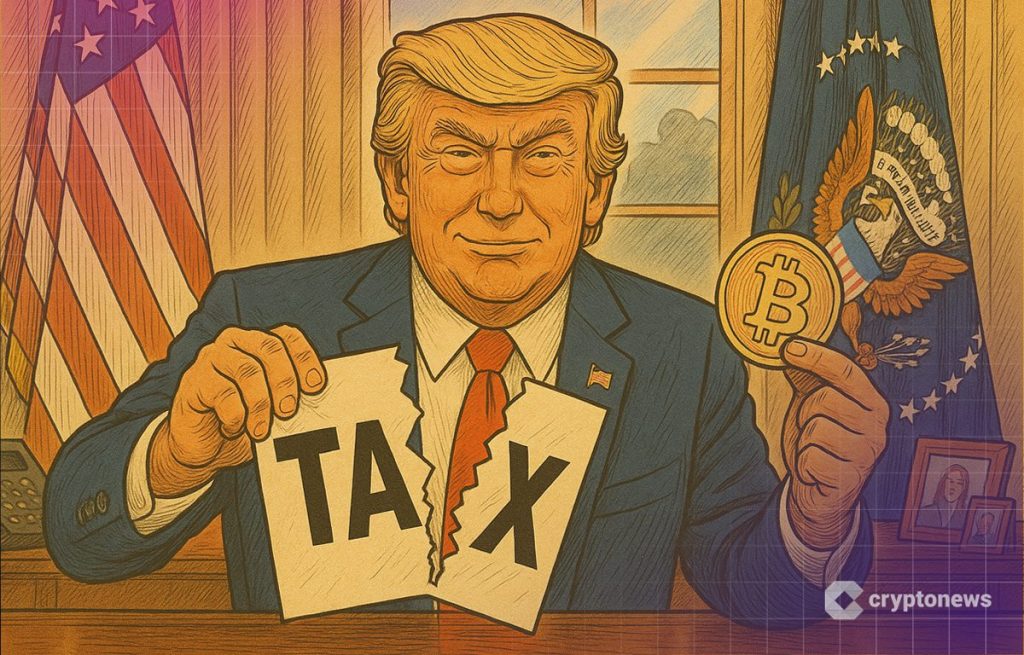 Donald Trump has introduced a series of initiatives to bolster the crypto sector.
Trump’s Bet On Bitcoin
Reducing federal debt through crypto is a classic gamble of the Trump administration. Instead of arbitrarily shifting the national debt to stablecoins, President Trump has proposed accumulating Bitcoin in the government reserve.
This plan has been variously “debunked” by crypto analysts. Ben Ritz, vice president of policy development for the think tank Progressive Policy Institute, states that the entire market cap of BTC is far from sufficient to cover the U.S.’s $37 trillion debt.
“If all the Bitcoin in existence isn’t valued enough to cover a single year’s budget deficit, there is no way purchasing 5% of it can realistically halt the growth of, let alone pay off, our national debt,” Ritz remarked in a Forbes op-ed.
It remains possible that a reserve currency held for 20 years could appreciate in value. However, aggressive purchasing could lead to price distortion, volatility, and potentially depress the BTC price, he noted. A perceived government takeover, even if limited to 5%, would also “rewrite” the rules of alternative finance.
The post $37T Question: Can Stablecoins Be a Magic Bullet for US Debt? appeared first on Cryptonews.
