Disclaimer: Information found on CryptoreNews is those of writers quoted. It does not represent the opinions of CryptoreNews on whether to sell, buy or hold any investments. You are advised to conduct your own research before making any investment decisions. Use provided information at your own risk.
CryptoreNews covers fintech, blockchain and Bitcoin bringing you the latest crypto news and analyses on the future of money.


While security has been a fundamental aspect of cryptocurrency, it has not always been the top priority. Nevertheless, quantum computing is no longer a theoretical concern; it is approaching reality, prompting serious investors to inquire about which projects are truly prepared for this shift. BMIC has provided a clear solution: a quantum-resistant wallet designed to safeguard assets before traditional cryptography falters.
The presale has just commenced at a price of $0.049474 per token. Some early investors are stepping in now, anticipating a significant shift towards security in 2026. Can BMIC genuinely contend with XRP, Hedera, Cardano, and Polkadot? The answer lies in what investors prioritize more: networks that function effectively today or those engineered to endure future challenges.
XRP: Quick, Cost-Effective, and Reliable
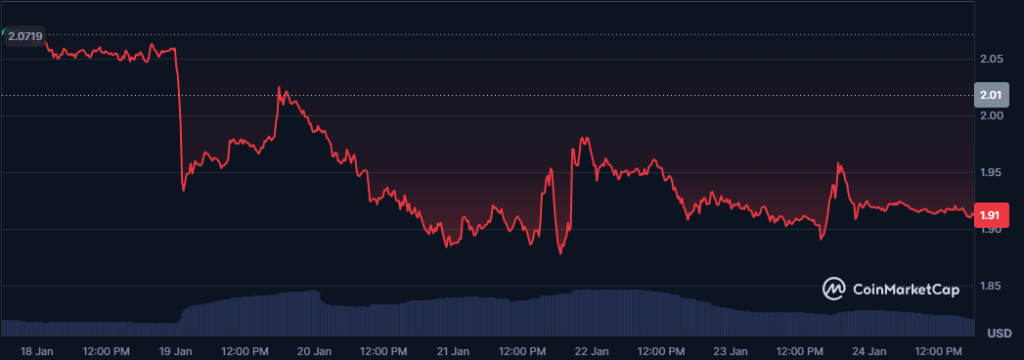
XRP has facilitated cross-border transactions for several years. Transactions are completed in just 3 to 5 seconds, with fees remaining below one cent. The total supply is capped at 100 billion tokens, with Ripple managing the release through escrow arrangements. This predictability is appealing to banks.
Ripple’s On-Demand Liquidity product already manages significant settlement volumes. XRP enables the bridging of fiat currencies without the necessity of pre-funded accounts in each country. The partial victory against the SEC has also clarified some regulatory uncertainties within the U.S. For payment networks, XRP is effective.
Source: CoinMarketCap/XRP
However, XRP relies on traditional cryptography, which BMIC asserts will eventually be compromised by quantum computers. Transitioning a global payment network to post-quantum standards involves coordinating migrations, risking downtime, and hoping that nothing fails. This is a considerable undertaking.
Thus, there exists a gap. Projects designed with quantum resistance from the outset bypass all these complications. The critical question is whether swift payments alone will remain competitive as the cryptographic landscape evolves.
HBAR, ADA, and DOT: Diverse Approaches to Security
Hedera, Cardano, and Polkadot have each developed their own interpretations of security. Hedera employs hashgraph consensus for rapid finality while incorporating enterprise governance. Its council structure appeals to banks and regulated firms, even at the cost of some decentralization.
Cardano adopted an academic methodology. With formal verification, peer-reviewed studies, and Haskell-based smart contracts, it aims for fewer bugs and more consistent behavior. Progress may be slow, but teams engaged in high-stakes applications value the thoroughness.

Polkadot has taken a modular approach. The Relay Chain secures all parachains, allowing each parachain to operate in isolation. A breach in one chain does not affect the others. This is an infrastructure mindset applied to blockchain technology.
All three are robust in their respective domains. However, BMIC contends that none of them were initially conceived with quantum resistance as a fundamental attribute. They will eventually need to retrofit post-quantum cryptography, leading to hard forks, compatibility challenges, and execution risks. BMIC claims it does not face such issues because it was conceived as quantum-native from the beginning.
BMIC: A Leading Altcoin for Post-Quantum Security
BMIC is the inaugural wallet constructed with signature-hiding smart accounts on ERC-4337 and PDA architecture. Public keys do not interact with the blockchain, eliminating the specific vulnerability that quantum computers will target first. The hybrid post-quantum signatures also automatically upgrade as standards evolve.
The wallet serves as merely the initial point of entry. BMIC additionally provides quantum-secure staking. Validator keys remain concealed within the same signature-private infrastructure, ensuring that stakers do not expose themselves to future threats. Moreover, there is a quantum-secure credit card system that employs PQC authentication and private routing to thwart cloning and key-recovery exploits.
Related Posts
Enterprises can access this through Quantum Security-as-a-Service APIs. Banks, fintechs, and healthcare organizations can incorporate custody, key management, and encrypted messaging without disrupting their existing systems. AI operates in the background, identifying threats before they escalate into significant issues, according to the team.
The roadmap includes a Quantum Meta-Cloud that links various quantum hardware providers into a single decentralized network. No vendor lock-in or corporate gatekeepers exist. BMIC positions itself as both a security layer and a computing access point as the demand for AI increases. According to BMIC, the crypto presale presents early participants with an opportunity to enter before widespread adoption begins.
BMIC Presale: Tokenomics and Growth Strategy
The presale consists of 50 phases, commencing at $0.049474 per token. The total supply is fixed at 1.5 billion tokens. Distribution includes: 50% presale (750M), 12% rewards and staking (180M), 10% liquidity and exchanges (150M), 10% private sale (150M), 9% ecosystem reserve (135M), 6% marketing (90M), and 3% team (45M).
The token model is deflationary. A portion of the platform revenue is allocated for buybacks and burns. As utilization increases, supply decreases. BMIC must be used for wallet functionalities, enterprise APIs, and computing workloads. Staking rewards participants and fortifies the network through quantum-secure validator configurations.
The roadmap is ambitious yet realistic. Phase 1 focuses on developing the wallet and integrating post-quantum cryptography. Phase 2 launches the alpha and initiates institutional pilots with QSaaS APIs. Phase 3 introduces the beta with comprehensive asset support, governance activation, and the initial burn events.
Phase 4 unveils the Quantum Meta-Cloud and activates burn-to-compute, converting tokens into computing credits. Phase 5 implements the mainnet, introducing decentralized governance, AI security updates, and enterprise partnerships across finance, insurance, and healthcare.
Early presale participants benefit from lower prices before the next price increment. This is a cryptocurrency to consider acquiring before quantum concerns become a headline issue.
Visit BMIC Presale
Why BMIC Holds an Advantage
In summary, XRP is recognized for its speed and institutional engagement. Hedera, Cardano, and Polkadot each contribute unique elements: governance, formal verification, and shared security. Yet, none were constructed with inherent quantum resistance. BMIC was created with that foundation, according to the team.
It secures wallets, staking, and payments while keeping public keys concealed. Enterprises can incorporate quantum security without costly migrations. The deflationary model and computational utility ensure steady demand. The roadmap progresses from wallet development to comprehensive quantum infrastructure.
Those searching for the top cryptocurrency to invest in for 2026 should contemplate the implications of quantum computing when it arrives. Most networks will be scrambling to rectify their code. BMIC asserts that it has already addressed that concern. The crypto presale is currently active at $0.049474 per token. Engaging now allows for better pricing before the subsequent phase begins.
Explore the future of quantum-secure Web3 with BMIC:
Website: https://bmic.ai/
Social: https://x.com/BMIC_ai
Telegram: https://t.me/+6d1dX_uwKKdhZDFk
The post Can BMIC Challenge XRP and Other Top Altcoins With a Security-First Thesis? appeared first on Cryptonews.
