Disclaimer: Information found on CryptoreNews is those of writers quoted. It does not represent the opinions of CryptoreNews on whether to sell, buy or hold any investments. You are advised to conduct your own research before making any investment decisions. Use provided information at your own risk.
CryptoreNews covers fintech, blockchain and Bitcoin bringing you the latest crypto news and analyses on the future of money.

Cambodia’s Central Bank Chief Asserts Digital Currency Will Enhance Fiat Adoption: Reasons Explained

On May 28, Central Bank Governor Chea Serey disclosed that the Central Bank Digital Currency (CBDC) Bakong could enhance the adoption of Cambodia’s Riel currency by enabling cross-border QR payments.
Cambodia’s Central Bank Governor States Cross-Border Transactions Can Enhance Riel Utilization
In a special interview at Nikkei’s Future of Asia conference in Tokyo, Chea Serey elaborated on the dynamics of Cambodia’s currency system and its ongoing evolution.
During the Nikkei Forum 29th Future of Asia, Secretary-General of ASEAN, Dr. Kao Kim Hourn, engaged with the Governor of the National Bank of Cambodia (NBC), Dr. Chea Serey.
They addressed the notable advancements achieved in ASEAN digital payments integration, financial… pic.twitter.com/pmy8pQ0ybk
— ASEAN (@ASEAN) May 24, 2024
She indicated that over 80% of Cambodia’s economy continues to depend on the U.S. dollar as part of a dual-currency framework. The government is working to encourage citizens to utilize the riel more frequently for local transactions.
The governor of Cambodia’s central bank noted that although the US dollar prevails in physical transactions, the local currency (riel) is increasingly utilized in digital transactions.
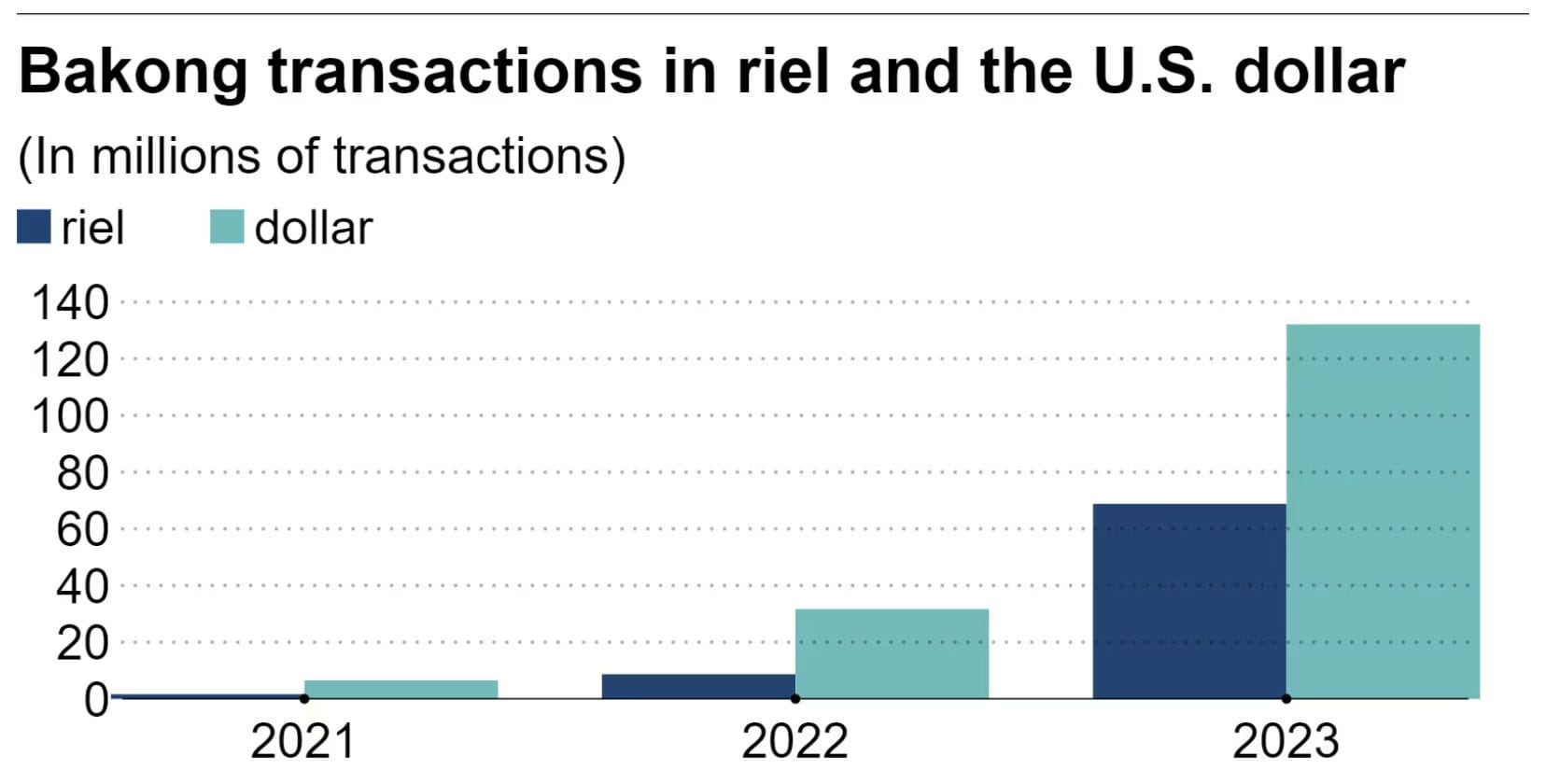 Bakong CBDC usage in transactions has seen substantial growth since its introduction
Since its inception in 2020, the Bakong CBDC has enabled a total of $70 billion in digital payments as of 2023, a figure roughly double the nation’s GDP.
Domestic transactions using the Bakong CBDC can be carried out in both riel and dollars, with the riel representing $20 billion of last year’s total, more than double the amount from 2022.
Serey further emphasized that cross-border transactions are crucial for fostering the use of the riel. Bakong’s capabilities include QR code-based payments among Cambodia, Thailand, Laos, and Vietnam, as well as transactions involving China’s UnionPay.
Related Posts
These cross-border payments exclusively utilize the riel, necessitating that Cambodian citizens possess a riel Bakong account to perform transactions with neighboring nations.
Likewise, Thai tourists can only execute QR code transactions in Cambodia if the merchants accept riel.
Today, Cambodia officially announced the launch of their central bank digital currency (CBDC).
Guess who recently met with the Central Bank of Cambodia? #XRP #XRPCommunity #crypto #blockchain pic.twitter.com/vVut3ZTvNX
— Cryptic Poet (@1CrypticPoet) October 29, 2020
 Today, Cambodia officially announced the launch of their central bank digital currency (CBDC).
Bakong distinguishes itself from other CBDCs as it is supported by both the Cambodian riel and the US dollar. This dual backing offers stability and extensive usability within Cambodia’s distinct dual-currency system, facilitating more seamless transactions and financial integration.
Cambodia is not the only nation investigating CBDC to reinforce its fiat currency. In March 2024, the Hong Kong central bank introduced a wholesale CBDC to enhance tokenization and the financial robustness of the city.
Moreover, the South Korean central bank is accelerating its CBDC initiative to trial the digital Korean won (KRW) by the final quarter of 2024, aimed at assessing the usability and deposit functions of the digital currency.
Cambodia’s Central Bank Aims to Launch Bakong Transactions in India & Japan
The governor of Cambodia’s central bank announced intentions to initiate cross-border payments utilizing the Bakong CBDC with India as early as June 2024 and is also considering partnerships with Japan.
“We are open to collaborating with other nations that have significant movement of people with Cambodia,” she stated.
Potential partnerships with technologically advanced nations like Japan could introduce technical expertise and innovations that enhance Bakong’s functionality and attractiveness. Such collaboration could improve the efficiency, security, and user experience of the payment system, making the riel more appealing to both domestic and international users.
The post Cambodia’s Central Bank Governor Believes Digital Currency Will Boost Fiat Use: Here’s Why appeared first on Cryptonews.
