Disclaimer: Information found on CryptoreNews is those of writers quoted. It does not represent the opinions of CryptoreNews on whether to sell, buy or hold any investments. You are advised to conduct your own research before making any investment decisions. Use provided information at your own risk.
CryptoreNews covers fintech, blockchain and Bitcoin bringing you the latest crypto news and analyses on the future of money.


The Boerse Stuttgart Group, the second-largest exchange in Germany, has finalized its blockchain testing as part of the initiative by the European Central Bank (ECB).
In the ECB’s blockchain trials, the Boerse Stuttgart Group was the pioneer in testing the settlement of exchange transactions involving blockchain-based securities using central bank money.
Participating banks, including Commerzbank, Deutsche Bank, DZ Bank, LBBW, Bankhaus Metzler, and V-Bank, acted as trading and settlement participants, connecting to the Stuttgart Stock Exchange’s DLT-based settlement framework. This system was also linked to the conventional Euro payment system via a connection with the Deutsche Bundesbank’s Trigger solution.
Efficiency Improvements and Cost Reductions
As stated in the press release provided to CryptoNews, the exchange’s settlement solution for tokenized securities has demonstrated remarkable efficiency, even for secondary market transactions.
The new framework significantly simplifies and speeds up the settlement of securities transactions, cutting the time needed “from two days to a few minutes.” This enhancement in efficiency is anticipated to result in cost reductions for both investors and financial institutions: “The tests indicated that settlement processes can be fully automated, step-by-step, and directly between trading participants – efficiently, securely, and without counterparty risk,” according to the press release.
The trials included a diverse array of tokenized securities, such as bonds, funds, and stocks, showcasing the adaptability of the technology.
“Blockchain technology is transformative for the digitalization of the European capital market. With the successful conclusion of the ECB blockchain tests, we have made a significant advancement in the EU,” stated Matthias Voelkel, CEO of the Boerse Stuttgart Group.
Voelkel also mentioned that its Swiss-based tokenized securities exchange, BX Digital, which is scheduled to launch in 2024, will utilize the exchange’s proprietary blockchain-based settlement solution.
In contrast to earlier ECB tests, the Boerse Stuttgart Group undertook a thorough evaluation of their blockchain-based settlement solution. Rather than focusing solely on individual transactions, they assessed the system across a range of scenarios, including both standard and exceptional situations.
Related Posts
To ensure a comprehensive evaluation, the group engaged several key participants, such as the broker EUWAX AG and the crypto custodian Boerse Stuttgart Digital Custody.
EU’s DLT Pilot Regime Encounters Adoption Challenges
While Germany has supportive legislation for the issuance of tokenized securities (and German institutions remain actively engaged in the ECB’s DLT settlement trials), trading and settlement operations are mainly regulated by European Union laws, such as the DLT Pilot Regime.
This regulation was established in May 2022 and came into effect a year later, in May 2023.
The DLT regime provides a legal framework for the trading and settlement of transactions in crypto assets that qualify as financial instruments (under MiFID II) – aiming to create an environment conducive to safe experimentation.
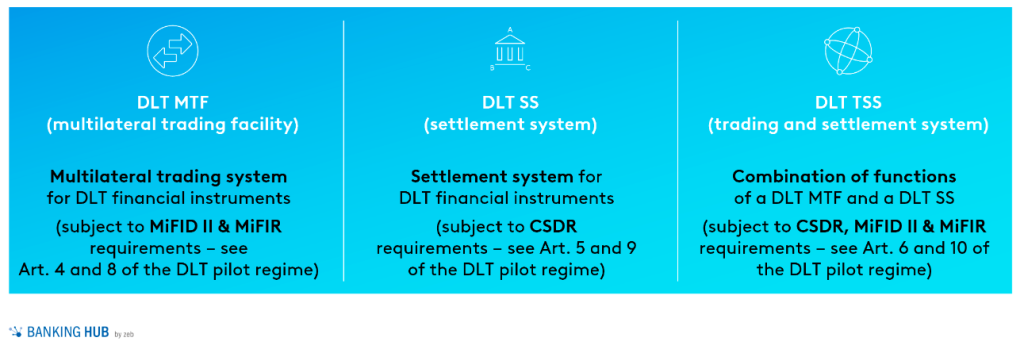 Three types of DLT market infrastructure. Source: Banking Hub
Verena Ross, Executive Director of the European Union’s Securities and Markets Authority (ESMA), pointed out the primary obstacles impeding the implementation of the DLT pilot regime in a letter to EU regulators in April 2024.
The letter indicated that the DLT Pilot Regime, a relatively new regulatory framework, faces multiple challenges that hinder its adoption. These challenges include a limited number of cash settlement providers, uncertainty surrounding custody services, interoperability issues between DLT and traditional systems, concerns regarding investor protection, and limitations on the types of financial instruments that can be traded. Furthermore, market participants are seeking clarity on the duration of the pilot regime.
In response, Mairead McGuiness, European Commissioner for Financial Services, emphasized the significance of the DLT regime and acknowledged the increasing interest from the financial sector. Additionally, the Commission will address these challenges and has clarified that there is no predetermined end date for the pilot regime.
The post Boerse Stuttgart, ECB Complete Trials for Tokenized Securities Trading appeared first on Cryptonews.
