Disclaimer: Information found on CryptoreNews is those of writers quoted. It does not represent the opinions of CryptoreNews on whether to sell, buy or hold any investments. You are advised to conduct your own research before making any investment decisions. Use provided information at your own risk.
CryptoreNews covers fintech, blockchain and Bitcoin bringing you the latest crypto news and analyses on the future of money.

Bitcoin Remains in Delicate Consolidation as Markets Shift to Risk-Averse Stance and Bearish Indicators Accumulate, Analysts Indicate

Bitcoin (BTC) finds itself in a delicate consolidation phase, according to analysts. This situation arises from diminishing demand and ongoing ETF outflows. Furthermore, it is significantly influenced by escalating macroeconomic uncertainty, geopolitical strife, and indecision in policy-making.
Additionally, the cryptocurrency has not succeeded in surpassing crucial resistance levels, and investors are adopting a risk-averse stance, diverting their resources into traditional safe-haven assets like metals.
Experts highlight that the coming days will be pivotal for the mid-term market trajectory. Low liquidity, cautious institutional strategies, and volatility driven by headlines are all heightening the risk of this consolidation period transitioning into a more extensive bearish trend.
‘Consolidation Will Prevail’
In the latest Bitfinex report, it is noted that Bitcoin’s efforts to rise have come to a halt. The cryptocurrency was unable to maintain its position above the $95,000–$98,000 resistance range, instead returning to its established trading range.
It peaked at $97,850 in mid-January, experiencing a double-digit decline since the start of the year. This follows a drop in buying momentum and increased ETF outflows.
Analysts state that “the rejection of any upward movements has occurred near the cost basis for short-term holders, indicating a fragile balance where downward pressure is being absorbed, yet upward movements are consistently countered by selling from previous cycle investors.”
Moreover, if ETF demand remains weak, Bitcoin is likely to continue trading within a limited range. Consolidation will “persist until a clearer demand driver presents itself.”
Bitcoin’s breakout is still on hold. $BTC was rejected at $95K–$98K, retreating over 10% from its $97.8K peak.
Weak spot demand and ETF outflows are constraining upside, keeping BTC range-bound for now. pic.twitter.com/ip5QmeKMrC— Bitfinex (@bitfinex) January 26, 2026
Market volatility indicates “event-driven caution rather than a broader regime shift,” as stated by Bitfinex.
Meanwhile, geopolitical instability adds to the volatility, particularly with escalations driven by the US. Threats of tariffs led to a brief risk-off reaction in equities, causing volatility to spike, but “the swift retreat in policy rhetoric restored short-term stability.”
The report concludes that investor positioning “suggests that markets perceive recent recoveries as stabilization rather than a resurgence of expansionary conditions.”
You may also like: Why Is Crypto Up Today? – January 27, 2026 The cryptocurrency market is slightly up today – but only marginally. The market capitalization of cryptocurrencies has increased by just 0.1% over the past 24 hours as of this writing, indicating it remains largely unchanged. It currently stands at $3.05 trillion, the same as yesterday. Additionally, 77 of the top 100 cryptocurrencies have experienced price increases. The total trading volume in crypto is at $113 billion. Crypto Winners & Losers On Tuesday morning (UTC), we observe that 7 of the top 10 cryptocurrencies by market capitalization are up, while three…
‘Teetering In the Grip of Bearish Sentiment’
Petr Kozyakov, co-founder and CEO of Mercuryo, remarked that BTC “is precariously positioned” at approximately $87,000. It continues to “teeter under bearish sentiment.” As the week commenced, it dropped to the $86,100 level during “frantic Asian trading.”
Markets are in risk-off mode as gold and silver prices rise. This indicates that investors are “flocking to traditional safe-haven assets amid growing geopolitical risks.”
Additionally, both retail and institutional crypto investors are remaining defensive, added Kozyakov. Participation from retail-driven sectors and institutions has diminished.
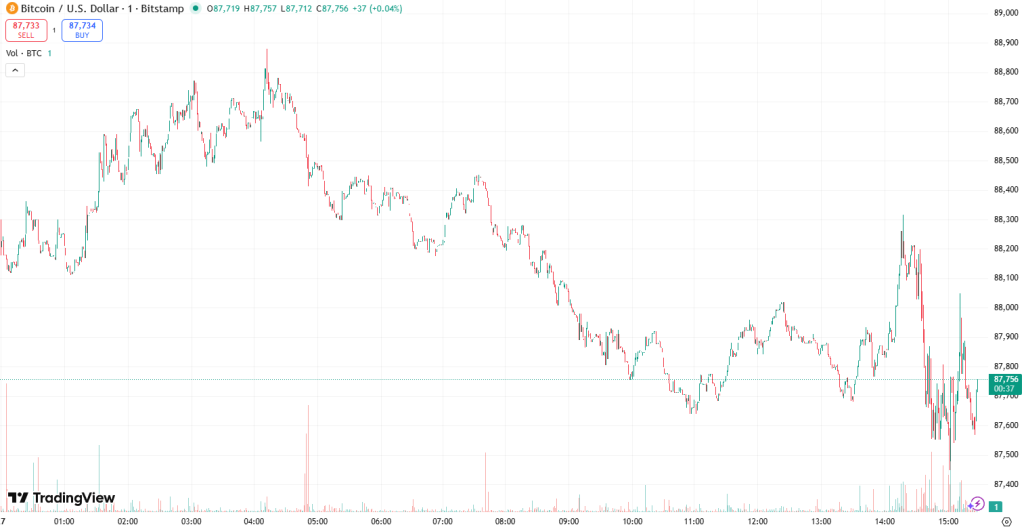 Source: TradingView
Furthermore, Nic Puckrin, investment analyst and co-founder of Coin Bureau, states that gold and silver are currently in “uncharted territory.” While forecasting prices is challenging, the ongoing surge “shows no signs of weakness.” The macroeconomic landscape supports a risk-averse environment for gold’s prominence.
As gold reached all-time highs, the US dollar experienced a 15.6% decline from its 2022 peak, marking its largest drop in history, according to Puckrin.
Simultaneously, “Bitcoin and digital assets continue to lag behind, despite the resurgence of dollar debasement concerns.”
Bitcoin ETFs have witnessed $1.7 billion in outflows. Even if surveys indicate optimism among institutional investors, particularly for the long term, many within this group also contend that we have entered a bear market.
“The longer Bitcoin remains below $100,000, the more momentum will shift to the downside,” Puckrin asserts.
The chart appears weak, with BTC possibly moving to the $92,000 mark in the near term.
“While a new all-time high this year is still a possibility, the next 30 days will be crucial in determining whether a bear market is already upon us,” the analyst predicts.
Related Posts
Historically, specific external catalysts have led to price breakouts in the crypto market. For instance, a similar decline in 2017 triggered a historic bull market. However, such catalysts are now sparse due to “ongoing macroeconomic uncertainty, fears of another US government shutdown, and prevailing expectations of a pause in rate cuts from the Federal Reserve,” Puckrin concluded.
You may also like: Euphoria Over the US Commitment to Crypto Quickly Faded, But Which Key Factors Affect Bitcoin – Analysts Weigh In Bitcoin (BTC) has dipped below the $90,000 threshold. However, how much of this decline can be attributed to various macroeconomic, geopolitical, and regulatory influences? Analysts have provided their insights on this issue. Over the past 24 hours, Bitcoin has remained relatively stable as of this writing (Thursday afternoon, UTC). It has increased by just 0.2%, currently trading at $89,582. Earlier in the day, it experienced a significant drop to the $87,300 level before briefly climbing to…
‘Hope For an Aggressive 2026 Easing Cycle Has Cooled’
Jimmy Xue, co-founder and COO of Axis, contended that Bitcoin’s pause at $90,000 represents a “macro repricing, not a demand collapse.”
More specifically, Xue states that the current pause reflects a macro-driven adjustment of the discount rate, as “the market’s expectations for an aggressive easing cycle in 2026 have significantly diminished.”
The inflows for spot ETFs remain a stable support level, he notes. However, they are currently functioning more as a “passive barrier” rather than an active driver of price discovery.
 Bitcoin spot ETFs. Source: SoSoValue
Xue mentions that “the $90,000 level has evolved into a psychological battleground where macro traders are realizing profits to hedge against a tightening Fed, while long-term institutional buyers continue to purchase on dips.”
He concludes that “any indication of Fed ‘patience’ this week effectively eliminates the immediate liquidity boost that the market was anticipating, leading to a period of ‘tense calm.’”
Thus, a lack of new capital “in an environment already influenced by geopolitical tensions and trade uncertainties” typically triggers ‘headline-driven volatility.’ Low order books result in sharper price movements dictated by news, Xue explains.
“In the absence of a dovish pivot, anticipate liquidity to stay defensive and concentrated in the most established assets,” he asserts.
BTC must establish its value as a structural hedge rather than “a high-beta liquidity sponge.” Xue concludes that “this heightened threshold for capital suggests that the ‘easy’ institutional profits of 2025 are likely to be succeeded by a more selective, value-oriented growth phase.”
You may also like: Are We Entering Wave V? Further Bitcoin Downside Still Likely, Analysts Say As the crypto market continues to trade sideways, analysts believe we may soon transition into the final phase of this bull run, while also anticipating further downside. Nonetheless, significant risk-averse factors are obstructing a Bitcoin (BTC) recovery. The crypto market saw a notable increase last week but fell over the weekend, starting this week on a lower note. Observing BTC, over the last 24 hours, it declined from an intraday high of $95,467 to a low of $92,263. At the time of…
‘Current Bitcoin Range Is a Fragile Truce’
Samer Hasn, senior market analyst at XS.com, stated that Bitcoin experienced a brief rise, one that “lacks conviction and feels more like a pause than a restart.”
The analyst pointed out several significant, interconnected factors currently affecting the market.
The first is the overall reduction in liquidity. Spot ETFs have primarily recorded outflows over the past week, while crypto futures open interest has decreased to $128 billion, and Bitcoin futures have fallen to around $58 billion.
At the same time, whales continue to accumulate Bitcoin. The addresses holding between 1,000 and 10,000 BTC reached 1,955 as of Sunday, nearly the highest level since November.
“This combination is significant because liquidity is essential for any sustainable rally. When upward movements occur with thin demand, they tend to be reversed sharply if a catalyst unsettles the markets.”
Moreover, Bitcoin’s hashrate has decreased following a severe storm in the US, causing major mining companies to suspend operations due to disruptions and rising costs. “If these mining firms are compelled to sell their Bitcoin holdings to cover fixed operating expenses during the downtime, it may exert substantial downward pressure on prices in an already liquidity-constrained environment,” Hasn writes.
Bitcoin (BTC)24h7d30d1yAll time
Finally, the upcoming US Fed meeting, political shocks, and geopolitical tensions pose additional threats to the market.
“In summary, Bitcoin’s current range represents a fragile truce,” Hasn argues. “Sustainable upward movement requires consistent spot demand, more stable funding conditions, and a clear resolution of the event risks that are currently depleting liquidity and shortening traders’ horizons.”
You may also like: (LIVE) Crypto News Today: Latest Updates for January 27, 2026 The digital asset market has returned to the positive this Tuesday, led by a strong recovery in the GameFi sector, which surged 4.64% over the last 24 hours. After a cooling-off period, investor interest in “Play-to-Earn” ecosystems has reignited, with Axie Infinity (AXS) achieving a substantial 36.94% rally. This movement follows Bitcoin (BTC) reclaiming the $88,000 level and Ethereum (ETH) surpassing $2,900, signaling a broader stabilization across the macro landscape. High-growth…
The post Bitcoin Is Stuck in Fragile Consolidation as Markets Turn Risk-Off and Bearish Signals Build Up, Analysts Say appeared first on Cryptonews.
