Disclaimer: Information found on CryptoreNews is those of writers quoted. It does not represent the opinions of CryptoreNews on whether to sell, buy or hold any investments. You are advised to conduct your own research before making any investment decisions. Use provided information at your own risk.
CryptoreNews covers fintech, blockchain and Bitcoin bringing you the latest crypto news and analyses on the future of money.


Bitcoin (BTC) defended the $85,500 level on Tuesday, 22 September, trading at $85,736 as a minor 0.97% correction cooled off a bullish move. This follows the top cryptocurrency pushing above $85,000 for the first time in eight months and reaching its highest level since January.
The move forces a critical question: is this a rally driven by a genuine shift in the macro backdrop, or merely a one-day reprieve from an inflation scare that persists?
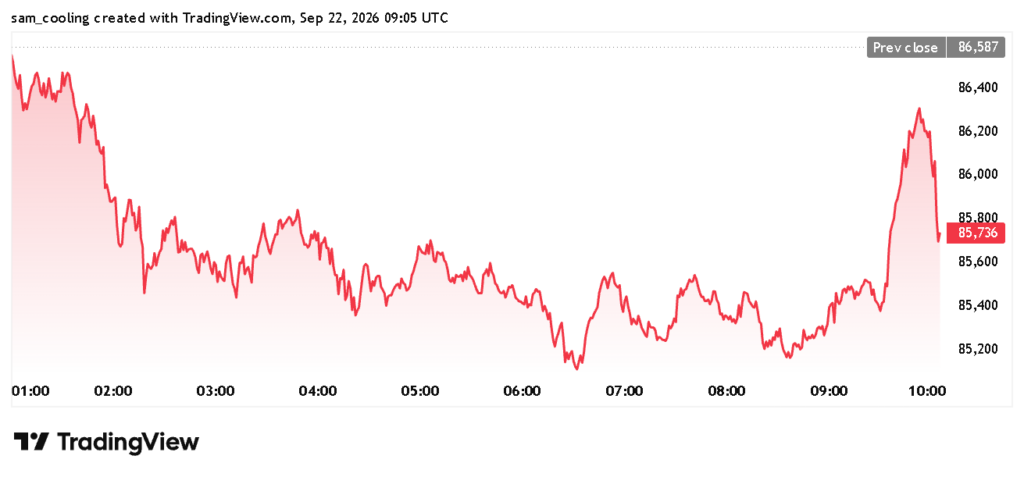
(Source – TradingView, BTC USD)
Why Is Oil Falling and Are Yields Back in Focus?
The catalyst was straightforward. Brent crude had topped $109 a barrel the previous week, and traders interpreted that spike as a direct threat to the inflation outlook – a shock that typically keeps central banks hawkish and long-dated yields elevated.
On Monday, Brent fell back below $100 on signs of potential de-escalation tied to Iran, and the 10-year Treasury yield eased to roughly 4.96% from a recent high of 5.04%.

(Source – OilPrice.com, WTI Crude)
This chain of events matters significantly for crypto. Bitcoin behaves as a risk-on asset that generally performs better when Treasury yields fall and weakens when they climb. Lower yields reduce the opportunity cost of holding a non-yielding asset and free up appetite for higher-beta positions.
The same logic pulled the S&P 500 up 1.5% and the Nasdaq Composite up 2.1% on the same session, providing evidence that this was a cross-asset move rather than something isolated to crypto desks.
It is worth treating the geopolitical trigger as a market read rather than a resolved outcome. Signs of de-escalation in the Strait of Hormuz are not a settlement. Although it is unlikely that President Trump will shake markets ahead of his meeting with Xi on Thursday, oil prices and yields remain historically elevated even after Monday’s pullback. This point is worth keeping in view alongside broader questions about how Federal Reserve policy shapes crypto-market sentiment and how Bitcoin’s price behavior compares with traditional havens.
What the Bitcoin Price Rally Proves: Why Is Bitcoin Going Up?
Related Posts
Oil prices, inflation expectations, and Treasury yields heavily influence Bitcoin’s price movements on a day-to-day basis, and Monday’s session serves as a clear illustration of that mechanism working in reverse from the prior week’s selloff.
Reported spot Bitcoin ETF inflows and short covering may have amplified the advance, adding fuel once the macro door opened, though no verified figures for either accompany that claim.
(Source – CoinGlass, BTC ETF)
What the move does not establish is a durable shift in the inflation cycle’s rate. A single session of falling yields and retreating crude is relief from a worsening shock, not confirmation that either has entered a sustained downtrend.
Bitcoin traders who treat Monday’s print as a green light for a new leg higher are underwriting a macro thesis that has not been tested beyond 24 hours.
The more durable read is narrower: crypto reconnected with broader risk appetite the moment the inflation-shock narrative lost steam, which is exactly what a risk-on asset is supposed to do.
Whether that connection holds depends on whether oil and yields keep drifting lower through the week or whether Monday turns out to be the low point of a temporary dip.
Bitcoin Clears $85,000, but Here’s Why the Range Still Matters
The intraday range tells its own story about how contested this level is. Bitcoin swung between $81,724 and $87,330 during the session, a spread of more than $5,600, before trading near $85,435, with a market capitalization of around $1.7 trillion. That is a wide band for a single day, consistent with a market still working out whether $85,000 is a floor or a ceiling.
Reclaiming $85,000 after eight months below it is a meaningful technical milestone, and Bitcoin reached its highest level since January.
For a closer look at how traders are treating the broader $80,000 level as support and what liquidation dynamics could mean for the next leg, see this breakdown of Bitcoin’s breakout above $80,000.
None of that changes the underlying dependency, though. Bitcoin rose as oil prices and Treasury yields retreated, and the range it traded in shows a market that has not yet decided whether Monday’s macro relief is the start of something or a one-off pause before the next data point resets the debate.
Don’t Miss: The Hottest Meme Coin Opportunities Silently Climbing the Crypto Ranks in September
The post Bitcoin Reclaims $85,000 as Oil and Yields Retreat appeared first on Cryptonews.
