Disclaimer: Information found on CryptoreNews is those of writers quoted. It does not represent the opinions of CryptoreNews on whether to sell, buy or hold any investments. You are advised to conduct your own research before making any investment decisions. Use provided information at your own risk.
CryptoreNews covers fintech, blockchain and Bitcoin bringing you the latest crypto news and analyses on the future of money.


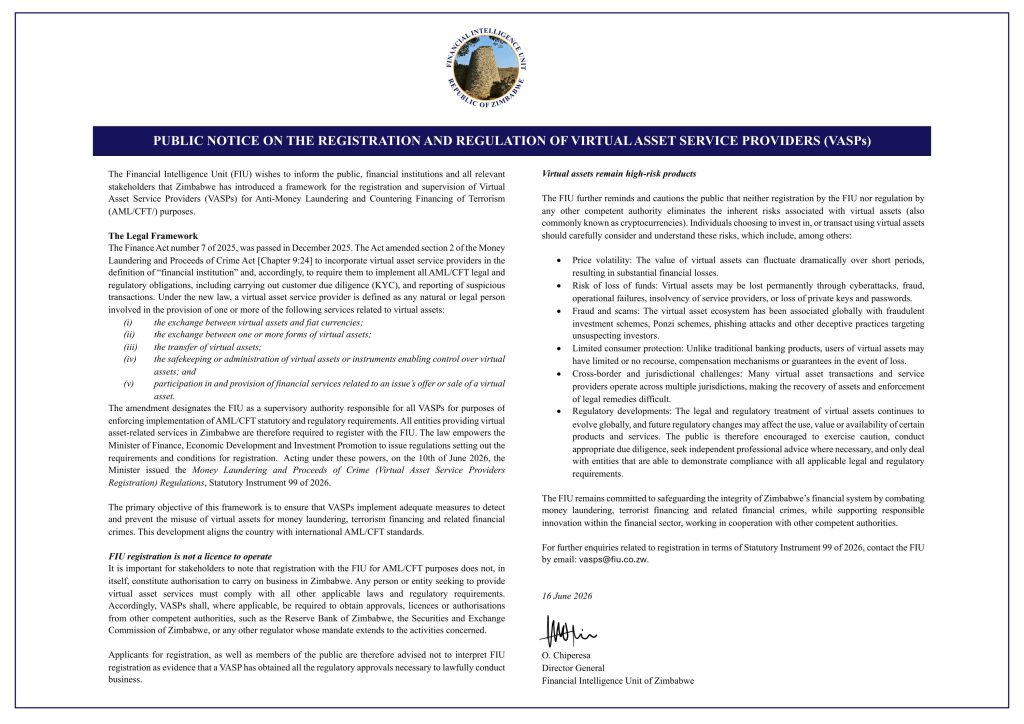
In the latest Bitcoin news, Zimbabwe’s Financial Intelligence Unit (FIU) issued a binding mandate on June 16, 2026, requiring all virtual asset service providers (VASPs) to register under Statutory Instrument (SI) 99 of 2026. This marks the country’s first dedicated crypto regulatory framework, taking effect immediately with criminal liability for non-compliance.
The framework formalizes what has been an eight-year grey market, largely driven by hyperinflation-induced demand for dollar-denominated alternatives to a succession of collapsing local currencies.
Source: Techzim
The regulatory event is straightforward. The question it reopens is not whether Zimbabwe can build the institutional scaffolding to supervise crypto, but whether there is a coherent case for the state itself to hold a Bitcoin reserve as a monetary anchor. The answer cuts both ways, and the arithmetic deserves a serious look.
SI 99 of 2026: What the FIU Mandate Actually Covers
The legal chain is worth anchoring precisely. The Finance Act No. 7 of 2025, passed in December 2025, amended Section 2 of Zimbabwe’s Money Laundering and Proceeds of Crime Act to incorporate VASPs into the statutory definition of a financial institution.
Acting under those expanded powers, the Zimbabwean Minister of Finance gazetted the Money Laundering and Proceeds of Crime (Virtual Asset Service Providers Registration) Regulations on June 10, 2026, codified as Statutory Instrument 99. The FIU issued its public enforcement mandate six days later.
The scope is broad and technology-neutral. Any entity exchanging cryptocurrencies for fiat, providing custody services, or facilitating crypto-related financial transactions must register. Notably, decentralization is not an exemption: if an operator can adjust smart contracts, route funds, or set transaction fees, the FIU considers them a VASP.
Related Posts
Under the new framework, any business involved in buying, selling, transferring, or safeguarding virtual assets must register annually with the Financial Intelligence Unit (FIU), the anti-money laundering arm of the Reserve Bank of Zimbabwe, at a fee of $500 per year.
— A&D Forensics (@ForensicsD) June 17, 2026
Registration carries a US$500 initial fee and US$400 annual renewals. It requires a locally incorporated entity, director background checks, KYC implementation, transaction monitoring, and compliance with the FATF Travel Rule.
The FIU was explicit about what registration does not provide. “Registration with the FIU for AML/CFT purposes does not, in itself, constitute authorization to carry on business in Zimbabwe,” the public notice stated.
VASPs still need separate operational approvals from the Reserve Bank of Zimbabwe (RBZ) or the Securities and Exchange Commission of Zimbabwe (SECZ), depending on their business model. This two-layer structure – crypto regulation for AML monitoring on one track, commercial licensing on another – is standard FATF architecture, and Zimbabwe is explicitly aligning itself with those international standards.
The historical context makes the policy shift sharper. In 2018, the RBZ issued Circular No. 2/2018, ordering all banks to cease servicing crypto exchanges and exit existing relationships within 60 days.
Local exchange Golix challenged the ban in court and obtained a provisional High Court order lifting it specifically against Golix, but broader regulatory uncertainty persisted for years.
SI 99 is effectively the formal end of that ambiguity, establishing a supervised integration model to replace blanket exclusion. This shift is driven by the recognition that hyperinflation and chronic currency instability had already pushed citizens into crypto regardless of official policy.
The post Zimbabwe Regulates Crypto Under SI 99: Could a Bitcoin Treasury Stabilize Its Economy? appeared first on Cryptonews.
