Disclaimer: Information found on CryptoreNews is those of writers quoted. It does not represent the opinions of CryptoreNews on whether to sell, buy or hold any investments. You are advised to conduct your own research before making any investment decisions. Use provided information at your own risk.
CryptoreNews covers fintech, blockchain and Bitcoin bringing you the latest crypto news and analyses on the future of money.


Hardware manufacturer Canaan has introduced a proof-of-concept initiative in Manitoba, Canada, utilizing liquid-cooled Bitcoin mining technology to harness waste heat and repurpose it for commercial agricultural use.
The 3 MW pilot program, revealed on Tuesday in collaboration with Bitforest Investment, examines whether high-density computing infrastructure can effectively act as a viable heat source in colder climates instead of releasing surplus energy into the atmosphere.
This initiative installs 360 Avalon A1566HA-460T units and four liquid-cooling modules at Bitforest’s tomato greenhouse over a 24-month period with a goal of achieving 95% uptime.
JUST IN:
@Canaanio collaborates with Bitforest in Manitoba for a 3.0 MW project utilizing Avalon computing systems to recycle heat for greenhouse heating. This 24-month pilot aims to improve energy efficiency and sustainability in agriculture, capturing 90% of server electricity. $CAN pic.twitter.com/UiBu5jFtss
— Bitcoin Mining Stock (@miningstockinfo) January 6, 2026
Canaan anticipates capturing approximately 90% of server electricity as heat, producing water temperatures that exceed 75°C at an all-in power cost of $0.035 per kilowatt-hour, which is particularly appealing for energy-intensive agricultural enterprises.
Transforming Mining Heat Into Agricultural Energy
The heat produced by the mining equipment will be collected through a closed-loop heat-exchange system and utilized to preheat intake water for the greenhouse’s electric boilers.
This method enables the facility to lower its direct heating expenses while ensuring optimal growing conditions for year-round crop cultivation.
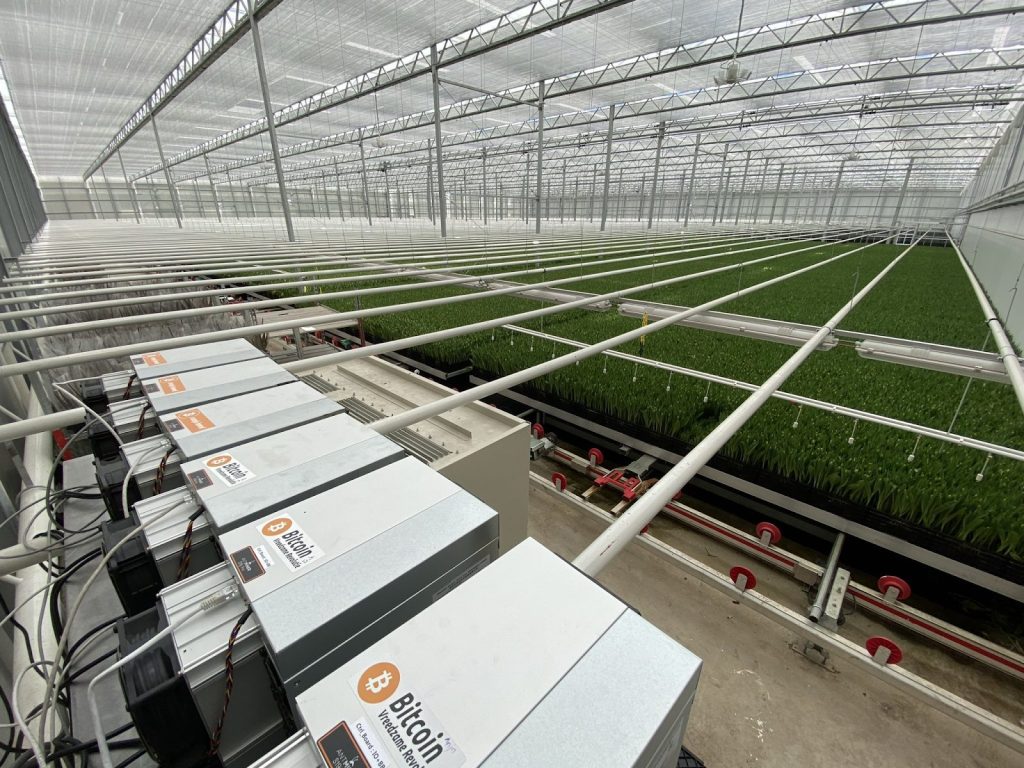 Bitcoin Mining Greenhouse. | Source: Bitcoinbloem
The project aims to evaluate heat-recovery efficiency, system reliability, and operational intensity while also assessing potential cost savings from eliminating industrial cooling towers.
In addition to energy reuse, Canaan intends to analyze key performance indicators for agricultural applications under real-world conditions, evaluating the commercial feasibility of merging Bitcoin mining with intensive farming practices.
Bitforest’s Manitoba facility specializes in year-round tomato production, making a reliable heat supply essential for sustaining production levels throughout the harsh Canadian winters.
The greenhouse application signifies a practical example of utilizing mining’s thermal output in northern climates where heating expenses represent a significant operational cost, potentially creating a blueprint for similar dual-purpose setups throughout Canada’s agricultural industry.
Institutional Pressure Accelerates Bitcoin Mining Sustainability Shift
Institutional interest is propelling Bitcoin mining’s green transformation, as stated by Kevin O’Leary, who informed Cryptonews that major buyers are increasingly demanding sustainably sourced coins.
Related Posts
O’Leary, speaking alongside Bitzero CEO Mohammed Bakhashwain, contended that Bitcoin mining has yielded net benefits for energy efficiency across the computing industry.
“When a coin is created from surplus electricity, as seen at Bitzero’s Norway site, it captures the value of that energy indefinitely,” he remarked. “It’s advancing computing and enhancing efficiency for everyone.”
Meanwhile, comprehensive research by independent analyst Daniel Batten disputes ongoing criticisms regarding Bitcoin mining’s impact on the grid.
His analysis, titled “Common Bitcoin Energy Misconceptions,” provides evidence from peer-reviewed studies and actual grid data that contradicts claims suggesting the technology burdens power systems and increases consumer costs.
New research indicates Bitcoin mining stabilizes electrical grids and lowers consumer costs through flexible demand rather than straining power systems. #Bitcoin #Mining https://t.co/4I4W2Lkcna
— Cryptonews.com (@cryptonews) January 5, 2026
Numerous independent studies affirm Bitcoin mining’s ability to stabilize electrical grids due to its interruptible nature, especially on networks transitioning towards greater reliance on variable renewable energy sources such as solar and wind.
A whitepaper from energy experts at Duke University concluded that Controllable Load Resources, including Bitcoin mining operations, aid in stabilizing grids and defer the costs associated with costly infrastructure upgrades.
Renewable Energy Now Powers Majority of the Bitcoin Network
Researchers from Cambridge University recently reported that renewable sources now supply over 52% of the Bitcoin network, an increase from 37% in 2022.
The Cambridge Centre for Alternative Finance study reveals that sustainable energy in Bitcoin mining comprises 9.8% nuclear and 42.6% renewables such as hydro, solar, and wind.
 Source: Cambridge Digital Mining Industry Report
Natural gas has supplanted coal as the primary energy source for the first time, now accounting for 38.2% of mining electricity compared to 25% three years ago.
Coal utilization has sharply decreased to 8.9% from 36.6% during the same timeframe, signifying one of the most remarkable energy transitions in any industrial sector.
This shift reflects miners’ movement towards more affordable, off-grid energy sources and signifies a significant turnaround in the industry’s carbon footprint.
The post Bitcoin Mining Gets Greener as Canaan Recycles Heat for Agriculture appeared first on Cryptonews.
