Disclaimer: Information found on CryptoreNews is those of writers quoted. It does not represent the opinions of CryptoreNews on whether to sell, buy or hold any investments. You are advised to conduct your own research before making any investment decisions. Use provided information at your own risk.
CryptoreNews covers fintech, blockchain and Bitcoin bringing you the latest crypto news and analyses on the future of money.


The Bitcoin mining sector is encountering a multitude of challenges, including escalating expenses, heightened competition, and challenging financial circumstances.
A recent Q3 Mining Report released by CoinShares provides insights into the current condition and future prospects of the industry.
Bitcoin Production Costs Reach Record Levels
A significant issue confronting miners is the surging cost of production. With mining difficulty increasing and hash prices falling, the average expense to generate one Bitcoin (BTC) has risen to $49,500, up from $47,200 in Q1.
This figure only accounts for cash costs. When including depreciation and stock-based compensation, the average cost estimate for producing one Bitcoin escalates to $96,100.
 Miners are experiencing a cost crisis, with the average expense to produce one BTC soaring to $49,500. Source: CoinShares
To alleviate these expenses, according to the report, miners are adopting energy-efficient methods such as curtailment and leveraging alternative energy sources. Nonetheless, some miners are finding it challenging to remain profitable in this climate.
The second challenge arises from the repercussions of the FTX collapse and rising interest rates, which have made it more difficult for miners to obtain funding. Consequently, many are seeking “alternative funding sources, often through share issuance.”
However, this approach has its drawbacks, as it can dilute shareholder value. “While this serves as a useful funding option for miners, it has been frustrating for investors due to significant shareholder dilution,” remarked CoinShares analysts James Butterfill and Max Shannon in the report.
Bitcoin Miners Confront Escalating Costs and Intense Competition
Butterfill and Shannon predict that Bitcoin’s hashrate will reach 765 EH/s by the conclusion of 2024, an increase from the current 684 EH/s, and could potentially attain a theoretical upper limit by 2050, which would reduce carbon emissions from flared gas by 63%. However, hash prices are anticipated to decrease until the next halving event in 2028:
“Hash prices, a measure of potential miner profitability, have also reached new lows this year, and with our forecasting tool, we expect them to continue to decline but remain range-bound between $50–32/PH/day until the next halving event in 2028.”
Related Posts
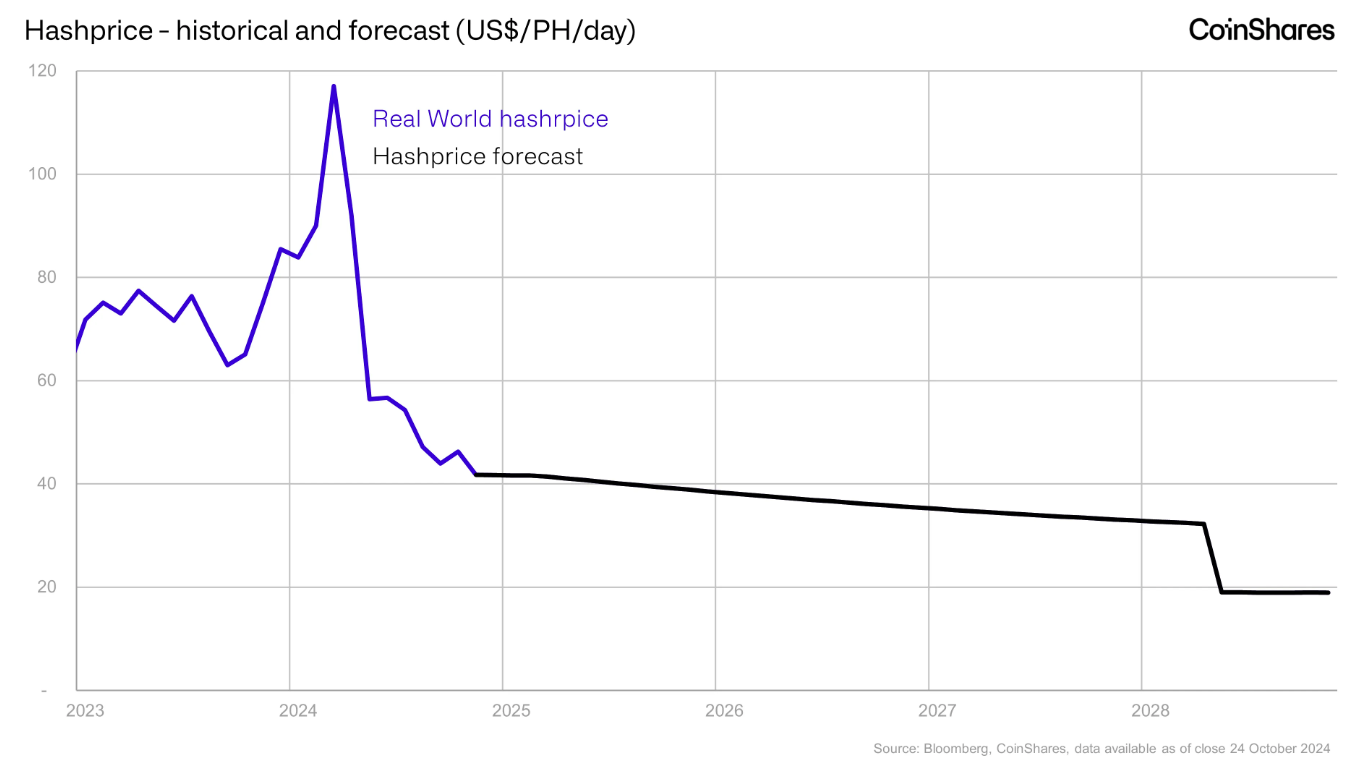 Hash prices are projected to decline until the next halving event in 2028. Source: CoinShares
Analysts also foresee that Bitcoin mining will become progressively competitive, with miners who maintain low costs and efficient operations gaining a substantial edge:
“Bitcoin mining’s long-term economics will likely face increasing pressure due to ongoing halvings and rising competition from self-miners, corporations, and even nation-states.”
Cormint, a private miner, emerged as the lowest-cost producer of Bitcoin with an expense of $16,700 per BTC. TeraWulf closely followed with a cost of $18,700 per Bitcoin, benefiting from fixed-rate power contracts and energy management strategies. The ability of these firms to effectively manage costs will be crucial for their long-term viability, according to the report.
In contrast, Riot reported the highest cost at $65,900 per Bitcoin. However, Riot generated $13.9 million in power curtailment credits in Q2 2024, which contributed to reducing its net power costs.
Can Bitcoin Mining Endure the Challenges?
The CoinShares report also examines how miners are tackling current obstacles.
Some Bitcoin miners, including Riot, Cleanpark, and Bitfarms, are adopting a dual strategy—capital efficiency and diversification—by emphasizing efficient growth and focusing on acquiring pre-built assets instead of constructing new ones.
Other miners, such as Core Scientific, are exploring artificial intelligence (AI) infrastructure to stabilize revenues and lessen reliance on the fluctuating price of Bitcoin.
The analysts concluded that the future of Bitcoin mining hinges on effective cost management and capital allocation. Miners with strong strategies will be better equipped to navigate the increasing challenges of mining and market fluctuations. The report states:
“Publicly traded mining companies will need to cut costs and maintain profitability for several reasons: 1) to create value for shareholders, 2) reduce dependency on equity capital markets and create high hurdles for shareholder dilution, and 3) sustain capital expenditure (capex) efforts for future growth.”
The post Bitcoin Miners Dig Deep Amid Rising Costs in Q3 – CoinShares appeared first on Cryptonews.
