Disclaimer: Information found on CryptoreNews is those of writers quoted. It does not represent the opinions of CryptoreNews on whether to sell, buy or hold any investments. You are advised to conduct your own research before making any investment decisions. Use provided information at your own risk.
CryptoreNews covers fintech, blockchain and Bitcoin bringing you the latest crypto news and analyses on the future of money.


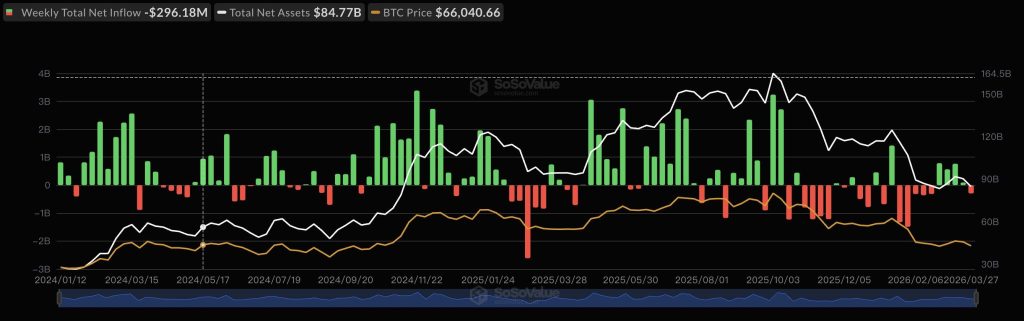
Between March 24 and March 27, U.S. spot Bitcoin ETFs experienced approximately $296 million in net outflows, as a widespread risk-averse shift took hold of global markets. The turnaround was abrupt – the week began with $167.2 million in inflows, only for sentiment to plummet by the end of the week.
Friday marked a significant downturn: $225.5 million in outflows in a single day, primarily driven by substantial redemptions from BlackRock’s IBIT. The total for the week represents one of the most significant instances of institutional de-risking since the launch of ETF products in January 2024.
Key Takeaways
- $296M in net outflows recorded across U.S. spot Bitcoin ETFs from March 24–27, with IBIT redemptions accounting for $225.5M on Friday alone.
- Macro pressures are intensifying – analysts have cited factors such as triple-digit oil prices, diminishing hopes for a ceasefire, and end-of-quarter rebalancing.
- BTC price support is identified at $65,600–$65,107; a drop below this range would indicate structural decline rather than tactical adjustments.
Discover: The best pre-launch token sales
ETF Flow Data Indicates Institutional De-Risking – But Is It Structural?
On Thursday, March 26, a total of $171.12 million exited across all 11 spot Bitcoin ETF products, marking the largest single-day outflow in over three weeks. BlackRock’s IBIT lost $41.92 million that day, while Fidelity’s FBTC, Grayscale’s GBTC, Bitwise’s BITB, and ARK’s ARKB each saw redemptions ranging from $20–30 million. The widespread nature of these outflows is significant: this was not a fund-specific issue but rather a coordinated institutional de-risking across multiple products.
This distinction is important. When outflows are concentrated in a single fund, the implications are operational or reputational. However, when all major products experience simultaneous selling, the signal is macroeconomic.
 Source: SoSoValue
Josh Gilbert, a market analyst at eToro, stated, “Risk-off is clearly the mood amongst markets,” referencing Bitcoin’s decline to a three-week low and the S&P 500’s fifth consecutive weekly loss – its longest losing streak since 2022. “The macro forces working against it are compounding,” he noted. “Triple-digit oil is fueling inflation concerns, which pushes rate cut expectations further away, thereby removing the very catalyst that risk assets need to stabilize.”
Bitcoin’s drop below $67,000 amid rising treasury yields had already indicated a weakening risk appetite before the ETF data confirmed it. Geopolitical tensions added to the pressure – comments from President Donald Trump to the Financial Times, suggesting the U.S. could “take the oil in Iran” and potentially seize Kharg Island, unsettled both commodity and risk markets.
Related Posts
Peter Chung, head of research at Presto Labs, remarked that the risk-off sentiment was the main driver, although he observed that the outflow “doesn’t seem that dramatic compared to recent trends.”
Pratik Kala, head of research at Apollo Crypto, echoed this sentiment, describing the $290 million figure as “quite normal” and attributing it to “risk-off sentiment and end-of-quarter rebalancing.”
Long-term holder balances remain stable, suggesting tactical adjustments rather than a structural exit from Bitcoin exposure. Cumulative ETF investments had exceeded $2 billion in recent weeks prior to this decline, highlighting the rapid pace of institutional adoption through early 2026.
Can Bitcoin ETFs Demand Recover – Or Is More Outflow Pressure Coming?
The price structure provides traders with a clear framework. Key support is identified at $65,631–$65,107, the lows from February 12–19, with a secondary support level at $65,619 – the low from March 8.
A decisive break below $65,600 would shift the interpretation from tactical reset to something more concerning for demand structure. Resistance is positioned at $71,880, the high from March 25.
 Bitcoin (BTC)24h7d30d1yAll time
Gilbert highlighted a ceasefire as the most immediate catalyst for a “strong relief rally,” but cautioned that without credible de-escalation, markets may face “more choppy sessions ahead.” The Fed rate outlook is the second variable – geopolitical factors impacting Bitcoin are compressing any near-term prospects for policy relief.
Three scenarios are currently in play. A ceasefire or dovish Fed signal could reignite inflow momentum, allowing BTC to reclaim the $71,000 range. The base case suggests choppy, range-bound flow data through April as macro uncertainty continues and ETF demand remains subdued. The bear case indicates that a break below $65,100 could trigger forced selling and a second wave of institutional outflows that surpasses last week’s total.
The week’s reversal from Monday to Friday – shifting from $167.2 million inflows to $225.5 million in single-day outflows – serves as a clear indication that institutional conviction is currently conditional, not structural. Traders navigating this environment should monitor weekly ETF flow totals as a leading indicator for BTC price direction, rather than a lagging one.
Discover: The best crypto to diversify your portfolio with
The post Bitcoin ETFs See $290M in Outflows as Risk-Off Sentiment Intensifies appeared first on Cryptonews.
