Disclaimer: Information found on CryptoreNews is those of writers quoted. It does not represent the opinions of CryptoreNews on whether to sell, buy or hold any investments. You are advised to conduct your own research before making any investment decisions. Use provided information at your own risk.
CryptoreNews covers fintech, blockchain and Bitcoin bringing you the latest crypto news and analyses on the future of money.


Key Takeaways:
- Bitcoin ETFs have amassed $121 billion in total assets since their inception one year ago.
- The majority of these assets are concentrated in just three funds – BlackRock’s IBIT, Fidelity’s FBTC, and Grayscale’s GBTC.
- Nearly $40 billion in fresh capital has been injected into all 12 spot Bitcoin ETFs.
With the surge in crypto ETF filings following Gary Gensler’s preemptive departure, it is pertinent to evaluate the performance of Bitcoin (BTC) exchange-traded funds one year after receiving SEC approval.
Gensler, the former Chair of the U.S. Securities and Exchange Commission (SEC), was known for his critical stance towards cryptocurrency. However, he was compelled to approve the ETFs after losing a lawsuit filed by Grayscale Investments.
On January 11, 2024, the first-ever spot Bitcoin exchange-traded funds in the United States commenced trading, with Gensler issuing a final warning that Bitcoin remains a “volatile asset” and that investors should exercise caution. Many chose to disregard his advice.
The launch was hailed as a significant milestone for the leading crypto asset, facilitating Bitcoin’s broader acceptance on Wall Street and paving the way for the introduction of additional crypto-based exchange-traded funds.
These products typically allow investors to gain exposure to Bitcoin without directly owning the asset. To date, there are 12 Bitcoin funds, including BlackRock’s iShares Bitcoin Trust (IBIT), Grayscale’s GBTC, and Fidelity’s FBTC.
Bitcoin ETFs Experience Record Inflows
The Bitcoin ETFs began trading one year ago with a total of $29 billion in assets, attributed to the conversion of Grayscale’s GBTC. As of January 29, the total assets under management (AUM) across all funds had risen to $121 billion, according to Sosovalue data.
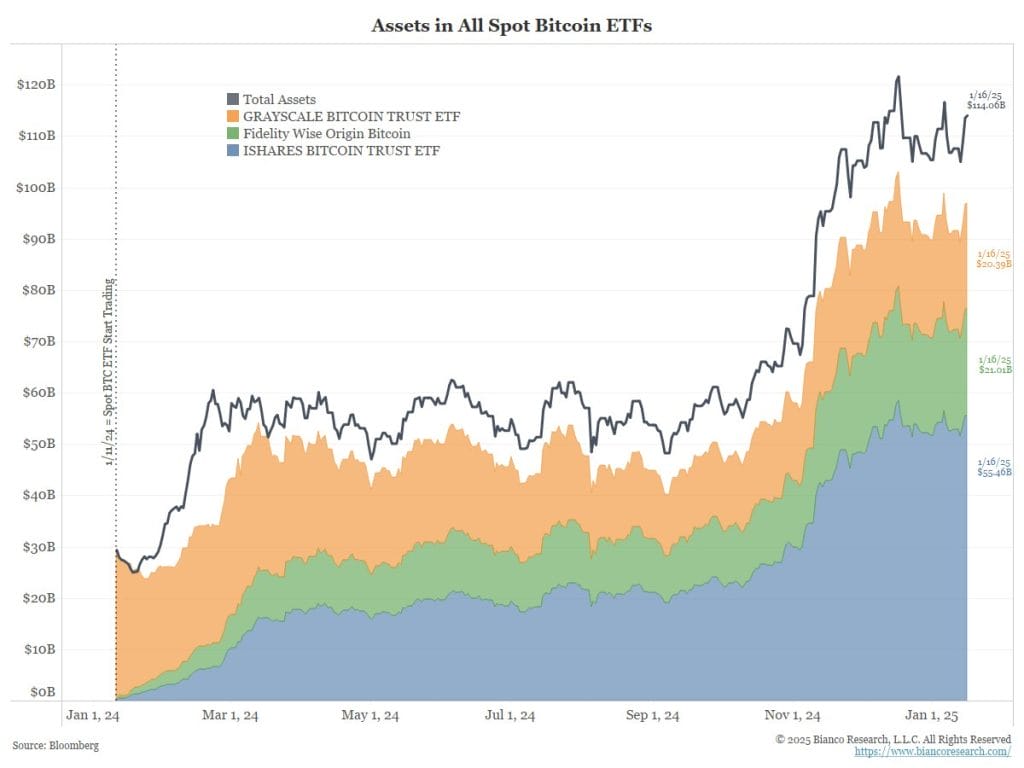
In early September, total assets dropped 26% to a three-month low of $46 billion, raising concerns that BTC ETFs had not become the vehicles for traditional finance or “boomer” adoption that many anticipated.
During that period, net outflows averaged over $1 billion in just one week. “It’s not an adoption vehicle,” crypto analyst and macro investment researcher Jim Bianco remarked on X at the time. “Instead, [it is] a minor tourist tool and on-chain is reverting to TradFi.”
Since then, the ETFs have witnessed a significant surge in new investments, with total net inflows nearing $40 billion as of this writing. Notable daily net inflows of $987 million and $908 million were recorded on January 6, 2025, and January 3, 2025, respectively.
As Bitcoin surpassed the psychological $100,000 threshold in December, the rally initiated a 16-day streak of net inflows from December 2 to December 18.
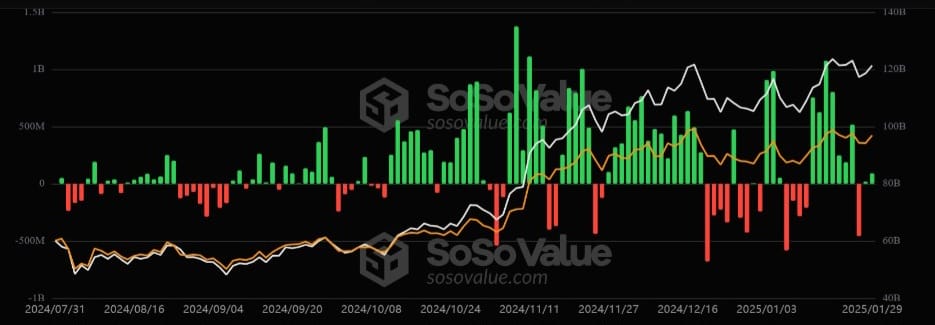 Spot Bitcoin ETFs daily inflows. Source: Sosovalue
On-chain holdings are also approaching record highs. Since the September lows, on-chain holdings of all spot Bitcoin ETFs have increased from approximately 933,000 BTC to 1,197,000 BTC as of press time, according to data from Dune Analytics.
This represents an increase of over 28% within five months, indicating that investors accumulated Bitcoin as prices declined. The on-chain holdings also account for roughly 6% of Bitcoin’s total market capitalization.
Matteo Greco, a research analyst at Canada Stock Exchange-listed crypto firm Fineqia, believes the heightened inflows signal a resurgence of investor confidence in Bitcoin.
“The strong inflows in 2024 [~ $36 billion] created a self-reinforcing cycle – rising demand led to price appreciation, which in turn generated further inflows,” Greco told Cryptonews, adding:
“These exchange-traded funds have played a crucial role in accelerating digital asset adoption, broadening the investor base, and enhancing market transparency, security, and liquidity.”
Substantial Assets
The majority of the $121 billion in assets under management are concentrated in just three funds – BlackRock’s IBIT (~$59.9 billion), Fidelity’s FBTC (~$22 billion), and Grayscale’s GBTC (~$21 billion).
In terms of total net inflows, IBIT also leads, with over $39.8 billion in new investments in the product since January 2024, according to Sosovalue. BlackRock’s Bitcoin ETF is particularly noteworthy.
As Greco highlighted, IBIT reached $10 billion in total assets in record time, achieving this milestone in just 37 trading days. By the end of December, it had expanded to over $50 billion in assets. No exchange-traded fund has ever had a more successful debut, experts assert.
Related Posts
Competitors FBTC and GBTC have reported total net inflows of $12.8 billion and $21.9 billion, respectively, since trading commenced one year ago.
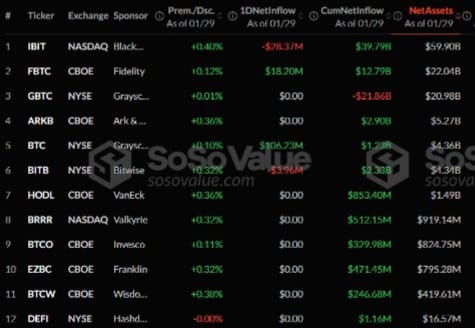 Spot Bitcoin ETFs net assets. Source: Sosovalue
Bloomberg senior ETF analyst Eric Balchunas referred to the BTC exchange-traded funds as the “most successful ETFs in history.”
In a previous post on X, Balchunas noted that the increase in net inflows indicates that institutional investors have confidence in Bitcoin, contrary to claims that the funds had failed to attract Wall Street wealth advisors.
Moreover, investors who allocated funds to the Bitcoin ETFs have realized some significant gains. Bianco stated that the dollar-cost average purchase price of the ETFs is $74,300 (represented in the chart below as a blue line), reflecting an unrealized gain of $12.7 billion (bottom panel).
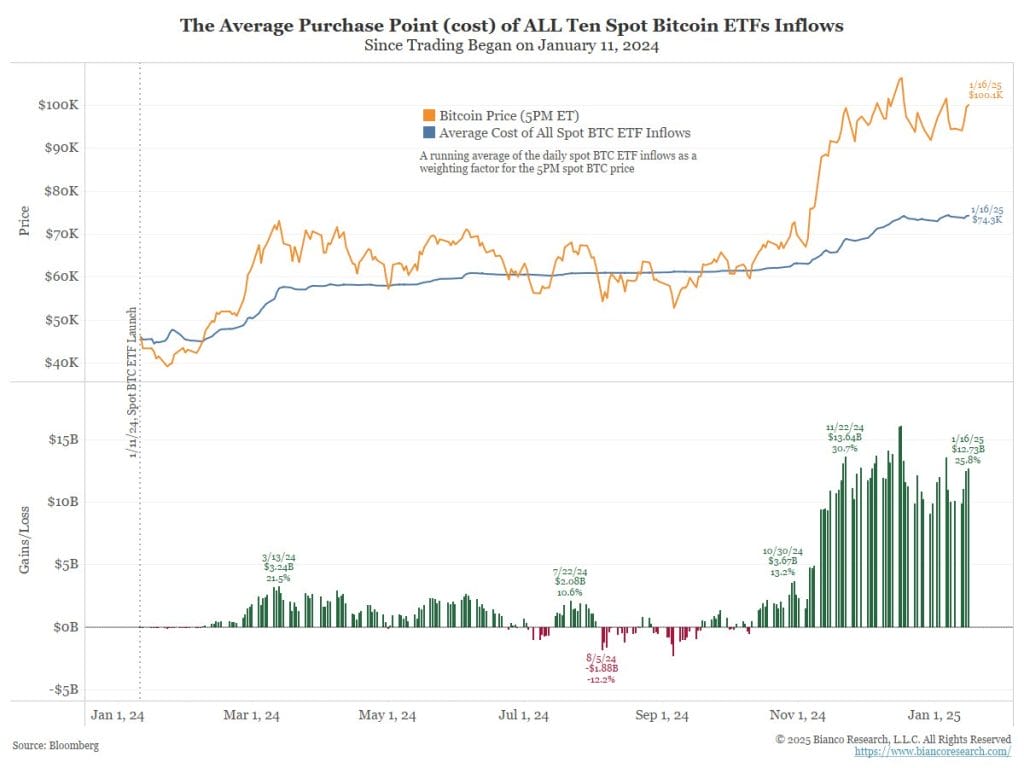
“All these gains occurred following the [U.S. presidential] election,” Bianco, who is also the founder of Bianco Research, posted on X. However, he cautioned that the unrealized gains could be “erased” if the BTC price falls to $68,000. BTC is currently trading at $105,000.
Balchunas, the Bloomberg analyst, stated that the spot Bitcoin exchange-traded funds started 2025 “with a bang,” recording $4.2 billion in inflows during the first three weeks of January. At that time, this accounted for approximately 6% of all ETF flows in the U.S., he detailed.
He noted that BTC ETFs have achieved a return of over 127% since their launch one year ago. The products have also surpassed Environmental, Social, and Governance ETFs in assets ($117 billion) and had approximately the same AUM as gold spot ($121 billion) on January 24.
Institutional Bitcoin ETF Adoption Faces Challenges—Or Does It?
Bianco’s analysis has not always endeared him to Bitcoin enthusiasts.
For instance, when the ETFs experienced significant outflows in the eight days leading to September 9 – totaling $1 billion – with traditional finance players leading the sales, he characterized this as evidence of the ETFs’ failure to attract institutional capital.
He supported his assertions with data. Bianco pointed to the average trade size of the ETFs, which fell to a six-month low of $12,000 at that time. He stated that the data indicates that the primary purchasers of Bitcoin ETFs are small retail investors, not institutional ones.
Compared to other exchange-traded funds, the average trade size of the Bitcoin ETFs “is a small fraction” of their sizes. For example, the average trade size of the GLD exchange-traded fund, which tracks a gold index, is approximately $70,000, according to data from Bianco Research.
One of the key indicators of the perceived failure of Bitcoin ETFs to attract mainstream traditional finance adoption is the composition of their holdings. Bianco noted that investment wealth advisors hold only 9% of the Bitcoin ETFs’ outstanding shares, with an additional 12% held by hedge funds. This means that 80% of the holdings are not from traditional finance clients.
80% of the buying is coming from self-directed online brokerage accounts.
It’s not coming from boomers through wealth managers.— Jim Bianco (@biancoresearch) January 17, 2025
He stated that this is supported by data from asset manager BlackRock, which revealed that 80% of inflows into its IBIT exchange-traded fund “are from self-directed online accounts.”
Nonetheless, Balchunas dismissed these concerns. According to the analyst, 1,000 institutions held Bitcoin ETFs on their books at the end of September, which was “unprecedented.”
BlackRock’s IBIT alone had over 660 holders, the analyst stated, with 20% of its shares reportedly held by large advisors and institutions. Balchunas anticipates that IBIT’s institutional holders will double this year.
Another point regarding the holders. Bitcoin ETFs collectively have over 1,000 institutional holders after just two 13F periods. That’s beyond unprecedented. $IBIT alone has 661 holders with 20% of its shares reported held by institutions and large advisors, potentially heading to 40% in…
— Eric Balchunas (@EricBalchunas) September 9, 2024
Greco, the Fineqia research analyst, stated that while the outlook for “spot Bitcoin exchange-traded funds and other digital asset ETFs remains optimistic, predicting the next phase is always challenging.”
“As with all risk-on markets, downturns are inevitable,” Greco told Cryptonews. “A broader market correction in equities or other asset classes would impact BTC ETFs, causing temporary negative flows.”
He added that despite short-term volatility, the long-term trajectory for these products “remains promising, with the industry continuing to grow and institutional involvement steadily increasing.”
The post Bitcoin ETFs: One Year On, Have They Lived Up to the Hype? appeared first on Cryptonews.
