Disclaimer: Information found on CryptoreNews is those of writers quoted. It does not represent the opinions of CryptoreNews on whether to sell, buy or hold any investments. You are advised to conduct your own research before making any investment decisions. Use provided information at your own risk.
CryptoreNews covers fintech, blockchain and Bitcoin bringing you the latest crypto news and analyses on the future of money.


Bitcoin is struggling to pass its most significant safe-haven evaluation of 2026 as the crisis in the Strait of Hormuz drives oil prices toward $113. Rather than decoupling, BTC is exhibiting a concerning 0.68 positive correlation with crude oil prices, indicating that digital gold is presently behaving like a risk asset.
Key Takeaways:
- Correlation Increase: The correlation coefficient between Bitcoin and WTI has reached 0.68, a significant change from historical averages that are typically below 0.3.
- Oil Influence: Goldman Sachs anticipates that Brent crude will average $110 through April if the flow through Hormuz remains at 5% capacity.
- BTC Level to Monitor: Bulls need to protect the $65,000 support level to avert a technical decline toward $58,000.
The Correlation Dilemma: How $100 Oil Affects Bitcoin This Time
The Strait of Hormuz is constricting 20% of the global oil supply, and the cryptocurrency market is responding with volatility instead of affirmation. On Monday, Goldman Sachs analysts significantly increased their forecasts, predicting Brent to average $110 in March and April. Futures have already reacted, with Brent reaching $113.32 and WTI rising to $101.01 following President Trump’s ultimatum to Tehran.
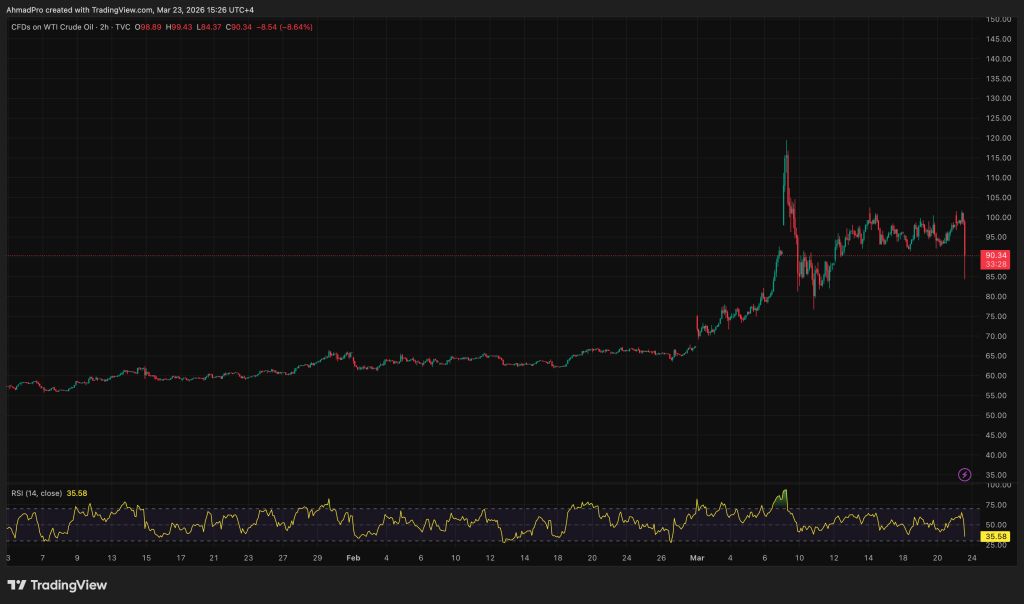
Traditionally, such geopolitical turmoil enhances the digital gold narrative. However, the data indicates a shift in this trend. The Bitcoin correlation with oil prices has surged to 0.68. The reason? The impact of oil prices on crypto is now conveyed through inflation expectations. $110 oil guarantees persistent inflation. Persistent inflation compels the Federal Reserve to maintain elevated rates. High rates diminish the global liquidity that Bitcoin relies on.
Bitcoin lags behind money supply growth and faces challenges when energy prices rise. The dynamics are harsh: increasing energy costs impose a burden on both consumers and miners. If Hormuz flows remain at 5% through April 10, as per Goldman’s base case, we could be entering a stagflationary scenario that adversely affects all risk assets, including crypto.
Related Posts
The trading patterns reveal much. Bitcoin is not rising due to “war fear”; it is declining because of “liquidity fear.” Until the correlation dissipates or oil prices stabilize, the potential for gains above $70,000 is restricted by macroeconomic challenges.
Can Whales Mitigate the Macro Risk Shock?
While the paper market is in turmoil, on-chain flows indicate a divergence in sentiment. Retail sentiment has become fragmented, yet whale wallets holding between 1,000 to 10,000 BTC continue to accumulate in the $65,000 to $70,000 range.
This suggests that institutional investors perceive the macro risk as temporary or anticipate a policy response, such as a significant liquidity injection, to address the oil crisis.
 Bitcoin (BTC)24h7d30d1yAll time
Morgan Stanley’s recent ETF application reinforces this institutional support. The necessary infrastructure is being developed regardless of where crude prices head next week. However, price movements adhere to levels, not narratives. The 0.68 correlation indicates Bitcoin is susceptible to any further escalation in the Middle East.
The threshold for invalidating the bear case is evident. If Bitcoin can reclaim $72,000 while oil stays above $100, the decoupling hypothesis could be revived. Until that occurs, trading involves a risk asset linked to energy markets.
The post Bitcoin ‘Digital Gold’ vs. Hormuz Crisis: Is BTC Decoupling? appeared first on Cryptonews.
