Disclaimer: Information found on CryptoreNews is those of writers quoted. It does not represent the opinions of CryptoreNews on whether to sell, buy or hold any investments. You are advised to conduct your own research before making any investment decisions. Use provided information at your own risk.
CryptoreNews covers fintech, blockchain and Bitcoin bringing you the latest crypto news and analyses on the future of money.


Binance is considering the possibility of reinstating stock trading on its platform, four years after halting the service, as reported by The Information.
The largest cryptocurrency exchange globally eliminated stock tokens in 2021 due to regulatory pressures, but it now seems poised to re-enter the equity markets as rivals move towards integrated investment platforms.
This development coincides with a wider industry trend towards “everything exchanges” that merge cryptocurrency and traditional assets into a single platform.
Coinbase started to introduce stock trading to select users earlier this month while positioning itself against conventional brokerages and its competitor Robinhood, which has provided combined stock and crypto trading for several years.
JUST IN: Binance is contemplating the revival of stock trading, according to The Information.
— Watcher.Guru (@WatcherGuru) January 23, 2026
Exchanges Compete to Create Unified Platforms
Binance’s possible return to stock trading occurs as various cryptocurrency platforms hasten efforts to integrate digital assets with traditional financial offerings.
Coinbase CEO Brian Armstrong defended his company’s venture into equities in a recent interview with Fortune, asserting that the exchange is well-positioned to lead as financial assets transition to blockchain-based infrastructure.
“We possess extensive expertise in crypto. We are the most trusted name in the crypto space,” Armstrong stated, emphasizing that Coinbase’s goal is to connect traditional finance with cryptocurrency while promoting tokenized equities.
The exchange currently provides stocks via Apex Fintech Solutions, intending to broaden access to all users in the upcoming weeks, although fully tokenized equities are still years away pending coordination with the SEC.
Austria’s Bitpanda also revealed on Wednesday that it plans to launch a unified investment platform on January 29, combining stocks, ETFs, cryptocurrencies, and precious metals within a single application.
This enhanced platform will feature over 10,000 stocks and ETFs with a flat trading fee of €1, alongside zero custody fees and no payment for order flow.
Infrastructure Progressing Towards On-Chain Markets
Conventional market operators are simultaneously advancing blockchain-based trading frameworks.
Earlier this week, the New York Stock Exchange announced intentions to develop a platform for 24/7 trading and on-chain settlement of tokenized securities, integrating its Pillar matching engine with blockchain-driven post-trade systems across various blockchains.
“For more than two centuries, the NYSE has revolutionized market operations,” stated Lynn Martin, President of NYSE Group.
Related Posts
She remarked that the exchange is now pioneering the industry towards entirely on-chain solutions that merge trust, regulatory compliance, and modern technology.
On January 22, Binance founder Changpeng “CZ” Zhao also mentioned during a World Economic Forum panel in Davos that he is in discussions with over a dozen governments to tokenize state-owned assets as the next significant step in crypto adoption.
Binance’s @cz_binance confirms negotiations with governments to tokenize national assets on-chain, branding it the subsequent phase after exchanges and stablecoins. #Crypto #Tokenization https://t.co/1mv1mt5WwR
— Cryptonews.com (@cryptonews) January 22, 2026
Zhao framed tokenization as the third phase following exchanges and stablecoins, explaining that governments aim to directly capture the financial benefits from their own assets instead of outsourcing value creation to private intermediaries.
Regulatory Clarity Enhances Institutional Momentum
Last month, the Securities and Exchange Commission (SEC) issued a rare no-action letter to the Depository Trust and Clearing Corporation, permitting it to move forward with a controlled tokenization program encompassing U.S. Treasuries, ETFs, and Russell 1000 equities.
The service is set to launch in late 2026 and will function on approved blockchains, with tokenized assets holding the same legal rights as traditional securities.
Market data and institutional analyses indicate this regulatory momentum is already translating into tangible growth.
Earlier this month, venture capital firm Andreessen Horowitz identified stablecoins, real-world asset tokenization, and privacy infrastructure as pivotal elements shaping the crypto landscape in 2026.
These observations arise as monthly transfer volumes for tokenized equities have decreased by approximately 17% over the past 30 days, totaling around $2.05 billion, according to rwa.xyz.
However, the count of Monthly Active Addresses has surged nearly 98%, with over 98,167 addresses active in the last month alone.
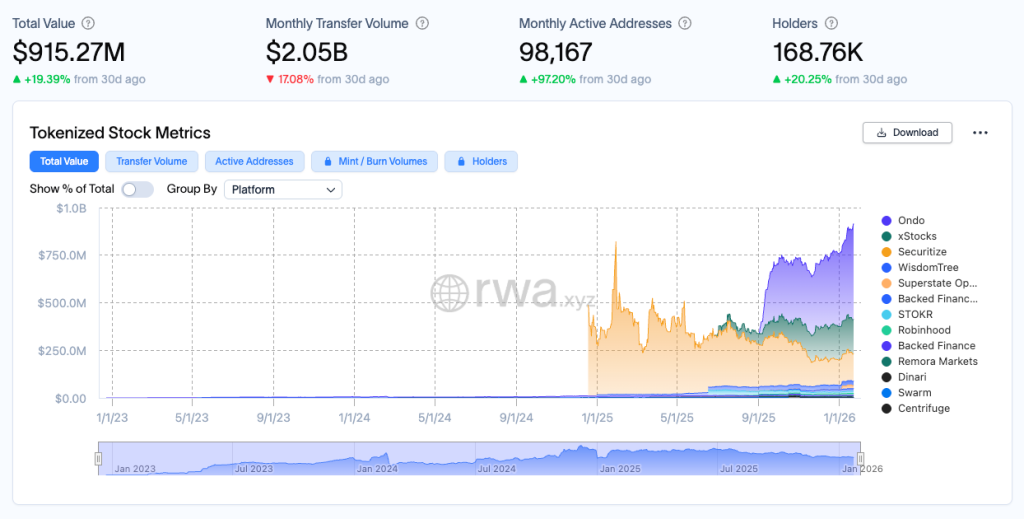 Source: RWA.xyz
David Duong, Coinbase’s head of investment research, also recently remarked that improvements in regulatory clarity and increasing institutional involvement are creating favorable conditions moving forward.
“We anticipate these dynamics to amplify in 2026 as ETF approval timelines shorten, stablecoins assume a larger role in delivery-vs-payment frameworks, and tokenized collateral gains wider recognition,” Duong wrote in a year-end outlook.
Meanwhile, Binance confirmed today that it has submitted a Markets in Crypto-Assets license application in Greece as cryptocurrency firms across Europe hurry to obtain regulatory approval before the transitional deadlines in June 2026 expire.
The post Binance Plans to Reintroduce Stock Trading Four Years After Removal appeared first on Cryptonews.
