Disclaimer: Information found on CryptoreNews is those of writers quoted. It does not represent the opinions of CryptoreNews on whether to sell, buy or hold any investments. You are advised to conduct your own research before making any investment decisions. Use provided information at your own risk.
CryptoreNews covers fintech, blockchain and Bitcoin bringing you the latest crypto news and analyses on the future of money.


The Bank of England will implement “temporary” restrictions on stablecoin holdings to safeguard credit availability, although Deputy Governor Sarah Breeden did not indicate when these limits might be removed, as confirmed on Tuesday.
The central bank intends to set limits of £10,000-£20,000 for individuals and £10 million for businesses concerning systemic stablecoins utilized for payments.
Breeden remarked, “we would anticipate lifting the limits once we determine that the transition no longer poses a risk to the provision of finance to the real economy.”
Nonetheless, the consultation document expected later this year does not provide a timeline or criteria to define when that threshold would be achieved.
This strategy differs from that of the U.S., where Congress enacted the GENIUS Act in July, establishing federal regulation for stablecoins without ownership limits.
Tom Duff Gordon, Vice President of International Policy at Coinbase, previously informed the Financial Times that “imposing caps on stablecoins is detrimental to UK savers, harmful to the City, and unfavorable for sterling,” highlighting that no other significant jurisdiction has considered caps necessary.
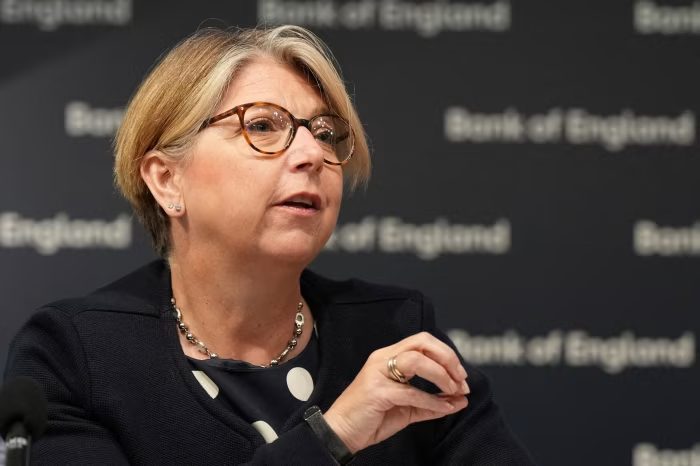 Deputy Governor Sarah Breeden | Source: WSJ
Deposit Outflows Threaten Credit
Breeden indicated that the Bank of England will offer accounts to systemic stablecoin issuers, enabling them to maintain reserves at the central bank and earn returns by investing a portion in short-term UK government securities.
The consultation will detail a potential liquidity facility to assist solvent issuers in monetizing assets during periods of redemption pressure.
Breeden stressed that this stance positions the Bank as “banker to systemic issuers,” thus reducing dependence on commercial banks for accounts.
This arrangement alleviates financial stability risks linked to the interconnectedness observed during Circle’s USDC de-pegging in March 2023, following the collapse of Silicon Valley Bank.
Earlier this month, Governor Andrew Bailey explained that swift deposit outflows into stablecoins could lead to “a precipitous drop in credit for businesses and households” if banks are unable to rapidly scale wholesale financing from insurers and funds.
In a conversation with Cryptonews, Varun Paul, former Head of the Fintech Hub at the BoE, noted that Bailey is “lifting the hood on the deep economic and policy questions” surrounding stablecoins for the first time, including whether a greater separation between payments and credit creation is sustainable.
Paul further mentioned that Bailey “opened the door to utilizing some regulatory features for non-bank stablecoin issuers—perhaps a stablecoin could have FSCS protection if the issuer contributes to the scheme.”
Related Posts
The Bank intends to broaden settlement assets in its Digital Securities Sandbox to encompass regulated stablecoins.
Fifteen firms, including Euroclear, HSBC, J.P. Morgan, and the London Stock Exchange Group, are preparing to establish trading venues potentially as soon as next year.
Industry Pushback Intensifies
limits simply don’t work in practice” because stablecoin issuers are unable to monitor token holders in real-time.
Enforcing caps would necessitate expensive systems, such as digital IDs or continuous wallet coordination.
The restrictions exacerbate tensions between the Bank and Treasury as Chancellor Rachel Reeves pledged back in July to “drive forward developments in blockchain technology, including tokenised securities and stablecoins.”
While the UK government faces criticism for its regulatory approach, Reform UK leader Nigel Farage has recently vowed to reduce crypto capital gains tax from 24% to 10% and create a £5 billion Bitcoin reserve if elected, labeling the Bank’s stablecoin caps “frankly ridiculous.” Reform currently leads in several polling forecasts.
Nigel Farage proposes UK Bitcoin reserve with £5B in seized assets and cutting crypto tax from 24% to 10% as Reform becomes first major party accepting crypto donations.#UK #Bitcoinhttps://t.co/w67fZLQTDR
— Cryptonews.com (@cryptonews) October 13, 2025
 Nigel Farage proposes UK Bitcoin reserve with £5B in seized assets and cutting crypto tax from 24% to 10% as Reform becomes first major party accepting crypto donations.#UK #Bitcoinhttps://t.co/w67fZLQTDR
Breeden acknowledged the challenges of coordination, stating that the UK government will appoint a Digital Markets Champion to oversee private sector initiatives.
The government is also set to issue a digital gilt instrument on a Sandbox platform to stimulate the adoption of DLT.
She noted that the Bank’s new wholesale payments infrastructure, RT2, already facilitates settlement using tokenized central bank money.
Synchronization functionality will be introduced next year in the Synchronization Lab for testing real-world applications prior to its production deployment.
Importantly, this global adoption is on the rise as the worldwide stablecoin market has surpassed $300 billion; however, sterling-pegged tokens remain below $580,000, in contrast to $473 million in euro-linked stablecoins, according to DeFiLlama.
 Source: DefiLlama
The post Bank of England Promises ‘Temporary’ Stablecoin Caps – But Sets No End Date appeared first on Cryptonews.
