Disclaimer: Information found on CryptoreNews is those of writers quoted. It does not represent the opinions of CryptoreNews on whether to sell, buy or hold any investments. You are advised to conduct your own research before making any investment decisions. Use provided information at your own risk.
CryptoreNews covers fintech, blockchain and Bitcoin bringing you the latest crypto news and analyses on the future of money.


Key Takeaways:
- Ethiopia has ceased granting new electricity supply permits to Bitcoin mining companies due to its inability to satisfy demand.
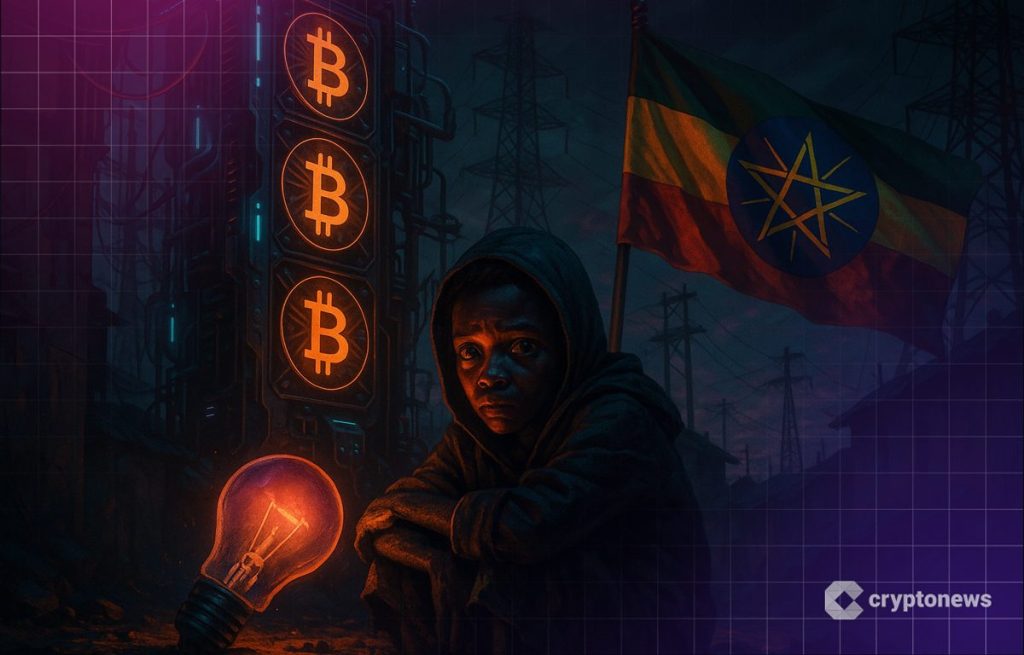
- This decision arises as 57 million Ethiopians continue to lack electricity access, prompting concerns regarding national priorities.
- Ethiopia’s state power corporation reported $220 million in revenue from Bitcoin mining over the last year.
Ethiopia has halted the issuance of new electricity supply permits to Bitcoin mining firms because it can no longer accommodate the rising demand, as stated by Ashebir Balcha, CEO of the state power utility Ethiopian Electric Power (EEP).
This situation has led to worries that the Ethiopian government is favoring profit over the well-being of its citizens. Fifty-seven million individuals — nearly half the population — still live without electricity due to insufficient transmission infrastructure.
Currently, Ethiopia has allocated 600 megawatts (MW) of electricity for Bitcoin mining — approximately 11% of the nation’s total generating capacity of 5,631 MW, according to the EEP website. This amount of energy is sufficient to power half of Addis Ababa, the capital city of Ethiopia, as reported by a recent BBC Africa article.
“Based on our current evaluation, access seems to be at full capacity,” Balcha remarked, as reported by Ethiopian news outlet Shega. He made these comments during the EEP’s annual performance review held in Addis Ababa last week.
Ethiopia’s Bitcoin Mining Boom
Bitcoin mining is experiencing significant growth in Ethiopia, the second most populous country in Africa after Nigeria. Since 2023, approximately 27 companies have received licenses to mine Bitcoin in Ethiopia, according to a report from the crypto firm Bitcoin Birr.
Nearly 20 additional foreign companies are presently on a waiting list. Miners are attracted to Ethiopia’s inexpensive hydroelectric power, primarily generated from the Grand Ethiopian Renaissance Dam (GERD), one of Africa’s largest energy projects.
The report indicates that miners pay $3.60 per kilowatt hour (kWh) of electricity after tax, making the cost of electricity for miners in this East African nation considerably lower than the average in other markets.
On average, each Bitcoin mining machine operating in Ethiopia yields a profit of $5.71 daily, rendering it a profitable venture. Some miners have set up as many as 50,000 Bitcoin miners at their facilities.
Kal Massa, founder of Bitcoin Birr, states that Ethiopia now contributes 5% of Bitcoin’s total computing power, or hashrate, an increase from about 2.5% in January. The rising hashrate indicates that miners are optimistic about generating profits.
For Ethiopian Electric Power, the choice to supply electricity to Bitcoin miners has also proven to be lucrative. The state-run utility reportedly earned over $200 million in revenue from mining in 2025 alone.
Some analysts initially questioned the revenue figures. “This was an early estimate,” Massa informed Cryptonews. “The actual figure is $25 to $28 million a month being generated by EEP from Bitcoin miners (sic).”
In a post on X, Bitcoin mining analyst Daniel Batten noted that EEP would have needed an average of 1.2 gigawatts mining at any given time between January and June 2025 to achieve those revenues at $31-35 per megawatt hour (MWh).
“Given that there was only 600MW in October 2024, that [$200 million revenue] seems excessive,” he stated.
They would’ve needed an average of 1.2GW mining at any one time between Jan-June 2025 to achieve those revenues at $31-35/MWh. Considering there was only 600MW in Oct 2024, that seems on the high side.
— Daniel Batten (@DSBatten) July 5, 2025
However, recent data from Ethiopian Electric Power indicates that the utility generated $338 million in revenue from electricity sales to neighboring countries and Bitcoin miners. This revenue pertains to the 2024/2025 fiscal year.
<papproximately 35%, or $118 million, of the total revenue was derived from power exports to djibouti, kenya, and sudan, as reported by ethiopian press agency. remaining $220 million generated data mining, including cryptocurrency mining.
Ethiopian regulations categorize Bitcoin mining as data mining.
Social Dilemma as Millions Lack Electricity
Ethiopia intends to add 5,000 MW of electricity to the national grid from its GERD project in the upcoming months. The country aims to increase its revenue from regional exports and Bitcoin mining to $427 million by 2026.
Related Posts
This suggests that the suspension on issuing power purchase agreements for miners may soon be lifted.
Critics challenge the rationale behind allocating a portion of Ethiopia’s limited energy resources to mining for short-term profits while millions still lack access to essential electricity services.
Over 45% of Ethiopia’s population, estimated at 120 million, live without power, and even in major urban areas, power outages are common.
“I believe the issue of Bitcoin mining is concerning,” David Gitonga, founder of the Kenya-based crypto platform BitKE, told CNBC Africa.
“It’s a report from the government of Ethiopia that actually raised this concern because… a significant portion of the population, 50%, still do not have access to electricity,” Gitonga added:
“The real concern is about priorities: should [Ethiopia] be mining Bitcoin and generating $400 million every year, or should we prioritize providing electricity to citizens? There needs to be a balance [between the two].”
Gitonga worries that profits from mining may not translate into timely improvements in energy access for the underprivileged. He advocates for Ethiopia to adopt policies that require miners to address community needs, similar to practices in other nations.
Conversely, Bitcoin Birr founder Massa asserts that there is a strategic rationale behind Ethiopia’s electricity sales to cryptocurrency miners, stating to Cryptonews:
“It’s a technical strategy. One third to one half of our [Ethiopia’s] energy is stranded. This excess energy can be sold instead of dissipating into the atmosphere.”
Stranded energy refers to electricity that is generated but not utilized, often due to the inability to transmit it to areas where it is needed.
Ethiopia possesses surplus energy in certain regions, but a lack of transmission lines and substations prevents much of it from reaching urban or rural communities.
Experts indicate that Bitcoin miners offer a ready market for stranded power because they can operate almost anywhere with a dependable energy source.
Mining ‘Jumpstarts’ Infrastructure Development
Despite new facilities like the Grand Ethiopian Renaissance Dam, Ethiopia has fewer than 200 substations, a small fraction of what is actually required to deliver power to the millions of individuals who still lack electricity.
“The country will need at least 10 times that amount as the large population transitions to the middle class and more people acquire water heaters and electric stoves,” Massa noted, adding:
“Bitcoin miners are helping to stimulate this investment, which will benefit both commercial sectors and residential energy consumers.”
He referenced Ercot in Texas, U.S., where flexible demand from data centers aids in “balancing the grid” by aligning supply and demand over a 24-hour period. When asked who benefits the most from mining in Ethiopia, Massa stated, “Everyone benefits.”
“There are numerous Bitcoin miners in various regions throughout Ethiopia purchasing otherwise wasted energy, expanding the tax base and employing hundreds, if not thousands of network engineers, electrical engineers, and related professionals from the value chain.”
Moges Mekonnen, the EEP communications director, did not respond to a request for comment. However, Balcha informed BBC Africa that funds generated from Bitcoin mining will be utilized to enhance Ethiopia’s electricity network.
“We can expand our network through the revenue we are generating from this data mining business (sic),” stated the CEO of Ethiopian Electric Power. “We will enhance our transmission and distribution network.”
Over the past year, EEP reportedly constructed 28,571 kilometers of new transmission lines, partially funded by revenue from Bitcoin mining. Additionally, more than 8,700 substation bays were installed during the year, according to Birr Metrics.
The post As Bitcoin Mining Grows, 57 Million Ethiopians Remain in the Dark appeared first on Cryptonews.
