Disclaimer: Information found on CryptoreNews is those of writers quoted. It does not represent the opinions of CryptoreNews on whether to sell, buy or hold any investments. You are advised to conduct your own research before making any investment decisions. Use provided information at your own risk.
CryptoreNews covers fintech, blockchain and Bitcoin bringing you the latest crypto news and analyses on the future of money.

Are Bitcoin Prices Facing Potential for a More Significant Decline? Large Holders Indicate Wariness | Analysis

Key Takeaways:
- Significant Bitcoin transactions exceeding $20 million have increasingly been directed to exchange hot wallets from October through mid-December.
- Approximately 65% of BTC associated with whales and institutional-related flows was transferred to exchanges, typically viewed as a preparatory measure rather than immediate liquidation.
- November represented the peak in outflows among whales, BlackRock-associated wallets, and Wintermute, coinciding with Bitcoin’s price decline below $85,000.
- The timing of these peaks indicates a widespread liquidity redistribution during the correction, rather than targeted pressure from a single market entity.
Table of Contents
- In This Article
Hot Wallets Are the Main Destination for Large BTC Transfers November Marked the Peak in Large Outflows During Bitcoin Price Weakness Why Are They Doing This? Conclusion
- In This Article
- Hot Wallets Are the Main Destination for Large BTC Transfers
- November Marked the Peak in Large Outflows During Bitcoin Price Weakness
- Why Are They Doing This?
- Conclusion
Show Full Guide
Bitcoin (BTC) prices continue to decline. The market currently resembles a back-and-forth contest between buyers and sellers. Prices decrease, but without a significant collapse. This is followed by a recovery, yet lacking strong upward momentum. Amid this scenario, speculation is rising that large players might be exerting pressure on the market and could be inclined to drive prices lower. However, does the data validate this notion?
In this analysis, Cryptonews examined substantial Bitcoin transactions exceeding $20 million per transfer between October 10 and December 15. This period allows for the observation of market behavior following the October sell-off. Transactions associated with BlackRock and Wintermute were also analyzed, as both are prominent institutional participants.
Hot Wallets Are the Main Destination for Large BTC Transfers
The analysis reveals that around 65% of BTC within these groups was directed to hot wallets, primarily exchanges. This was the predominant destination.
Such transfers are typically regarded as a preparatory step prior to selling. However, they do not necessarily indicate immediate liquidation. Sales may occur later or may not take place at all. Nonetheless, this type of activity often heightens market caution and influences expectations.
The second most prevalent category was internal transfers. These encompass Bitcoin moved from one cold wallet to another or to unlabelled addresses. The intent behind these transactions is more challenging to interpret. In certain instances, they may signify rebalancing, adjustments in custody structure, or preparation for over-the-counter transactions. In the current market environment, these movements can also heighten uncertainty, particularly when large BTC volumes frequently shift between addresses without a clear rationale.
November Marked the Peak in Large Outflows During Bitcoin Price Weakness
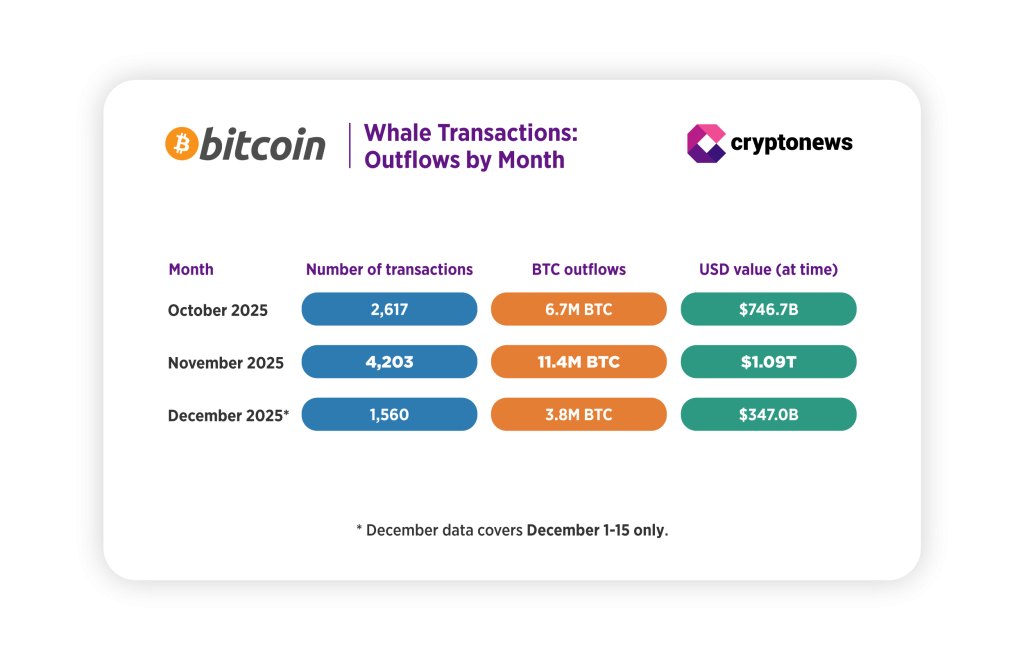
Among all three groups, Bitcoin whales as well as flows linked to BlackRock and Wintermute, activity peaked in November. This followed the October 10 sell-off and coincided with Bitcoin trading below $85,000, a time characterized by heightened uncertainty.
The trend was most pronounced among Bitcoin whales. In November, their transaction volumes reached the highest levels both in terms of the number of transfers and total BTC moved. Approximately 11.4 million BTC in outgoing transfers were recorded during the month. At prevailing prices, this represented over $1 trillion in value. These figures significantly surpassed October levels and were higher than the activity observed in early December, when volumes began to taper off.
Institutional flows exhibited a similar trend. Bitcoin outflows associated with BlackRock also peaked in November. Estimates indicate that around $1.3 billion worth of BTC was transferred during the month, marking it as the most active period for this group within the analyzed timeframe.

Related Posts
Wintermute, one of the largest crypto market makers, also recorded its highest monthly volume of outgoing transfers in November. Given Wintermute’s role in providing liquidity, this increase likely reflects heightened trading activity and fund reallocation amid increased volatility.
The fact that all three groups peaked at approximately the same time suggests a broader redistribution of liquidity during a price correction rather than coordinated action by a single market participant.
Why Are They Doing This?
The increasing proportion of BTC transfers to exchange wallets naturally prompts inquiries. While these movements are often interpreted as preparation for selling, they do not automatically indicate that large players are poised to exit their positions.
During the correction, some market participants have proposed that declining prices could serve to test the resilience of major Bitcoin holders or even to instigate redistribution among them.
When Bitcoin prices face prolonged pressure, large and highly visible corporate holders like Strategy inevitably attract closer scrutiny. The company is among the largest corporate Bitcoin holders and is closely associated with a strong long-term BTC thesis. This raises a pertinent question: could price pressure be a method to assess how resilient such positions truly are, and what would transpire if one of the largest public holders altered its stance?
Experts caution that drawing direct conclusions is premature. David Dobrovitsky, CEO of Wowduck, informs Cryptonews that it would be an oversimplification to identify one company as a primary driver of Bitcoin price fluctuations:
It’s challenging to pinpoint a private entity as the reason for BTC’s rise or fall. BlackRock, for instance, holds more Bitcoin than Strategy, not to mention various governments. Strategy is a highly visible holder, but overall BTC ownership remains sufficiently distributed, meaning one private company should not be able to move the market independently.
Nevertheless, the concept of a “stress test” for corporate holders is increasingly discussed in light of current market dynamics.
Dobrovitsky contends that the market is not at that stage yet:
Not yet. There is still enough distribution in Bitcoin holdings for price movements to be fully indicative of pressure on a specific corporate holder. What we are witnessing instead is a broader downturn across tech markets. Employment opportunities are diminishing, venture capital funding has decreased, and there are fewer sectors yielding outsized returns, both for retail and institutional investors.
From this perspective, the decline in Bitcoin prices appears more as part of a broader cooling in risk assets than targeted pressure on specific players.
That said, Michael Saylor’s role remains a significant aspect of the market narrative, even if it is not decisive. “Positive sentiment surrounding Saylor and Strategy certainly benefits Bitcoin,” Dobrovitsky adds. “However, it should not be regarded as the sole factor influencing BTC price dynamics.”
Conclusion
Depending on interpretation, this activity can be understood in various ways. On one hand, the increase in BTC transfers to exchanges and the rise in internal movements may signify a broader market cooldown and standard risk reallocation during a price correction and weaker macro conditions. Conversely, some participants believe that declining prices may function as a stress test for the largest Bitcoin holders, including corporate entities like Strategy, whose commitment to BTC has become part of the market narrative.
Simultaneously, on-chain data does not indicate targeted pressure on any single participant. Both interpretations remain within the realm of market expectations rather than confirmed scenarios.
Disclaimer: Crypto is a high-risk asset class. This article is provided for informational purposes and does not constitute investment advice. You could lose all of your capital.
The post Is Bitcoin Price at Risk of a Deeper Reset? Whales Signal Caution | Research appeared first on Cryptonews.
