Disclaimer: Information found on CryptoreNews is those of writers quoted. It does not represent the opinions of CryptoreNews on whether to sell, buy or hold any investments. You are advised to conduct your own research before making any investment decisions. Use provided information at your own risk.
CryptoreNews covers fintech, blockchain and Bitcoin bringing you the latest crypto news and analyses on the future of money.


Privacy in cryptocurrency is fading.
All prominent exchanges now require users to submit their passports, selfies, proof of residence, and in some cases, biometric information. Financial activities are monitored, scrutinized, and stored in databases that are frequently compromised.
However, this situation can be changed.
Anonymous cryptocurrency exchanges are still available – platforms that allow you to exchange Bitcoin, Ethereum, Monero, and countless other cryptocurrencies without revealing your identity.
GhostSwap claims it has risen to be one of the top choices for traders who are unwilling to trade privacy for ease of use. This guide outlines the significance of anonymous exchanges, how private swaps function, and why GhostSwap has become a preferred platform for crypto users who prioritize privacy.
The Issue: Crypto Exchanges Have Complete Knowledge of You
When Satoshi Nakamoto invented Bitcoin, the intention was straightforward: peer-to-peer electronic cash without the need for trusted intermediaries. No banks. No middlemen. No monitoring.
Fast forward to 2026, and the majority of cryptocurrency trading resembles nothing of that original vision.
What Centralized Exchanges Gather
To utilize Coinbase, Binance, Kraken, or any significant exchange, you are required to provide:
- Government ID – passport, driver’s license, national ID
- Selfie verification – often with liveness detection
- Proof of address – utility bills, bank statements
- Phone number – linked to your actual identity
- Email address – typically your main personal email
- Bank accounts – for fiat deposits/withdrawals
- Employment information – some exchanges inquire about your profession
- Source of funds – where your funds originate.
This is not optional. Without KYC (Know Your Customer) verification, trading is not permitted.
Why This Is Important
Data Breaches Are Unavoidable
Crypto exchanges are prime targets for cybercriminals. Not only for the cryptocurrency – but also for the identity information. In recent years, significant breaches have revealed personal information of millions of users:
- Names and addresses associated with cryptocurrency holdings
- Transaction histories revealing wealth status
- ID documents facilitating identity theft
- Phone numbers enabling SIM swap attacks.
When an exchange is compromised, your identity is jeopardized indefinitely. You may change your password, but you cannot alter your passport number, the GhostSwap team states.
Government Monitoring
Exchange data is frequently shared with governmental bodies. Tax agencies, law enforcement, and intelligence organizations can request (or subpoena) your entire transaction history. Certain jurisdictions necessitate that exchanges proactively inform about user activities.
Even if they haven’t committed any wrongdoing, numerous users prefer not to have every government entity aware of their complete cryptocurrency holdings and every transaction they have ever conducted.
Financial Profiling
Exchanges examine your trading habits, assets, and conduct. This information is valuable for targeted advertising, credit assessments, insurance pricing, and purposes that you may never be informed about, GhostSwap notes.
Account Freezes
Centralized exchanges have the ability to freeze your assets at any time. Suspicious activity flags, compliance checks, or merely being from a particular country can restrict your access to your own funds, in some cases indefinitely.
The Answer: Anonymous Crypto Exchanges
An anonymous crypto exchange enables you to trade without disclosing your identity. No accounts. No KYC. No collection of personal data.
How Anonymous Exchanges Operate
In contrast to centralized platforms, anonymous exchanges function on a straightforward model:
- Select your swap – choose which cryptocurrency you are sending and which you are receiving
- Provide a receiving address – where your exchanged crypto will be sent
- Send your crypto – to the exchange’s deposit address
- Receive your swap – directly to your wallet.
That’s all there is to it. No registration. No identity checks. No ongoing account relationship.
Categories of Anonymous Exchanges
Instant Swap Services
Platforms like GhostSwap facilitate swaps within minutes. You interact solely for the duration of the swap – no persistent account retains your data.
Decentralized Exchanges (DEXs)
On-chain platforms like Uniswap or dYdX allow you to trade directly from your wallet. Fully decentralized but limited to single-chain tokens (cannot swap BTC for ETH on Uniswap).
Peer-to-Peer Platforms
Marketplaces that connect buyers and sellers directly. More intricate and slower, but maximum privacy if executed correctly.
Atomic Swap Protocols
Trustless cross-chain swaps using cryptographic protocols. Technically sophisticated, but with limited liquidity and pairs.
For the majority of users seeking privacy alongside convenience, instant swap services provide the optimal balance.
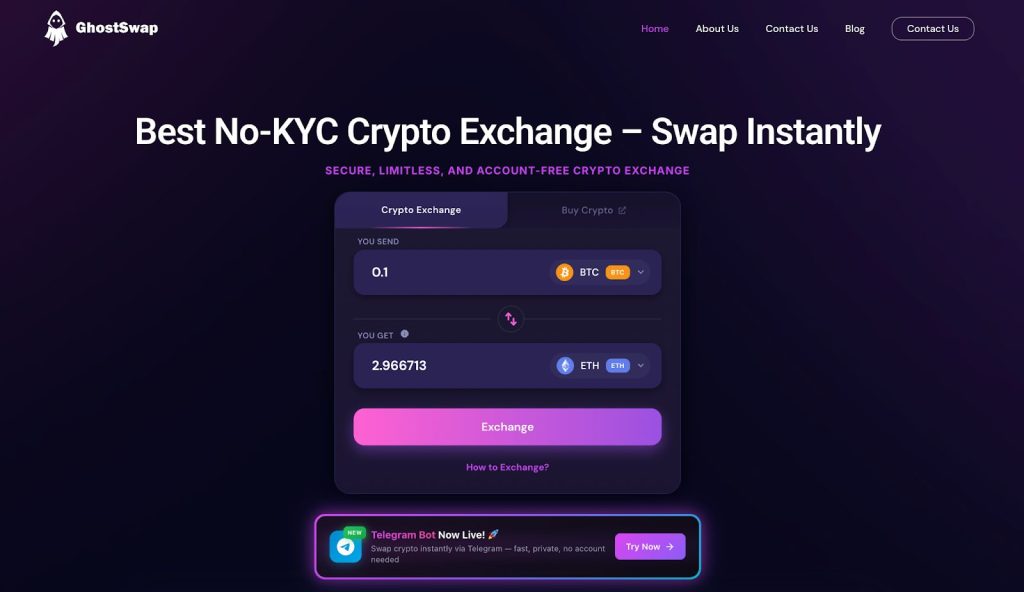
Why Choose GhostSwap for Anonymous Crypto Trading
Among anonymous exchanges, GhostSwap distinguishes itself for several reasons:
Genuine No-KYC Policy
Numerous exchanges assert “no KYC” but initiate verification requests for larger amounts or specific coins. GhostSwap claims it processes over 99.5% of swaps without any identity checks, regardless of amount or cryptocurrency.
No accounts. No emails. No phone numbers. No ID uploads. Ever.
1,600+ Cryptocurrencies
GhostSwap supports more coins than the majority of competitors:
- Major coins: BTC, ETH, SOL, XRP, ADA, DOT, AVAX
- Privacy coins: XMR (Monero), ZEC (Zcash)
- Stablecoins: USDT, USDC, DAI, BUSD (across multiple networks)
- Meme coins: DOGE, SHIB, PEPE, BONK, FLOKI
- DeFi tokens: UNI, AAVE, LDO, ARB, OP
- And 1,500+ more.
If it’s a legitimate cryptocurrency, GhostSwap likely supports it.
Cross-Chain Private Swaps
This is where GhostSwap claims it excels. You can privately swap between entirely different blockchains:
- Bitcoin to Ethereum – BTC → ETH
- Ethereum to Monero – ETH → XMR
- Solana to Bitcoin – SOL → BTC
- USDT to Monero – Stablecoin → Privacy coin.
Users cannot accomplish this privately on a DEX, as they only operate within single ecosystems.
Non-Custodial Structure
GhostSwap asserts it never retains users’ funds in an account balance.
The swap process:
- You send crypto to a temporary deposit address
- The swap takes place
- Your new crypto is sent directly to your wallet.
No “exchange wallet” accumulating your assets. No balance that could be frozen or serve as a target for hackers.
Established Track Record
GhostSwap reports:
- $750M+ in completed swap volume
- 1.5M+ users served
- Years of continuous operation.
Scam platforms do not achieve these figures, the team notes, adding that legitimate volume at this scale signifies a real, functioning business.
Rapid Execution
Most swaps are completed in 10-30 minutes, depending on blockchain confirmation times. Bitcoin swaps typically take longer (more confirmations required). Solana and Tron swaps are almost instantaneous.
Telegram Bot Access
GhostSwap provides a Telegram bot for swapping directly within the messaging application. No website required. Useful when:
- Traveling with limited internet access
- Desiring additional privacy (Telegram’s encryption)
- Preferring mobile convenience.
How to Perform a Private Swap on GhostSwap
Here’s how to anonymously swap crypto:
Step 1: Visit GhostSwap
Go to ghostswap.io or open the Telegram bot.
No account creation is necessary. No email signup. Just the swap interface.
Step 2: Choose Your Trading Pair
Select:
- You send: The cryptocurrency you’re exchanging (e.g., BTC)
- You receive: The cryptocurrency you desire (e.g., ETH).
The interface displays the current exchange rate and the estimated amount you will receive.
Step 3: Enter the Amount
Indicate how much you wish to swap. GhostSwap shows:
- Exchange rate
- Network fees
- Final amount you’ll receive.
Minimum amounts are low (a few dollars), the team notes. Maximum amounts are generous, they add. There are no artificial limits pushing users towards KYC.
Step 4: Provide Your Receiving Address
Related Posts
Input the wallet address where you want your exchanged cryptocurrency to be sent.
Important: Use a wallet that you control. Avoid exchange wallets. Self-custody preserves your privacy.
Recommended wallets:
- Bitcoin: Electrum, Sparrow, Ledger, Trezor
- Ethereum: MetaMask, Rabby, Ledger, Trezor
- Monero: Feather Wallet, Cake Wallet, Monero GUI
- Multi-chain: Trust Wallet, Exodus.
Step 5: Send Your Crypto
GhostSwap provides a deposit address. Send your cryptocurrency from any wallet.
You will receive a transaction ID to monitor the swap’s progress.
Step 6: Receive Your Swap
Once your deposit is confirmed on the blockchain, the swap is executed automatically. Your new cryptocurrency will arrive in your wallet within minutes.
Done. No account created, identity revealed, or data stored, the team states.
The team encourages everyone to try a private swap via the official website.
Top Anonymous Swaps for Privacy
Some swap pairs provide greater privacy benefits than others, according to GhostSwap.
Maximum Privacy: Swap TO Monero
Monero (XMR) is the benchmark for financial privacy. Its technology ensures transactions remain untraceable.
Exchanging any transparent cryptocurrency for Monero is the ultimate privacy action:
Once you possess XMR, your subsequent transactions are entirely private, the team asserts.
Breaking Chain Analysis: Any Cross-Chain Swap
Blockchain analysis firms monitor funds across transparent chains. A cross-chain swap disrupts this:
- BTC → ETH: Disrupts Bitcoin chain analysis
- ETH → SOL: Separates Ethereum and Solana activity
- Any → Different chain: Creates analytical gaps.
Even without Monero, cross-chain swaps complicate tracking significantly.
Stablecoin Privacy
Need to maintain a stable value discreetly? Exchange for stablecoins on privacy-oriented networks:
Anonymous Exchange Comparison: GhostSwap vs Alternatives
How does GhostSwap stack up against other anonymous trading options? This is what the team claims.
GhostSwap vs Changelly
Conclusion: GhostSwap asserts it provides stronger privacy assurances. Changelly often initiates KYC for privacy coin exchanges and larger transactions.
GhostSwap vs ChangeNow
Conclusion: Both are solid choices. GhostSwap claims it offers more coins and the advantage of a Telegram bot.
GhostSwap vs Bisq
Conclusion: Bisq is more decentralized but considerably slower and more complex to use. GhostSwap argues it excels in convenience.
GhostSwap vs Uniswap (DEX)
Conclusion: DEXs are excellent for single-chain swaps but cannot accommodate cross-chain or Bitcoin transactions. GhostSwap claims it covers all bases.
Privacy Best Practices for Anonymous Swapping
Utilizing an anonymous exchange is just the first step. Enhance your privacy with these practices:
Use a VPN
Conceal your IP address when accessing any crypto service. Recommended privacy-focused VPNs include:
- Mullvad (accepts cryptocurrency, no account necessary)
- ProtonVPN
- IVPN.
Use Fresh Wallet Addresses
Avoid reusing addresses. Generate new receiving addresses for each swap to prevent linking transactions.
Avoid Exchange Wallets
Never send proceeds from anonymous swaps to a centralized exchange. Doing so instantly links the funds to your KYC’d identity.
Consider Tor Browser
For utmost anonymity, access GhostSwap through Tor. This conceals your IP even from VPN providers.
Don’t Announce Holdings
Privacy technologies are meaningless if you disclose your wallet addresses on social media or discuss specific holdings publicly.
Split Large Transactions
For significant amounts, consider dividing into several smaller swaps over time. This minimizes the visibility of single transactions.
Is Anonymous Crypto Trading Legal?
This is a frequent concern. The brief answer: In most jurisdictions, yes.
What’s Legal
- Using non-KYC exchanges as an individual
- Privately swapping cryptocurrencies
- Holding privacy coins like Monero
- Not disclosing information beyond what is required.
Your Responsibilities
- Tax reporting: Most countries mandate reporting capital gains regardless of how you traded. Using an anonymous exchange doesn’t exempt you from tax duties.
- Source of funds: Funds must be lawfully obtained. Anonymous trading is not a tool for money laundering.
- Local regulations: Some nations limit cryptocurrency usage overall. Be aware of your local laws.
The Key Difference
KYC mandates apply to exchanges as businesses, not to individual users. An exchange must gather KYC to function legally in regulated territories. However, individuals opting for non-KYC platforms is not illegal, GhostSwap asserts. It’s a preference for privacy.
The crypto community frequently confuses “anonymous” with “illegal.” They are not synonymous. Financial privacy is a right, not a criminal act, the team insists.
Who Utilizes Anonymous Crypto Exchanges?
Privacy is not solely for wrongdoers, despite what regulators may sometimes suggest. Legitimate users of anonymous exchanges include:
Privacy Advocates
Individuals who believe financial surveillance is fundamentally wrong. They utilize privacy tools not because they have something to conceal, but because privacy is an inherent right.
Security-Conscious Holders
Significant assets on transparent chains make you susceptible to hackers, scammers, and even physical threats. Anonymous swaps mitigate this risk.
Journalists and Activists
Individuals operating in hostile settings where financial surveillance could jeopardize their safety. Receiving funds privately can be crucial for security.
Business Owners
Entrepreneurs who wish to prevent competitors from scrutinizing their financial activities on public blockchains.
Residents of Authoritarian Regimes
Individuals living under governments that employ financial surveillance for political control. Privacy coins and anonymous exchanges offer financial independence.
Anyone Who Values Privacy
You don’t need a special justification. Not wanting strangers, corporations, and governments to know your entire financial history is reason enough.
Frequently Asked Questions
What is an anonymous crypto exchange?
An anonymous crypto exchange allows you to trade cryptocurrencies without identity verification (KYC). You exchange directly without creating accounts or submitting personal documents. GhostSwap claims it is a leading example, processing over 99.5% of swaps without any KYC.
Is GhostSwap truly anonymous?
Yes. GhostSwap does not require accounts, emails, or identity verification. You simply select your swap, provide a receiving wallet address, and send crypto. No personal data is collected or retained.
What’s a private swap?
A private swap is a cryptocurrency exchange that does not require identity verification or generate records linking your identity to the transaction. GhostSwap’s non-custodial model guarantees swaps are private: you send crypto, receive crypto, with no account relationship in between.
Can I swap Bitcoin anonymously?
Yes. Utilize GhostSwap to convert Bitcoin to any of 1,600+ cryptocurrencies without KYC. Popular anonymous BTC swaps include BTC to ETH, BTC to XMR, and BTC to USDT.
Is it legal to use anonymous exchanges?
In most jurisdictions, yes. KYC regulations usually pertain to exchanges as regulated entities, not to individual users. However, users are still accountable for tax obligations on capital gains. Verify
