Disclaimer: Information found on CryptoreNews is those of writers quoted. It does not represent the opinions of CryptoreNews on whether to sell, buy or hold any investments. You are advised to conduct your own research before making any investment decisions. Use provided information at your own risk.
CryptoreNews covers fintech, blockchain and Bitcoin bringing you the latest crypto news and analyses on the future of money.

Analysts Caution that Saylor’s BTC Approach is “Negatively Impacting Bitcoin Price Movement” as His Holdings Decline

Analysts from Samosa Capital Investment Fund have cautioned that Michael Saylor’s BTC approach is “hurting Bitcoin’s price action”, which negatively impacts the Bitcoin community.
As per certified analysts, Saylor’s Bitcoin digital asset treasury firm, Strategy (previously MicroStrategy), is “a highly leveraged holding company traded on public exchanges that could blow up, which is in stark contrast to Bitcoin’s original purpose.”
Vinny Lingham, an economist and co-founder at Praxos Capital, also expressed concerns that Saylor’s Strategy might ultimately inflict more damage on Bitcoin (and the crypto sector) than what FTX caused.
https://twitter.com/VinnyLingham/status/1869382634020954214?s=20
Saylor’s Strategy Is the Antithesis of Bitcoin’s Intended Purpose
These apprehensions arise just days after Saylor revealed that the Bitcoin Strategy company had acquired 8,178 BTC at an average price of $102,171, roughly 10% above current market prices.
Data from CryptoQuant indicates that this latest Bitcoin acquisition places approximately 40% of Strategy’s 649,870 BTC holdings in the negative zone.
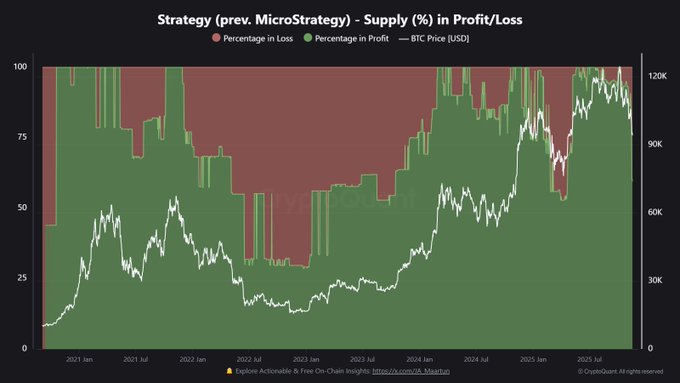 Source: CryptoQuant
Bitcoin critic Peter Schiff labeled Strategy’s entire business model a “fraud.”
He disclosed that both he and Saylor will participate in Binance Blockchain Week in Dubai in early December and challenged Saylor to a debate, concluding: “Regardless of what happens to Bitcoin, I believe $MSTR will eventually go bankrupt.”
https://twitter.com/cryptonews/status/1990265728541610183?s=20
These concerns emerge as Bitcoin has declined over 25% since early October, prompting market participants to question why Saylor, who frequently shared trackers and purchased during market rallies, has suddenly become silent during downturns.
“Buy High, Do Nothing,” Critics Critique Saylor’s Inactive Strategy During Market Declines
Notable crypto KOL Ansem identified this trend in April when Bitcoin fell 30% to $74k, commenting: “the most amusing part about all of this is when we genuinely needed a turbo bid to revive the digital gold safe haven narrative, this individual Saylor has bought absolutely zero Bitcoin.”
Helius Labs CEO Mert Mumtaz echoed this sentiment, observing that DATs tend to buy in large quantities when prices peak but remain silent during price drops.
Related Posts
https://twitter.com/0xMert_/status/1990732346199249310?s=20
“So their strategy is essentially to buy high and then do nothing? Just a creative method of directing crypto funds to CNBC, it appears.”
Bitcoin Maxis now contend that BTC’s foundational cypherpunk vision has been compromised.
A Delphi Digital analyst noted that Strategy and DATs are “hurting Bitcoin’s price action,” not only because Bitcoin has underperformed compared to assets like the Nasdaq-100 Index, but “because its function as a sovereign, censorship-resistant, private medium of wealth storage and transfer has been undermined.”
For instance, approximately 9% of all BTC is currently held in US ETFs or government treasuries, which are custodial, monitored, and fully transparent structures where personal sovereignty is virtually nonexistent.
 Source: Cryptonews research
Analysts contend that this dilution into central authority, which Bitcoin was designed to resist as censorship-resistant currency, is diverging from its original intent since the rise of DATs like Saylor’s Strategy.
Saylor Asserts MSTR Can Endure 80-90% Bitcoin Decline.
However, when GrokAI was queried about the price at which Bitcoin would need to fall for MSTR to encounter difficulties and be compelled to sell Bitcoins.
It indicated that Bitcoin would have to decrease to around $12,650 for MicroStrategy (MSTR) to face significant financial challenges, where the value of its Bitcoin holdings would roughly equal its total debt of about $8.22 billion.
At that point, the company’s balance sheet would be in jeopardy without other assets or refinancing options, potentially necessitating a sale of Bitcoin to meet liabilities.
Nonetheless, the debt is structured through convertible notes that do not impose strict covenants linking assets to Bitcoin’s price, so immediate liquidation is not assured.
CEO Michael Saylor also mentioned that the firm could withstand an 80-90% Bitcoin decline (to ~$18,800-$9,400) and remain overcollateralized.
https://twitter.com/SimplyBitcoin/status/1866057875980009513?s=20
In summary, despite analysts’ warnings regarding MSTR’s potential collapse, the underlying fundamentals continue to appear robust.
The post Analysts Warn Saylor’s BTC Strategy is “Hurting Bitcoin Price Action” as His Portfolio Turns Red appeared first on Cryptonews.
