Disclaimer: Information found on CryptoreNews is those of writers quoted. It does not represent the opinions of CryptoreNews on whether to sell, buy or hold any investments. You are advised to conduct your own research before making any investment decisions. Use provided information at your own risk.
CryptoreNews covers fintech, blockchain and Bitcoin bringing you the latest crypto news and analyses on the future of money.


Julian Assange’s significant 2010 disclosure of the Afghan War Logs represented a pivotal moment in transparency, unveiling classified information regarding US military activities during the Afghanistan War.
A recent report from The Block indicates that a new initiative is underway to ensure these records remain permanently accessible by inscribing them onto the Bitcoin blockchain through Project Spartacus.
This ambitious project entails encoding 76,911 files from the Afghan War Diary into Bitcoin’s decentralized ledger, employing the Ordinals protocol to protect the data from censorship or loss.
Supporters and family of Assange are leading this initiative as part of WikiLeaks’ mission and its enduring connection with Bitcoin as a means of resilience.
WikiLeaks’ Afghan War Logs: How Can Bitcoin Blockchain Ensure Immortality?
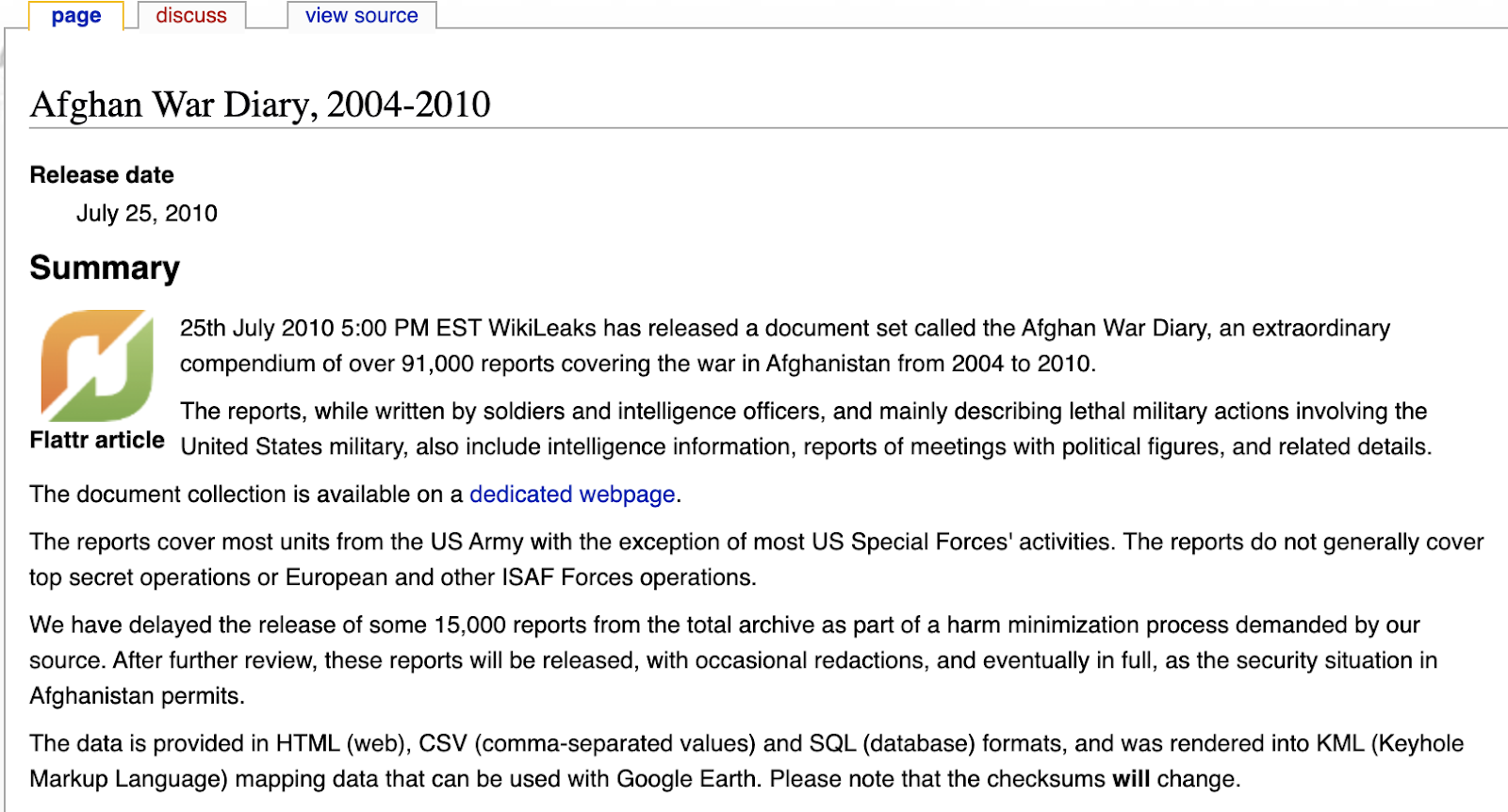 Source: Screenshot from WikiLeaks
The Afghan War Logs, initially published by WikiLeaks in 2010, offer a comprehensive overview of military operations conducted between 2004 and 2010.
They reveal concerning elements of the conflict, such as civilian casualties and contentious interrogation methods. Despite being publicly accessible, there is an ongoing threat of suppression or deletion due to the politically sensitive nature of the material. To counter this, Project Spartacus will inscribe the logs onto the Bitcoin blockchain utilizing OrdinalsBot to guarantee permanence.
In contrast to conventional digital storage, which depends on centralized servers, Bitcoin’s decentralized network disperses data across thousands of nodes worldwide, rendering it nearly impossible to modify or remove.
Gabriel Shipton, Assange’s brother and chair of the Assange Campaign, stated: “This information should last forever.”
The minting process is scheduled to commence on December 12, 2024, and will be free for participants via ProjectSpartacus.org, subsequently continuing on the OrdinalsBot marketplace, Trio.
Given the extensive amount of data, the mint is anticipated to cover multiple Bitcoin blocks, making it one of the most extensive and technically intricate blockchain projects to date.
Related Posts
A Symbol of Resistance and Legacy
Bitcoin played a vital role in supporting WikiLeaks during its financial blockade, when major payment processors refused service to the organization.
Contributions in BTC enabled WikiLeaks to remain operational and demonstrated the resilience of decentralized systems against state-level suppression.
Assange’s early involvement with Bitcoin even attracted attention from Satoshi Nakamoto, the mysterious creator of the cryptocurrency. In 2010, Nakamoto expressed concern regarding WikiLeaks’ utilization of Bitcoin, fearing it could attract unwanted scrutiny to the emerging technology.
Nakamoto commented in a Bitcointalk forum post: “WikiLeaks has kicked the hornet’s nest, and the swarm is headed towards us.”
Despite this initial apprehension, Bitcoin emerged as a crucial resource for WikiLeaks as a means of censorship-resistant currency.
A “Forever Iconic” Endeavor
Utilizing the Ordinals protocol simplifies and optimizes the process of permanently archiving the logs. Ordinals enable data to be inscribed onto individual satoshis—the smallest unit of Bitcoin—creating unchangeable records directly linked to the network’s ledger.
Toby Lewis, founder of OrdinalsBot, characterized the project as a “forever iconic” endeavor. However, he recognized the challenges associated with the scale of the mint, which encompasses tens of thousands of files.
Lewis remarked: “This isn’t a 10K collection.” He added that the infrastructure is designed for large-scale mints but still expects some delays.
While the initiative is not aimed at generating funds for Assange—who continues to seek a full pardon from U.S. President Joe Biden—it offers a means for supporters to connect with his legacy.
Shipton highlighted that the project serves as a reminder of Bitcoin’s original purpose, to act as a tool against systemic constraints. “It’s one of the strengths of Bitcoin — being able to withstand state-level attacks and continue publishing.”
The post WikiLeaks’ Afghan War Logs to Be Permanently Archived on Bitcoin Blockchain appeared first on Cryptonews.
