Disclaimer: Information found on CryptoreNews is those of writers quoted. It does not represent the opinions of CryptoreNews on whether to sell, buy or hold any investments. You are advised to conduct your own research before making any investment decisions. Use provided information at your own risk.
CryptoreNews covers fintech, blockchain and Bitcoin bringing you the latest crypto news and analyses on the future of money.


Cardano’s ADA token experienced a significant decline on Friday following a rare and disruptive chain split caused by a malformed delegation transaction.
This incident momentarily divided the network into two competing versions of its ledger, created confusion among exchanges and service providers, and led the FBI to initiate an investigation into what Cardano developers referred to as a potential cyberattack.
After the chain split, ADA fell by as much as 16% before stabilizing around $0.41.
The token remains down over 30% in the last two weeks as investors await further information from investigators and core developers.
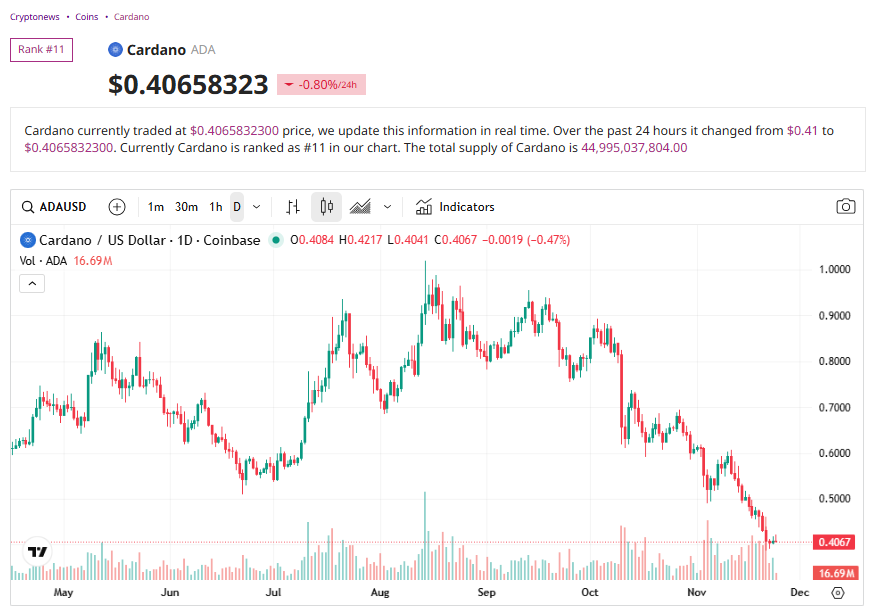 Source: Cryptonews
Cardano Chain Split Forces Coinbase, Kraken, Upbit to Pause ADA Deposits and Withdrawals
As detailed by Intersect, Cardano’s ecosystem governance body, the issue arose when a single delegation transaction, created using AI-generated instructions, was validated by newer node versions but rejected by older ones.
Mainnet Incident Update
Cardano experienced a temporary chain partition today after a malformed transaction triggered a bug in an underlying software library.
The ecosystem moved quickly in a coordinated response. Upgrades to node version 10.5.2/10.5.3 are restoring full…— Intersect (@IntersectMBO) November 21, 2025
This discrepancy caused nodes to generate blocks on different branches of the blockchain, effectively splitting Cardano into two chains: one with the malformed, or “poisoned,” transaction, and another without it.
Developers indicated that the malformed transaction took advantage of a long-standing bug in a core software library that had remained undetected.
The split mirrored a similar issue observed on Cardano’s testnet just a day prior, raising suspicions that the exploit had been tested before being deployed to the mainnet.
Intersect reported that block production continued on both chains, but the split disrupted wallet services, block explorers, and some DeFi protocols.
 Source: Coinbase
Transaction confirmations slowed or failed as the network attempted to resolve the split, leading major exchanges, including Coinbase, Upbit, and Kraken, to suspend ADA deposits and withdrawals until consensus was restored.
The disruption attracted attention due to the rarity of full chain splits for Cardano, which has functioned for eight years without a similar incident.
No user funds were lost; however, the event raised concerns regarding potential orphaned transactions and isolated double-spending.
Related Posts
Update https://t.co/48YGQbF05R
— Charles Hoskinson (@IOHK_Charles) November 21, 2025
Cardano co-founder Charles Hoskinson characterized the event as a deliberate attack from a disgruntled stake pool operator, asserting that the individual had spent months seeking ways to harm the reputation of Input Output Global (IOG), the organization behind Cardano’s development.
Cardano Developers Rush Out Patch After Chain Split, Attacker Calls It a Mistake
A few hours after the network split, an X account under the name “Homer J” came forward, claiming responsibility for the faulty transaction that triggered the incident.
In their post, the user stated they had been experimenting on their own system, attempting to replicate what they described as a problematic transaction.
Sorry (I know the word isn’t enough given the impact of my actions) Cardano folks, it was me who endangered the network with my careless action yesterday evening. It started off as a “let’s see if I can reproduce the bad transaction” personal challenge and then I was dumb enough
— Homer J (AAA) (@KpunToN00b) November 21, 2025
They mentioned that the attempt was based on instructions generated by an AI tool and was conducted while they intentionally blocked network traffic on their server.
They asserted they acted alone, did not gain any profit, and had no intention of causing financial harm.
Cardano founder Charles Hoskinson dismissed this explanation, labeling the event a deliberate attack and confirming that the FBI had been notified.
Cardano works so fast that we forked, fixed, and caught the guy all in one day. He was quite active in the Fake Fred discord. It was absolutely personal and now he’s trying to walk it back because he knows the FBI is already involved https://t.co/MNK6d7bEWv
— Charles Hoskinson (@IOHK_Charles) November 21, 2025
Intersect later indicated that its forensic review suggested possible connections to a participant from Cardano’s previous Incentivized Testnet and that U.S. federal authorities were now engaged.
Engineers from IOG, Intersect, the Cardano Foundation, and EMURGO collaborated on a patch within three hours, advising stake pool operators to upgrade their nodes to realign the chain.
Whenever something unexpected happens, the usual rumours and hot takes start flying. Let’s ground everything in clear facts instead of noise.
Yes, this was a serious incident. But the network demonstrated its resilience, stayed online, and the ecosystem responded with speed and… pic.twitter.com/iGc1MUn53a— Intersect (@IntersectMBO) November 23, 2025
By Nov. 22, consensus had naturally re-formed, and major exchanges began to restore ADA services. Coinbase experienced the longest downtime, suspending ADA transfers for approximately 14 hours.
The disruption drew parallels to previous chain splits in the crypto space, including Bitcoin’s 2013 fork caused by node-version incompatibilities.
The post ADA Crashes 16% as AI-Generated Transaction Splits Cardano — FBI Investigates appeared first on Cryptonews.
