Disclaimer: Information found on CryptoreNews is those of writers quoted. It does not represent the opinions of CryptoreNews on whether to sell, buy or hold any investments. You are advised to conduct your own research before making any investment decisions. Use provided information at your own risk.
CryptoreNews covers fintech, blockchain and Bitcoin bringing you the latest crypto news and analyses on the future of money.


An improperly configured Oracle system in Aave led to $27 million in forced liquidations on March 10, mispricing wrapped staked Ether by 2.85% compared to its true market value.
As detailed in the analysis by Chaos Labs, the CAPO oracle malfunction resulted in Aave V3 Ethereum Core and Prime instances applying an exchange rate of approximately 1.1939 wstETH-per-ETH, while the actual onchain rate was around 1.228. This discrepancy was sufficient to automatically push 34 high-leverage E-Mode positions below their liquidation thresholds.
Related Posts
This incident caused the liquidation of 10,938 wstETH. The protocol reported that it did not incur any bad debt and is taking steps to reimburse all impacted users.
The Impact: 34 Users, $27M in Liquidations, and 499 ETH in Bot Gains
The oracle error resulted in the liquidation of 34 users, with a total volume of $27 million in wstETH positions.
Aave founder and CEO Stani Kulechov confirmed in a post on Wednesday that the protocol did not generate any bad debt from this event.
1/ stETH CAPO Misconfiguration
Today, a misconfiguration on Aave’s CAPO oracle caused wstETH E-Mode liquidations, resulting in a loss of 345 ETH.
No bad debt was incurred, and all affected users will be fully reimbursed.
More below.— Omer Goldberg (@omeragoldberg) March 10, 2026
Of the 499 ETH distributed to liquidators, Aave managed to recover 141 ETH ($285,000) through BuilderNet refunds and an additional 13 ETH in liquidation fees.
These recovered amounts will be allocated directly to the affected users as compensation, with DAO treasury funds covering any remaining deficit up to the total 345 ETH identified as the excess liquidation gain.
Lido contributors confirmed that the incident was unrelated to wstETH or the Lido staking protocol; the issue was entirely due to Aave’s oracle configuration layer.
With Ethereum maintaining the $2,000 support level around the time of the incident, the liquidation values were exacerbated by the broader market conditions for ETH-denominated collateral.
Discover: The best pre-launch crypto sales
Chaos Labs Validates Aave CAPO Oracle Misconfiguration: Findings Revealed
Chaos Labs, Aave’s external risk management partner, confirmed that the incident arose from what it characterized as an onchain configuration misalignment under varying onchain update constraints, rather than a design flaw in the CAPO system or in Aave’s core oracle infrastructure.
The team highlighted that Chaos Risk Oracles had successfully processed over 1,200 payloads and more than 3,000 parameters across Aave markets without any issues prior to March 10.
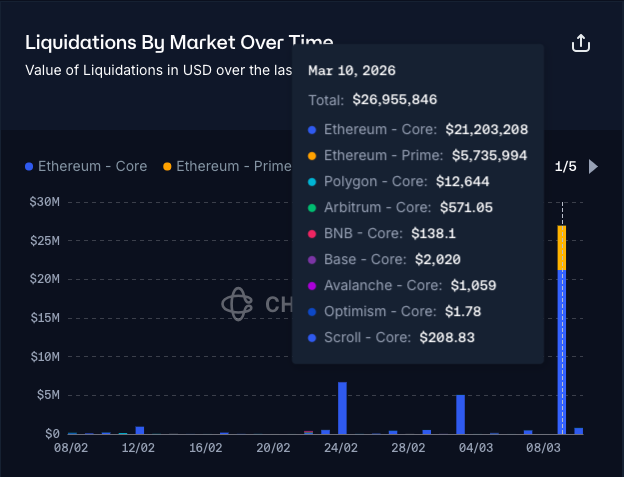 24-hour liquidations on Aave. Source: Chaos Labs
Chaos Labs promptly addressed the situation: borrow caps on wstETH were immediately reduced, and snapshot parameters were manually realigned to restore oracle precision. Kulechov noted in his public statement that the configuration issue had already been resolved by the time the post-mortem was released, commending the team’s rapid response in mitigating broader DeFi risk contagion.
The Aave governance post-mortem identifies this as the first operational failure in CAPO’s deployment history on Aave V3, despite over a year of successful operation across multiple markets.
What Traders and Aave Users Are Monitoring Next
The immediate concern is the timeline for full reimbursement. Aave DAO service providers are finalizing compensation for all 34 affected users following the initial 141 ETH refund via BuilderNet, with a formal governance announcement anticipated soon.
In addition to compensation, governance teams are undertaking a comprehensive review of CAPO parameters across all Aave markets, updating outdated snapshots and developing enhanced monitoring to identify rate divergences before they approach liquidation thresholds.
The governance question to observe is whether this review will lead to binding parameter update standards or remain advisory.
If the DAO formalizes automated CAPO synchronization requirements and publishes updated risk oracle documentation, the incident may ultimately bolster Aave’s operational credibility. Conversely, if the review stagnates at the discussion phase, the reputational damage will compound the financial impact.
Discover: The best new cryptocurrencies
The post Aave Oracle Glitch Causes $27M Liquidations: CAPO Misconfiguration Confirmed appeared first on Cryptonews.
