Disclaimer: Information found on CryptoreNews is those of writers quoted. It does not represent the opinions of CryptoreNews on whether to sell, buy or hold any investments. You are advised to conduct your own research before making any investment decisions. Use provided information at your own risk.
CryptoreNews covers fintech, blockchain and Bitcoin bringing you the latest crypto news and analyses on the future of money.


When a trader loses $50M in mere seconds, the industry typically suspects a bridge hack or an advanced exploit. However, late on Thursday (March 12), a crypto whale nearly obliterated their entire balance with a single click of an AAVE crypto swap.
The user attempted to exchange $50M worth of USDT for AAVE in a single on-chain transaction. Due to an utter lack of liquidity for such a large order, the trade experienced severe slippage, resulting in just 324 AAVE crypto, valued at approximately $50,000, for the $50M expended.
Poor individual swapped $50M -> $35K on Ethereum mainnet
https://t.co/fYRYqGzXlt pic.twitter.com/QGW8NnTikh
— deebeez (@deeberiroz) March 12, 2026


Transaction data indicates that the wallet engaged with the Aave interface through CoW Swap. Stani Kulechov, founder of Aave Labs, stated that the interface clearly “warned the user about significant slippage and required confirmation via a checkbox.”
In a statement on X, CoW Swap affirmed that explicit price-impact warnings were shown and that the transaction adhered to the signed parameters. This incident boils down to user error and a lack of self-preservation by not utilizing MEV bot protection.
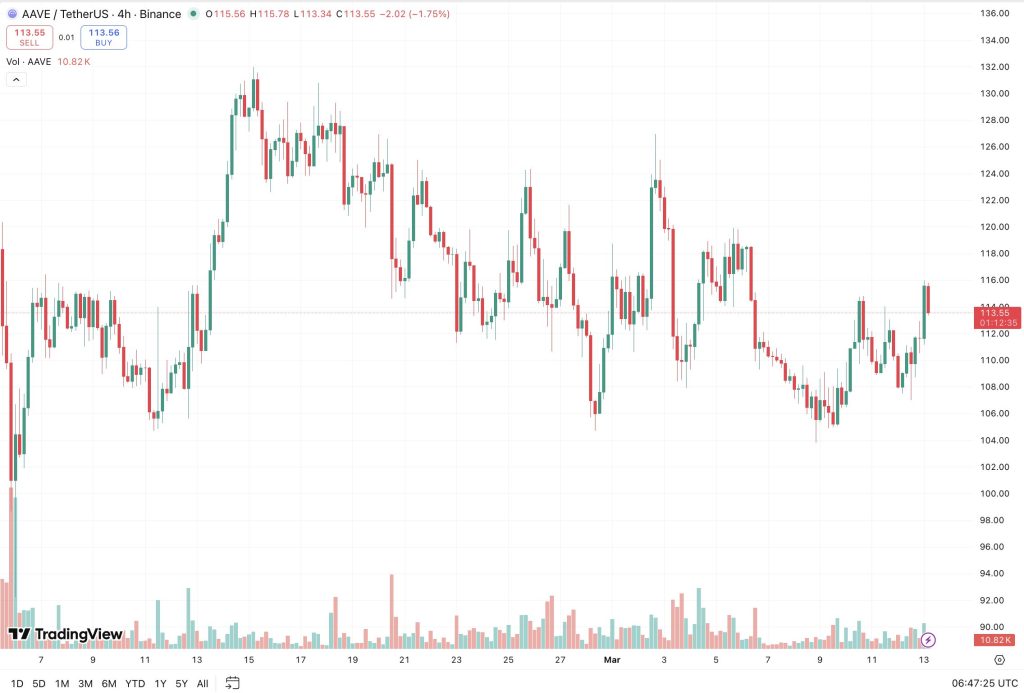 SOURCE: TradingView
How a Single Swap Cost One Whale $50M While Buying AAVE Crypto
The mechanics behind this loss are harsh yet typical. Decentralized exchanges (DEXs) depend on liquidity pools. When a buy order surpasses the available liquidity at the current price, the automated market maker (AMM) adjusts the price upwards to fulfill the order.
To satisfy the $50M order, the protocol had to purchase available AAVE at significantly inflated prices, leading to an average entry price that immediately depleted the capital.
This underscores why institutional players generally divide such trades into numerous smaller segments or utilize OTC (over-the-counter) desks.
While Ethereum is rapidly establishing itself as the foundation for institutional settlement, this occurrence illustrates that the user interface layer still permits catastrophic human error. Smart contracts do not evaluate the prudence of a trade; they merely execute the parameters signed by the wallet.
Hey everyone — we’re aware of the large swap transaction circulating on X.
Based on what we’ve observed so far, there’s no indication of a protocol exploit or any malicious activity. The transaction executed according to the parameters of the signed order.
Our interface shows…— CoW DAO (@CoWSwap) March 12, 2026
DISCOVER: The 16 Best Meme Coins to Buy in March 2025
Related Posts
What This Reveals About DeFi Market Structure
This incident highlights the perilous reality of “fat finger” trades in DeFi, where human intervention or alert systems would likely halt such anomalies in traditional finance.
Current liquidity on Aave, or nearly any single DEX pool, cannot accommodate $50M in a single tick without substantial price distortion.
Interestingly, the AAVE crypto token has risen by +5% over the past 24 hours, a price increase that may have been influenced by an unfortunate user who acquired $50,000 worth of the token for $50M.
Similar risks have been underscored recently, as just yesterday, the Bonk.fun website was compromised, resulting in user funds being drained.
While that incident involved malicious actors, the AAVE swap demonstrates that users can inflict similar losses upon themselves without a compromised platform.
What Happens Next for the Whale and How to Avoid Their Mistake
Earlier today, a user attempted to purchase AAVE using $50M USDT through the Aave interface.
Given the unusually large size of the single order, the Aave interface, like most trading interfaces, warned the user about extraordinary slippage and required confirmation via a checkbox.…— Stani.eth (@StaniKulechov) March 12, 2026
There is no reversal option on the blockchain. However, Kulechov mentioned that Aave Labs is trying to reach out to the user to return approximately $600,000 in fees accrued from the transaction.
While a considerate gesture, it represents just over 1% of the lost funds. For the wider market, the message is clear: liquidity warnings are not mere suggestions.
If the interface alerts you to “Extraordinary Slippage,” take heed. And even for smaller transactions, especially five-figure ones, always enable MEV protection when executing trades to safeguard users from sandwich attacks and being front-run.
EXPLORE: Best Crypto Presales to Buy in 2026
The post AAVE Crypto Swap Costs Nearly $50M Lost: ETH MEV Pocketed $9.9M appeared first on Cryptonews.
