Disclaimer: Information found on CryptoreNews is those of writers quoted. It does not represent the opinions of CryptoreNews on whether to sell, buy or hold any investments. You are advised to conduct your own research before making any investment decisions. Use provided information at your own risk.
CryptoreNews covers fintech, blockchain and Bitcoin bringing you the latest crypto news and analyses on the future of money.


A7A5 is designed as a tool for managing ruble liquidity within the cryptocurrency sector: it can be stored in a personal wallet, transferred between addresses, and utilized within blockchain services without relying on banking infrastructure.
Unlike traditional banking instruments, A7A5 operates on a public network: transactions can be verified through blockchain explorers, and management is conducted directly by the owner of the crypto wallet. This format also defines the scenarios for token usage.
Related Posts
Transfers Between Wallets
The primary scenario involves transferring ruble value in the form of a token between crypto wallets. If a user operates on the Tron network, the transfer of A7A5 occurs according to the TRC-20 standard; on the Ethereum network, it follows the ERC-20 standard. In both cases, the transaction is processed on the blockchain, confirmed, and recorded in the network.
This enables the direct transfer of the ruble equivalent to another user, without intermediaries such as banks and approval procedures. The only requirement is the correct selection of the network and the recipient’s address.
Advantages:
— The speed of transfer is determined by the network confirmation time;
— No need for banking details or interbank fees;
— Transparency of the operation through the blockchain explorer.
Disadvantages:
— The necessity of correctly choosing the network (ERC-20 or TRC-20);
— The inability to reverse a transaction once confirmed;
— Network fees depend on its load.
For instance, a user transfers 50,000 A7A5 from their cold wallet to a hot wallet connected to an exchange to prepare funds for trading. The transaction on the Tron network is confirmed within a few minutes, after which the tokens become available for further operations.
Usage Within Crypto Services
A7A5 can be utilized as a means of payment on centralized exchanges, decentralized exchanges, brokerage structures, Web-3 wallets, and applications that support ERC-20 and TRC-20 token standards.
Practically, this means the ability to use the ruble asset within on-chain infrastructure, exchange it for other crypto assets, and hold it in a wallet as part of a portfolio alongside USDT, BTC, or ETH.
Advantages:
— Retaining ruble denomination within the crypto infrastructure;
— The ability for quick exchanges for other assets;
— A unified storage environment without needing to access the banking system.
Disadvantages:
— Token support depends on the specific service;
— Platform and network fees apply during exchanges.
For example, a user holds part of their capital in A7A5 on the Tron network and quickly converts it to USDT or another token when a trading opportunity arises on the exchange.
Hedging Volatility
A7A5 can serve as a tool for temporarily exiting volatile assets (BTC, ETH) into a ruble equivalent without withdrawing funds to a bank account. This allows for:
Advantages:
— Fixing value in rubles within the network;
— No need for bank withdrawals;
— Quick return to crypto assets.
Disadvantages:
— Dependence on market conditions for reverse conversion;
— Network fees during exchanges and transfers.
For instance, after an increase in ETH, a user locks in profits by converting the asset to A7A5. This way, they temporarily exit a volatile instrument into a ruble denomination, keeping funds within the blockchain infrastructure.
Cross-Border Settlements for Businesses
A7A5 can be utilized in scenarios involving cross-border settlements, where a prompt transfer of ruble equivalents between counterparties from different jurisdictions is required. The use of a stablecoin allows for:
Advantages:
— Conducting settlements within minutes via blockchain;
— No risk of payment blockage by the correspondent bank;
— The possibility of subsequent deal formalization through brokerage infrastructure with closing documents;
— In operations with digital financial assets (DFA), it is possible to apply VAT exemption under current regulations.
Disadvantages:
— The need for proper legal documentation of transactions;
— Dependence on the chosen infrastructure for fiat withdrawal;
— Requirements for understanding the regulatory model of the transaction.
For example, two counterparties agree on a settlement in ruble equivalents. One party transfers 300,000 A7A5 to the specified address on the Tron network, the transaction is recorded on the blockchain, serving as confirmation of the obligation fulfillment.
Ruble Liquidity with Income Accrual
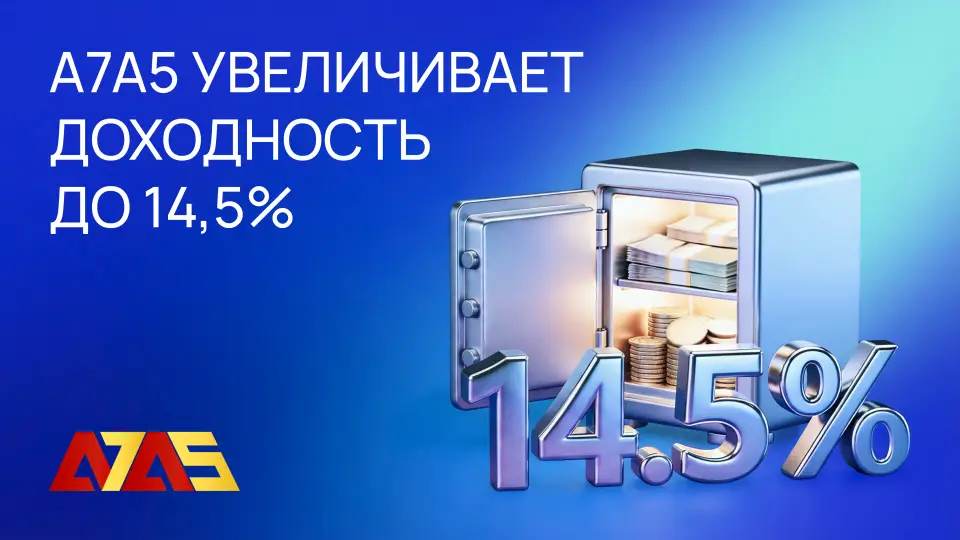
A7A5 includes a mechanism for income accrual. Income is generated from placing ruble funds in bank deposits. The calculation formula is defined as the key rate of the Bank of Russia minus one percentage point. At the current rate level, the estimated yield is 14.5% per annum.
The accrual is reflected in the token structure and does not require additional actions from the user. Meanwhile, the token remains liquid and can be used at any moment.
Advantages:
— Income accrual without a fixed term;
— The ability to manage the token at any time;
— Automatic reflection of income in the asset structure.
Disadvantages:
— Yield depends on changes in the key rate;
— The user is responsible for the storage of keys.
For example, a user holds 150,000 A7A5 in their wallet as a ruble reserve. Income is accrued automatically, and if necessary, funds can be immediately converted to USDT for participation in a deal.
Entry and Exit to Rubles for Crypto Investors
A7A5 can be used as a tool for introducing ruble funds into the crypto infrastructure and subsequently exiting back to fiat. The token allows for the conversion of rubles into on-chain format, using them within the blockchain, and returning to the banking system when needed without complex intermediary operations.
Advantages:
— Retaining ruble denomination within the blockchain;
— Quick exchange for USDT or another asset;
— A unified storage environment without the need for banking operations for each transaction.
Disadvantages:
— The need to consider fees during purchases and transfers;
— The importance of correctly selecting the network (ERC-20 or TRC-20).
For instance, a user funds their account with rubles, receives A7A5, transfers the tokens to an exchange, and exchanges them for the necessary token for trading. After closing positions, they convert part of the funds back to A7A5 and, if needed, arrange for a fiat withdrawal.
Technical Aspects
When working with A7A5, it is important to consider:
-
the correct selection of the network (ERC-20 or TRC-20);
-
the network fee for transactions;
-
self-storage of private keys;
-
compatibility of services with the chosen token standard.
Practically, A7A5 is used as a ruble unit within the cryptocurrency industry. It allows for storing, transferring, and utilizing ruble value within the network without resorting to bank accounts for each operation.
For users engaged with crypto infrastructure, this provides a means to maintain ruble liquidity within the blockchain—with the ability to move funds and utilize them in various scenarios.
A7A5 remains a tool within the strategy chosen by the user. The decision to use it depends on how significant the intra-network format of working with ruble assets and independent control over them is.
