Disclaimer: Information found on CryptoreNews is those of writers quoted. It does not represent the opinions of CryptoreNews on whether to sell, buy or hold any investments. You are advised to conduct your own research before making any investment decisions. Use provided information at your own risk.
CryptoreNews covers fintech, blockchain and Bitcoin bringing you the latest crypto news and analyses on the future of money.

A Developer Has Created Quantum-Resistant Bitcoin Without Modifying the Protocol: Could This Be the Solution for BTC?

Researcher Avihu Levy released a functional implementation of Quantum Safe Bitcoin on April 9, 2026 – requiring no alterations to the protocol.
This system operates entirely within Bitcoin’s current script limitations, making it accessible to any user willing to incur the computational expense today.
The governance culture surrounding Bitcoin renders coordinating a soft fork exceptionally challenging. BIP-360, co-authored by Levy and merged into Bitcoin’s official repository in February 2026, proposed a quantum-resistant address standard, but it necessitates protocol-level consensus that could take years to achieve.
Quantum-Safe Bitcoin Transactions Without Softforkshttps://t.co/1lx5waX9VV pic.twitter.com/Ni7pA6dEsC
— Avihu Levy
(@avihu28) April 9, 2026

 (@avihu28) April 9, 2026
Quantum Safe Bitcoin completely avoids that bottleneck. It is not merely a theoretical solution; Levy provided GPU-accelerated CUDA code, Python pipelines, and comprehensive Bitcoin scripts alongside the academic paper.
How QSB Actually Works – Hash Puzzles, Not Elliptic Curves
Standard Bitcoin transactions depend on ECDSA signatures over the secp256k1 curve. Shor’s algorithm can efficiently compute discrete logarithms, implying that a sufficiently advanced quantum computer could forge those signatures and deplete any wallet with an exposed public key.
Post-quantum cryptography addresses this issue – however, every known implementation necessitates larger signatures and new opcodes, which implies a soft fork.
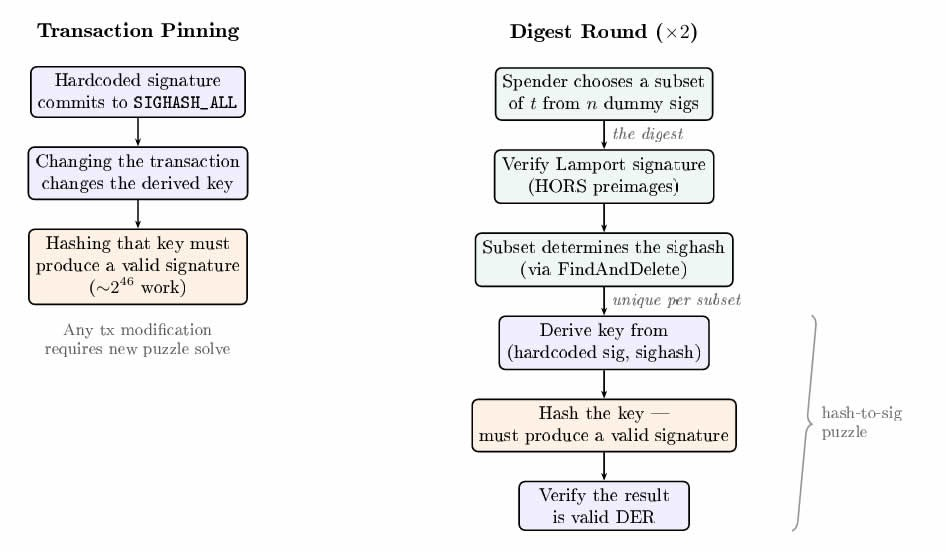
Levy’s method eliminates the elliptic curve dependency at its core. The scheme, based on Binohash (Robin Linus, 2026), substitutes the standard signature verification with a hash-to-signature puzzle. The Bitcoin script hashes a transaction-bound public key using OP_RIPEMD160 and interprets the resulting 20-byte output as a DER-encoded ECDSA signature.
A random 20-byte string meets DER structural constraints with a probability of approximately 2−46 – that equates to about one in 70 trillion attempts – which establishes the proof-of-work target.
The key difference: the security of this puzzle relies entirely on RIPEMD-160’s preimage resistance, rather than any elliptic curve assumption.
 Source: GitHub
Shor’s algorithm targets discrete logarithms. It does not compromise hash functions. This singular architectural choice is what renders Quantum-Safe Bitcoin resilient to the quantum threat without altering the protocol.
Related Posts
The construction unfolds in three stages. First, transaction pinning: the prover explores (sequence, locktime) parameter pairs until the recovered public key’s RIPEMD-160 hash yields a valid DER signature – approximately 246 work.
Second, two digest rounds: for the pinned transaction, the prover examines subsets of dummy signatures; each subset modifies the scriptCode via FindAndDelete, resulting in a different sighash and a different recovered key.
Identify a subset whose recovered key hashes to a valid DER signature (~246 candidates per round). The total computational expense is $75–$150 per transaction on cloud GPUs.
Zero-Knowledge Proofs and Dashlink come into play as an efficiency layer for proof verification. The QSB construction utilizes post-quantum cryptography principles by anchoring security to hash-based assumptions – the same foundation that supports ZK-friendly hash functions employed in contemporary Zero-Knowledge Proofs.
Dashlink’s function is to reduce the verification load so that proof validation remains within Bitcoin’s existing 10,000-byte script limit and 201-opcode ceiling. No new opcodes. No consensus alteration. The scheme is consensus-valid under rules already enforced by Bitcoin.
Bitcoin Hyper Targets Early Mover Upside

Bitcoin Hyper (HYPER) is presently in presale, aiming for early-mover advantages in the Bitcoin yield infrastructure layer – a sector attracting significant institutional interest as US spot Bitcoin ETFs garnered $471.3 million in a single week.
The presale has accumulated $32 million thus far, with the current token price at $0.0093 and staking APY reaching 86% annualized for early participants.
The primary technical differentiator: Bitcoin Hyper functions as a Bitcoin-native Layer 2 executing smart contracts with BTC as the settlement asset – circumventing the wrapped-token credit risk that affects existing BTC DeFi infrastructure.
This represents a specific, verifiable architectural claim in a domain filled with ambiguous interoperability assurances.
Research Bitcoin Hyper here before the presale window closes.
The post A Developer Just Built Quantum-Safe Bitcoin Without Changing a Single Line of the Protocol: Is This the Fix BTC? appeared first on Cryptonews.
