Disclaimer: Information found on CryptoreNews is those of writers quoted. It does not represent the opinions of CryptoreNews on whether to sell, buy or hold any investments. You are advised to conduct your own research before making any investment decisions. Use provided information at your own risk.
CryptoreNews covers fintech, blockchain and Bitcoin bringing you the latest crypto news and analyses on the future of money.


President Donald Trump’s February 1 tariff deadline concerning eight European countries over Greenland has ignited a classic trader’s dilemma, where markets are poised to shake up positioning ahead of a potential turnaround.
ChatGPT’s examination of historical patterns related to similar Trump tariff occurrences indicates an 86% probability of some form of off-ramp (a pause, delay, exemption, or reversal) either prior to the tariffs taking effect or within approximately a week thereafter.
This results in a high-stakes timing challenge where Bitcoin’s around-the-clock price movements may respond to the outcome before conventional markets can react.
The tariff declaration has already led to $875 million in crypto liquidations within a single day as Bitcoin dropped 3% to $92,000, with 90% of forced liquidations affecting long positions across Hyperliquid, Bybit, and Binance.
On January 17, 2026, at 11:19 AM EST, Trump announced via Truth Social that Denmark, Norway, Sweden, France, Germany, the UK, the Netherlands, and Finland would incur 10% tariffs starting February 1, escalating to 25% by June 1 “until a Deal is reached for the Complete and Total purchase of Greenland.”
Trump’s Europe tariff threats erase $875 million in crypto positions as Bitcoin falls 3% to $92,000 amid geopolitical market shock.#Trump #Europe #Tariffs #Bitcoinhttps://t.co/heRs8hxlkV
— Cryptonews.com (@cryptonews) January 19, 2026
The Pattern Behind the Probability
ChatGPT’s evaluation of historical tariff deadline events where Trump announced specific commencement dates for significant trade actions reveals notable reversal trends.
When categorizing outcomes into reversal, softening, or no-easing, 86% of instances show some form of off-ramp materialized, whether through full cancellations, delays, exemptions, or partial reversals.
Diving deeper into the timeline, there’s a 58% chance of an off-ramp occurring before February 1, combining a 29% likelihood of a complete reversal prior to the start date with another 29% chance of softening measures like delays or exemptions.
“The fact that this threat was communicated on social media rather than formalized in an executive order, coupled with its delayed implementation, means many investors might choose to wait things out before reacting impulsively,” said Brian Jacobsen, chief economic strategist at Annex Wealth Management, in comments to Bloomberg.
The liquidation event that took place on October 10 offers insightful parallels.
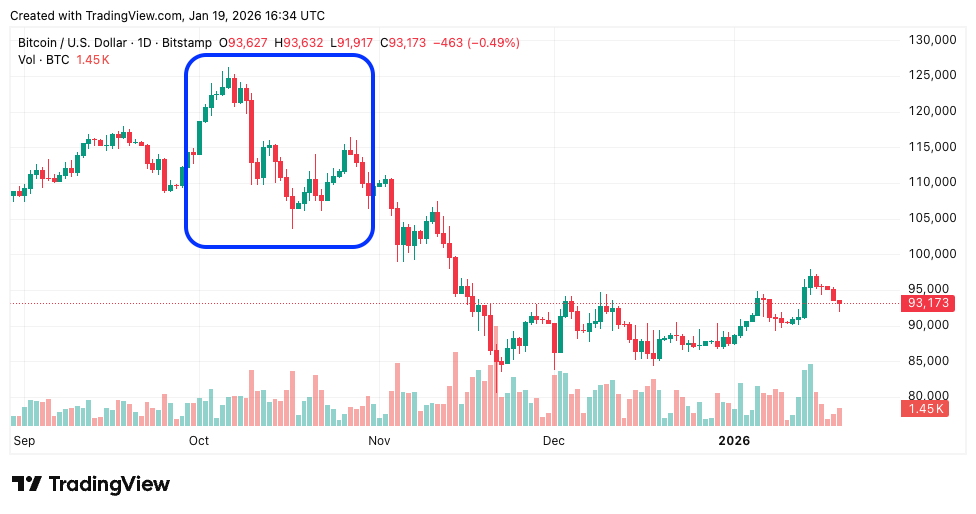 Source: TradingView
This incident witnessed severe liquidations cascading through crypto markets during the pre-announcement phase as positions accumulated, followed by sharp volatility fluctuations between the announcement and implementation as traders endeavored to preemptively adjust to policy changes.
Following implementation, markets eventually found stability once the actual tariff framework became apparent, but not without significant capital erosion during the period of uncertainty.
Bitcoin’s 24/7 Lie Detector Function
While stock markets close overnight and on holidays, Bitcoin continues to reflect fear or relief in real-time.
This continuous liquidity renders crypto markets the first responders to shifts in headlines, especially during the critical January 29–February 1 timeframe, where any shift in language towards “pause,” “delay,” “talks,” “exemptions,” “framework,” or “deal” could trigger a sharp relief rally, with altcoins potentially reacting even more vigorously than Bitcoin.
Indeed, Farzam Ehsani, CEO of crypto exchange VALR, noted in an interview with Cryptonews that escalating concerns regarding a U.S.-EU tariff confrontation, paired with Trump’s belligerent trade rhetoric, pushed markets into a renewed de-risking phase amid low weekend liquidity.
“Low weekend liquidity and leveraged positions intensified the impact of the decline, transforming the pullback into a rapid drop of nearly $4,000 in under two hours and triggering a cascade of liquidated positions totaling over $780 million,” Ehsani explained.
Related Posts
“As capital shifted into established safe havens like gold, digital assets continued to behave like high-risk assets.”
The weaknesses extend beyond tariff anxieties into more general vulnerabilities associated with cryptocurrencies.
While other risk assets, such as the KOSPI, remained flat or increased amidst US-EU trade-war worries, cryptocurrencies consistently underperformed, with only privacy coins standing out.
The 72-Hour Signal Window
The final phase leading up to February 1 represents maximum tension for traders positioned either for a reversal or further declines.
If no off-ramp language emerges within the last 48-72 hours, markets may begin to perceive the threat as credible, with Bitcoin reflecting fear ahead of traditional assets.
European leaders are already united in their firm opposition, indicating a higher likelihood of a concession before the specified date.
As reported by the BBC, UK Prime Minister Keir Starmer conveyed to Trump in a phone conversation that “applying tariffs on allies for pursuing the collective security of NATO allies is incorrect,” while Swedish Prime Minister Ulf Kristersson asserted, “We will not allow ourselves to be coerced.”
As Prime Minister, I will always act in the United Kingdom’s national interest. pic.twitter.com/ZkveFmD1R1
— Keir Starmer (@Keir_Starmer) January 19, 2026
French President Emmanuel Macron also advocated for activating the EU’s “trade bazooka,” a tool designed to counter coercive measures that would restrict U.S. market access and impose extensive limitations on American goods.
Moreover, Germany’s Bundeswehr has completed a reconnaissance operation in Greenland as part of NATO’s “Arctic Endurance” initiative aimed at enhancing the alliance’s presence in the region.
Trump perceived these European military actions as aggressive, stating that these nations “journeyed to Greenland, for purposes unknown” and introduced “a level of risk in play that is not tenable or sustainable.“
Despite Bitcoin’s efforts to approach $100,000, monetary policy anticipations provide little solace.
According to CME FedWatch tools, investors are forecasting the first significant rate cut only for June 2026, suggesting that tight financial conditions will remain.
 Source: CME FedWatch Tool
“Clear indicators of a turnaround toward sustained growth are still absent,” Ehsani stated, adding that consolidation remains the default scenario for Bitcoin and most altcoins without new liquidity catalysts.
For the time being, the trading strategy for the upcoming 72 hours is binary.
If the final two days before February 1 pass without any conciliatory statements from Washington, Bitcoin will likely lead the capitulation as markets begin to price tariffs as credible rather than merely rhetorical.
On the other hand, any news suggesting diplomatic retreat will trigger immediate repricing across crypto markets, with altcoins intensifying Bitcoin’s relief rally as leveraged positions scramble to adjust their defensive stances established during the selloff.
The post 86% Chance Trump Blinks on Tariffs, But Bitcoin Will Tell You First appeared first on Cryptonews.
