Disclaimer: Information found on CryptoreNews is those of writers quoted. It does not represent the opinions of CryptoreNews on whether to sell, buy or hold any investments. You are advised to conduct your own research before making any investment decisions. Use provided information at your own risk.
CryptoreNews covers fintech, blockchain and Bitcoin bringing you the latest crypto news and analyses on the future of money.


Key takeaways:
- Most tokens received through airdrops tend to rapidly depreciate due to significant selling.
- Tokens that have active developers and frequent updates generally perform better.
- Robust community backing and a clear purpose for the token can enhance success.
- Launching within the appropriate ecosystem can significantly influence outcomes.
Although interest in airdrops remains strong, the performance of tokens distributed through this method after their launch often reveals a less optimistic narrative. Let’s examine the data to identify the trends that contribute to this situation and understand why many of these tokens face substantial drops in value following their initial distribution.
What Are Airdrops?
The idea of airdrops in the cryptocurrency space originated as a novel method to distribute tokens directly to users, frequently aimed at encouraging adoption, creating network effects, or decentralizing authority. Early airdrops set the stage for what has become a widely accepted approach in DeFi and Web3 communities. Below are some of the earliest significant airdrops:
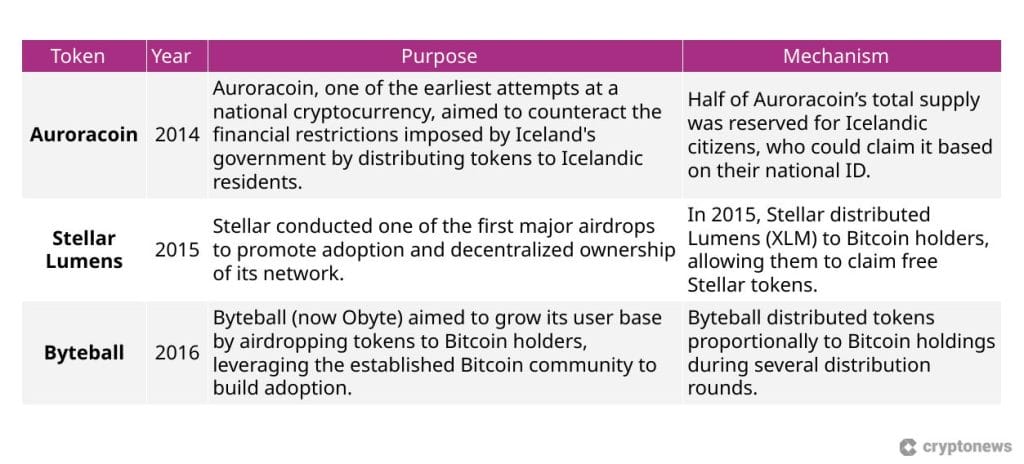
Among these three instances, only one remains somewhat relevant, highlighting the challenges that airdropped tokens frequently encounter.
Why Airdropped Tokens Decline Post-Launch
Despite the initial enthusiasm, most airdropped tokens tend to experience declining price trends following their token generation events (TGE). Several factors contribute to this post-launch downturn:
- Economics of token issuance: Airdropped tokens are often distributed at no cost, resulting in immediate selling pressure from holders who may view them as disposable rather than as long-term investments. This situation creates sell-side pressure that often surpasses buy-side demand.
- Investor psychology: For many recipients, “free” tokens do not carry the same perceived value as purchased assets. In the absence of strong incentives to retain them, recipients frequently sell at the first chance, leading to price declines.
- Liquidity and utility: The enduring value of a token is closely linked to its utility within the network and overall liquidity. Many airdropped tokens lack significant use cases beyond speculative trading, which restricts their ability to maintain value.
This reality is underscored by recent performance data: Out of a sample of 23 airdropped tokens, only seven have demonstrated positive returns. The majority show downward trends, driven by increased selling activity as recipients offload their free tokens.
Case Study: Optimism’s Airdrop
The Optimism network serves as a clear example of a typical post-airdrop trend. The $OP token from Optimism, distributed regularly to contributors of the network, experienced a notable sell-off during its fifth distribution cycle in October. This cycle saw the distribution of 10,368,678 OP tokens across 54,723 unique addresses. The result? A significant rise in zero-balance addresses, with nearly half of the distributed wallets liquidating their holdings shortly after receiving tokens.
The chart above illustrates this selling behavior, indicating a fivefold increase in wallet liquidations following the October airdrop. This trend reinforces the problem: without inherent incentives to hold, recipients frequently sell tokens immediately, exerting downward pressure on prices.
Related Posts
The Outlier: BONK – A Reason to HODL
One airdrop that has defied the trend is BONK, a token that has delivered significant returns to its holders. What distinguishes BONK from others?
- Staking rewards: BONK introduced staking options, encouraging holders to retain their tokens instead of selling them right away.
- DeFi integration: BONK developed various DeFi tools, enhancing trust in the asset and promoting a wider usage ecosystem.
- Strategic ecosystem placement: Most importantly, BONK launched on the Solana blockchain. The strong performance of Solana’s ecosystem has directly bolstered BONK’s value, demonstrating that the success of a network can positively impact token performance.
The ecosystem in which a token is launched plays a vital role in its success. This is evident in the two most lucrative recent airdrops, BONK and Kamino, both of which debuted on Solana—a network that has seen considerable interest and user growth.
Build and They Will Come: Developer Activity’s Impact on Token Success
In the cryptocurrency space, “build and they will come” is more than just a catchy phrase—developer engagement is a crucial element in determining a project’s long-term success. While the correlation between developer activity and token profitability may not always be straightforward, a dedicated and active development team often aligns with improved price performance.
Examining Optimism (OP) and DYDX, both of which exhibit significant monthly development activity, it is evident that projects with regular updates and enhancements tend to maintain user interest and bolster holder confidence. Optimism, with over 2,400 monthly commits, retains 50% of holders in profit—a commendable figure among airdropped tokens. This type of consistent development aids projects in remaining relevant, adapting to user requirements, and fostering loyalty, ultimately benefiting token price stability.
Rather than a fleeting hype cycle, tokens with dedicated development teams behind them are likely to establish a more robust foundation. Over time, this helps to mitigate sell pressure and can transform a speculative asset into a long-term hold—making “build and they will come” an essential strategy for tokens seeking to counteract the post-airdrop decline.
The Open Door: Retail Buying Pressure
While we have concentrated on the sell pressure that negatively impacts airdropped tokens, there is another important aspect to consider before concluding: buy pressure—or rather, its absence.
For an airdropped token to sustain its value, it requires consistent demand from buyers, particularly retail investors willing to acquire these tokens on the open market. In the absence of that buy pressure, even the most well-executed airdrop will ultimately succumb to the weight of sell pressure as recipients cash out their free tokens.
In the current market cycle, conditions have not been favorable for airdropped tokens. Despite Bitcoin’s relatively strong performance this year, much of that momentum has been fueled by institutional interest. Retail participation, typically the main driver of new demand for smaller tokens, has been noticeably lacking. The chart below depicts the trend: while we would typically observe a surge in new Bitcoin addresses during price increases, this year has seen a decline, reaching new lows in address creation. This absence of retail activity has created a challenging environment for airdropped tokens, as the sell pressure lacks a fresh influx of buyers to absorb it.
In summary, airdropped tokens encounter significant obstacles in preserving value without consistent buy pressure and strong retail interest. While airdrops continue to be popular, tokens frequently undergo rapid sell-offs due to limited use cases, a lack of perceived value among recipients, and weak buy-side demand, particularly from retail investors.
The positive aspect is that retail interest in cryptocurrency has shown signs of resurgence in recent weeks. This renewed enthusiasm could aid in stabilizing airdropped tokens, but long-term success will rely on more than just distribution. To create lasting value, tokens must establish genuine utility, active development, and sustained buy-side demand.
The post 70% of Airdropped Tokens Fail to Deliver Profits, Here’s Why appeared first on Cryptonews.
