Disclaimer: Information found on CryptoreNews is those of writers quoted. It does not represent the opinions of CryptoreNews on whether to sell, buy or hold any investments. You are advised to conduct your own research before making any investment decisions. Use provided information at your own risk.
CryptoreNews covers fintech, blockchain and Bitcoin bringing you the latest crypto news and analyses on the future of money.


Seventy economists from Europe have urged EU legislators to prioritize the public good over private-sector influence when developing the digital euro, cautioning that poor design decisions could lead to Europe’s reliance on foreign payment systems and dollar-pegged stablecoins.
The open letter, released on Sunday by Utrecht University’s Sustainable Finance Lab, coincides with the European Parliament’s efforts to finalize legislation that will determine whether the digital currency serves as a substantial alternative to private money or ends up being a “symbolic compromise.”
The scholars contend that Europe’s payment infrastructure has become perilously centralized in non-European hands, with thirteen eurozone nations now depending entirely on international card networks for basic retail transactions.
“This reliance on foreign (US) payment providers puts European citizens, businesses, and governments at risk of geopolitical manipulation, foreign commercial agendas, and systemic hazards beyond Europe’s influence,” the letter emphasizes, noting that U.S.-backed private digital currencies are advancing while Europe takes its time to decide.
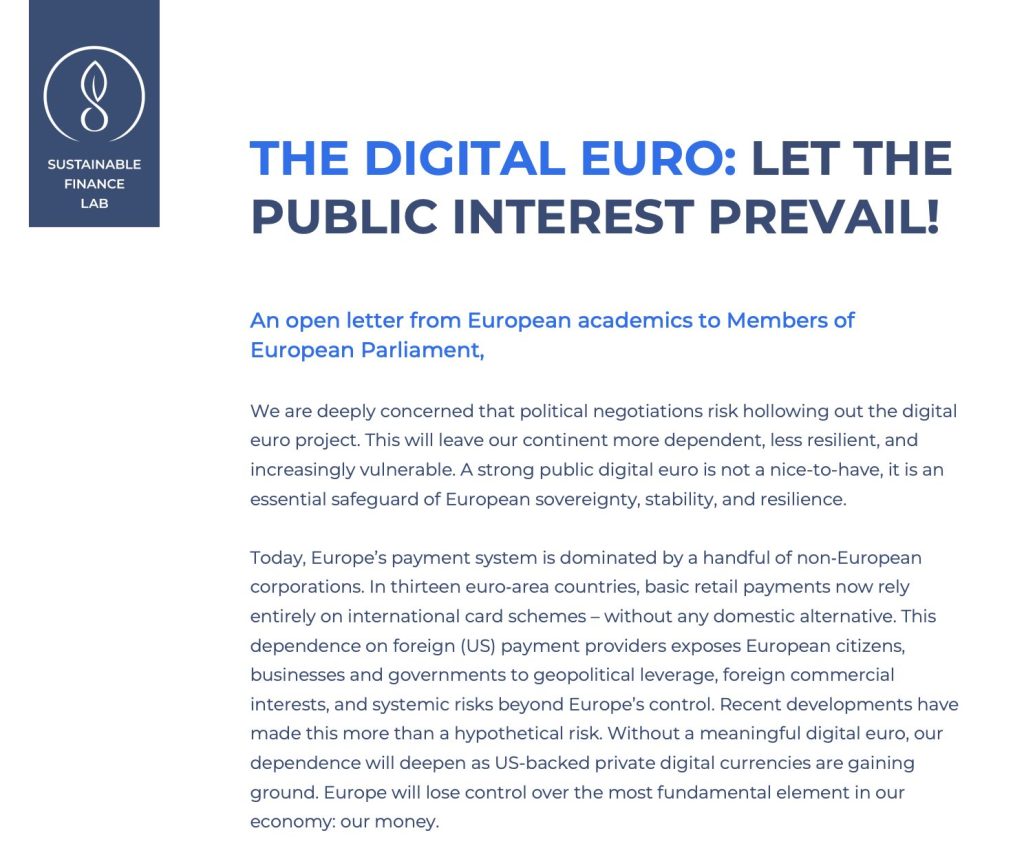 Open Letter to MEP. | Source: Sustainable Finance Lab
Key Design Elements Crucial for Digital Euro Success
The signatories, which include former central bank governors and well-known economists like Thomas Piketty and Paul De Grauwe, advocate for three essential features.
The digital euro should act as “the foundation of a sovereign, robust European payment system based on domestic providers adhering to the highest privacy standards,” provide “public digital currency that is accessible to all Europeans, fostering financial inclusion,” and deliver “a reliable store of value through a generous and progressively increasing holding limit.”
Without these components, the economists caution that the initiative will be doomed to failure.
“If a significant portion of European businesses is excluded or permitted to reject it, or if holding limits are so restrictive that citizens cannot use it as a legitimate store of value, then the digital euro will fail to achieve its potential,” they assert.
The letter outlines the stakes clearly, posing the question of whether Europeans will “assert control over their money in the digital era, or will we permit others to manage it for us?”
ECB Officials Associate Digital Euro with Safe Asset Growth
ECB Executive Board member Philip Lane reinforced the strategic rationale in a speech to the Danish Economic Society on January 9, positioning the digital euro within broader efforts to enhance Europe’s financial framework.
Lane maintained that structural transformations, including geopolitical changes, digital advancements, and climate issues, constitute common shocks best addressed through monetary union, with the digital euro providing “retail central bank currency in digital form” as transaction systems evolve.
Related Posts

ECB Philip Lane. Source: CEPR
Lane also highlighted Europe’s lack of safe assets, pointing out that the German Bund alone is insufficient to satisfy global demand for euro-denominated securities.
He proposed potential solutions, such as expanded common bonds for European public goods and the “blue bond/red bond” reform, where member states would earmark tax revenues to support jointly issued securities.
“The collective benefit would be the reduction in debt servicing costs generated by the safe asset services provided by an expanded pool of common debt,” Lane stated.
Progressing Timeline Amid Ongoing Political Negotiations
Technical preparations are nearing completion following the ECB’s decision in October to enter the readiness phase.
ECB President Christine Lagarde confirmed last month that “we have completed our work, we have laid the groundwork,” placing the onus on EU institutions to finalize the legislation.
Board member Piero Cipollone previously suggested that pilot transactions could commence in mid-2027, with the first issuance anticipated in 2029 if lawmakers approve the regulatory framework next year.
Last month, the EU Council also reached an agreement on its negotiating stance, establishing a framework that encompasses both online and offline payment methods.
The offline variant would facilitate device-to-device transactions without internet connectivity, offering privacy akin to cash for low-value payments while ensuring compliance with anti-money laundering regulations for wallet funding.
ECB President Christine Lagarde stated that the digital euro is technically prepared and is now awaiting legislative approval.#ECB #DigitalEuro #EUStablecoinhttps://t.co/4cdYV6UdSJ
— Cryptonews.com (@cryptonews) December 19, 2025
Lagarde stressed that the digital euro would serve as a complement to physical currency under Europe’s Markets in Crypto-Assets Regulation, characterizing MiCA-compliant stablecoins as “an alternative form of payment” that can be “considered safe.”
Public acceptance remains uncertain, as recent ECB surveys indicate that many Europeans perceive limited necessity for the new payment method despite official reassurances.
The post 70 Economists Urge EU to Launch Public Digital Euro Over Private Stablecoins appeared first on Cryptonews.
