Disclaimer: Information found on CryptoreNews is those of writers quoted. It does not represent the opinions of CryptoreNews on whether to sell, buy or hold any investments. You are advised to conduct your own research before making any investment decisions. Use provided information at your own risk.
CryptoreNews covers fintech, blockchain and Bitcoin bringing you the latest crypto news and analyses on the future of money.


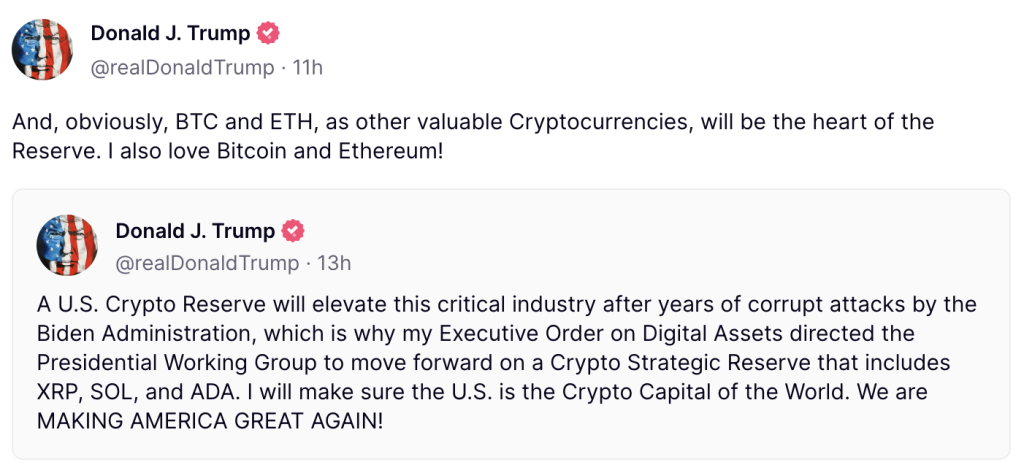
In a somewhat unexpected post on Sunday, Donald Trump announced that the U.S. is establishing a “crypto strategic reserve.”
The president initially confirmed that XRP, SOL, and ADA could be included, swiftly adding a few hours later that BTC and ETH would be at the “heart” of this stockpile.
Crypto markets rallied on the news, with Bitcoin nearing $95,000 and Cardano breaking through $1 for the first time since 2022. However, much of those gains have since been reversed, with stock markets tanking as new tariffs targeting Mexico and Canada came into force.
24h7d30d1yAll time
No further details about this reserve have been confirmed — there hasn’t even been an official statement from the White House. So: let’s look at some of the big questions that remain unanswered.
1. Will This Cost Taxpayers Money?
The Department of Government Efficiency, led by Elon Musk, is currently attempting to slash billions of dollars in spending — all with a view to reducing the tax burden on everyday Americans. That makes this plan to start investing in a slew of altcoins much more unusual.
Trump’s plan for a strategic Bitcoin reserve made sense, because it wouldn’t need to cost taxpayers a dime. About 200,000 BTC has been seized from criminals recently — which means that this could be used as a starting point for the reserve, instead of coins being auctioned off.
It’s highly likely that Republicans and Democrats alike may take a dim view of their taxpayer dollars getting used to snap up cryptocurrencies they’ve never heard of — particularly should they make a considerable loss.
Any move to convert some of this seized BTC into ETH, XRP, SOL, and ADA would inevitably spark an outcry.
According to The New York Times, there was a suggestion that a new tax — which would function as a levy on stablecoin transactions — might be used to generate investable funds.
2. Why XRP, SOL, and ADA?
You may argue that this reserve is meant to serve as a showcase for cryptocurrencies created in the U.S., but that theory falls flat when you consider that the Cardano Foundation is based in Switzerland.
Allegations are swirling that certain crypto firms, Ripple among them, have been lobbying hard for inclusion in a U.S. reserve — with Brad Garlinghouse warning against “Bitcoin maximalism.”
But critics are questioning how decentralized these altcoins really are, and claim they’re vastly inferior to Bitcoin.
Related Posts
3. What Will the Allocation Look Like?
This is a critical question — the answer to which may cause these five named cryptocurrencies to surge considerably or crash dramatically.
Perhaps the fairest way of doing this may be to determine the allocation based on each digital asset’s respective market cap.
At the time of writing, that would mean Bitcoin represents 77% of this crypto strategic reserve — with Ether on about 11.5%, XRP on 6.5%, SOL on 3.5%, and ADA on 1.5%.
4. What Other ‘Valuable Cryptocurrencies’ Will Be Included?
There would be little point adding stablecoins like USDC and USDT — they’re designed to be pegged to the dollar, so wouldn’t deliver much price upside.
You might imagine there’s a great temptation to add Dogecoin, it inspired the name of a whole government department after all. And if you’d suppose the White House wouldn’t be so brazen to add $TRUMP to this reserve, nothing can be ruled out with an administration as unpredictable as this.
5. Will This Need Congressional Approval?
Very likely — and while there is bipartisan support for clearer regulation, a reserve containing volatile altcoins may be a bit of too much for lawmakers to stomach. Professional Capital Management founder Anthony Pompliano had an interesting theory here, telling Fox Business:
“I’m wondering if Trump is actually trying to negotiate. If you go and consider the art of the deal, everything is negotiated. He’s asking for 5 or 6 assets — and as it works through the political process, he’s then willing to give up a bunch of them and end up with a Bitcoin-only reserve. I don’t know if that’s what he’s doing or not, but I certainly hope so.”
6. Will Other Countries Follow Suit?
The consensus seems to be this: major economies will sit up and take notice if the U.S. is making a reserve that includes Bitcoin.
However, many countries will probably end up giving these altcoins a wide berth.
The post 6 Unanswered Questions on Trump’s Crypto Reserve appeared first on Cryptonews.
