Disclaimer: Information found on CryptoreNews is those of writers quoted. It does not represent the opinions of CryptoreNews on whether to sell, buy or hold any investments. You are advised to conduct your own research before making any investment decisions. Use provided information at your own risk.
CryptoreNews covers fintech, blockchain and Bitcoin bringing you the latest crypto news and analyses on the future of money.


At least five Ethereum liquid staking providers have either established or are in the process of establishing a self-limit policy, pledging not to exceed 22% of the Ethereum staking market — a measure viewed as a way to maintain the decentralization of the Ethereum network.
Among the Ethereum staking providers that have either already committed or are working towards this self-limit policy are Rocket Pool, StakeWise, Stader Labs, and Diva Staking, as noted by Ethereum core developer Superphiz.
Puffer Finance, another liquid staking platform, has also declared its commitment to the self-limit.
These providers are dedicated (or are in the process of dedicating) to self-limiting to <22% of Ethereum validators. This is how our chain will thrive: Coordination over greed. Collaboration instead of winner-takes-all.@Rocket_Pool @stakewise_io @staderlabs @divastaking
— superphiz.eth ️ (@superphiz) August 30, 2023
The initiative is presumably intended to tackle concerns regarding the increasing centralization of Ethereum staking.
Regarding the choice of a 22% self-limit, Superphiz clarified that since 66% of validators must agree on the state of Ethereum, setting the limit below 22% ensures that at least four significant entities would need to collude for the chain to achieve finalization.
Finality refers to the stage at which transactions on a blockchain are deemed immutable, thereby ensuring that transactions within a block cannot be modified.
This concept was introduced by Superphiz in May 2022 when he raised the question of whether a staking pool would prioritize the health of the chain over its own profits.
Notably, the largest Ethereum liquid staking provider, Lido Finance, voted against self-limiting by a 99.81% majority in June.
“They have indicated a desire to control the majority of validators on the beacon chain,” Superphiz remarked in a post on Aug. 31.
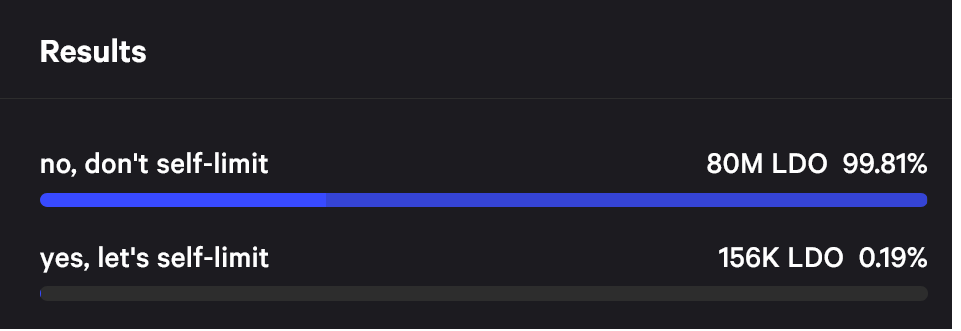 Votes cast by Lido (LDO) token holders on the self-limiting proposal. Source: Snapshot
Related Posts
Lido currently leads the Ethereum staking market, representing 32.4% of all staked Ether, while the next largest entity, Coinbase, holds only 8.7% of the market, according to data from Dune Analytics.
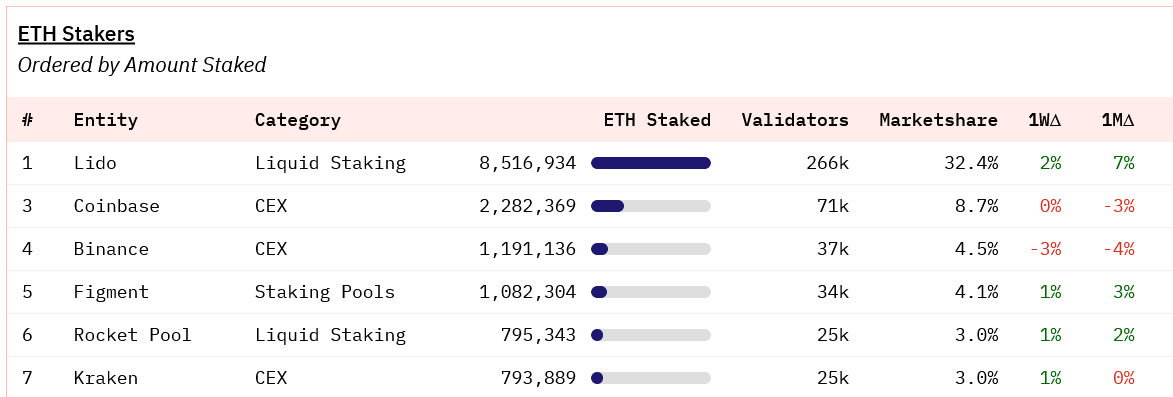 Ethereum stakers by staking amount and market share, indicating that Lido is the only provider exceeding the 22% threshold. Source: Dune Analytics
Who’s in the right? Mixed reactions from the Ethereum community
One industry commentator, “Mippo,” stated on Aug. 31 that the self-limit proposal is unrelated to “Ethereum alignment” — a concept understood to facilitate credible neutrality and permissionless innovation on Ethereum.
Mippo asserted that those advocating for the proposal would not concede if they were in Lido’s position.
Related: Ethereum is about to get crushed by liquid staking tokens
“Everyone is acting in an economically selfish and rational manner here,” Mippo concluded.
Yeah because they have way less market share than that now… easy to chirp from the cheap seats.
This has nothing to do with “Ethereum alignment.” None of these teams would self-limit were they in Lido’s place.
Everyone is doing the economically selfish and rational thing…— Mippo (@MikeIppolito_) August 31, 2023
“Members of the ETH community should not criticize more user-friendly solutions as greedy products,” remarked another observer.
Conversely, others expressed greater concern regarding the potential centralization risks, labeling Lido’s market share dominance as “disgusting and selfish.”
Magazine: DeFi Dad, Hall of Flame: Ethereum is ‘woefully undervalued’ but growing more powerful
