Disclaimer: Information found on CryptoreNews is those of writers quoted. It does not represent the opinions of CryptoreNews on whether to sell, buy or hold any investments. You are advised to conduct your own research before making any investment decisions. Use provided information at your own risk.
CryptoreNews covers fintech, blockchain and Bitcoin bringing you the latest crypto news and analyses on the future of money.


The centralization of nodes is among the most significant challenges confronting the Ethereum network and should be tackled by making node operation more affordable and accessible, as stated by Ethereum co-founder Vitalik Buterin.
Presently, a substantial portion of the 5,901 active Ethereum nodes is operated through centralized web service providers like Amazon Web Services, which many experts assert leaves the Ethereum blockchain vulnerable to a centralized point of failure.
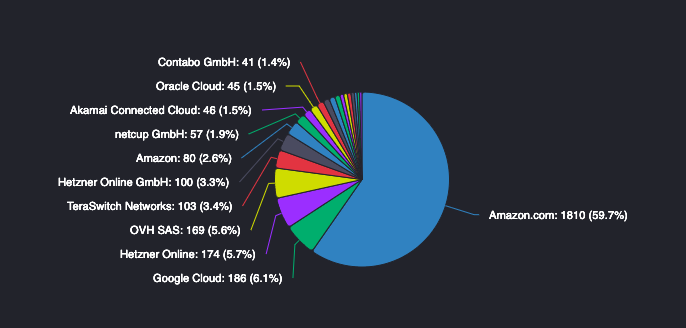 Distribution of Ethereum nodes from web service providers. Source: Ethernodes
During Korea Blockchain Week, Buterin discussed six critical issues that need to be resolved to mitigate centralization, emphasizing that the node situation represents a “major piece of the puzzle” in ensuring the long-term decentralization of the Ethereum network.
“One of those six items is making it technically simpler for individuals to operate nodes, and statelessness is one of the genuinely crucial technologies in achieving that,” he clarified.
“At present, it requires hundreds of gigabytes of data to operate a node. With stateless clients, you can run a node on virtually zero.”
The idea of statelessness pertains to eliminating dependence on centralized service providers for validating activities on the network. According to the Ethereum Foundation, true decentralization cannot be attained until node operators can run Ethereum on modest and budget-friendly hardware.
As Buterin pointed out, statelessness is a vital element of the Ethereum roadmap, with significant advancements toward statelessness being made in “The Verge” and “The Purge” phases:
“In the long run, there’s a strategy to maintain fully verified Ethereum nodes that you could literally run on your phone.”
Related Posts
Updated roadmap diagram! pic.twitter.com/MT9BKgYcJH
— vitalik.eth (@VitalikButerin) November 4, 2022
Despite statelessness being a fundamental aspect of the Ethereum roadmap, Buterin acknowledged that these highly technical issues are unlikely to be resolved in the near future.
“These technical challenges will need to be addressed eventually — perhaps on a 10-year timeline, maybe a 20-year timeline,” he remarked.
Related: Ethereum staking services agree to 22% limit of all validators
Apart from statelessness, Buterin indicated that the next most critical steps toward reducing Ethereum centralization involve simplifying documentation, lowering barriers to distributed staking, enhancing the security of staking, and more generally, making it easier to stake Ether (ETH).
Ultimately, however, Buterin concluded that the most urgent and pressing issue for Ethereum as a whole is achieving higher levels of scalability.
Currently, Ethereum scaling protocols primarily utilize zero-knowledge (ZK) rollups.
ZK-rollups have been praised by many in the Ethereum community as a vital tool for achieving scalability, as they work to enhance throughput on the main Ethereum chain by shifting computation and state storage off-chain.
Magazine: Here’s how Ethereum’s ZK-rollups can become interoperable
