Disclaimer: Information found on CryptoreNews is those of writers quoted. It does not represent the opinions of CryptoreNews on whether to sell, buy or hold any investments. You are advised to conduct your own research before making any investment decisions. Use provided information at your own risk.
CryptoreNews covers fintech, blockchain and Bitcoin bringing you the latest crypto news and analyses on the future of money.

Vitalik Buterin states that Ethereum layer 2 solutions will maintain varied strategies for scaling.

The Ethereum layer-2 ecosystem is anticipated to keep advancing with various technological strategies, as stated by co-founder Vitalik Buterin.
On his personal blog, the co-founder of the smart contract blockchain elaborated on the current state of Ethereum’s scaling ecosystem, noting that several layer-2 protocols employ distinct methods to enhance scaling capacity, reduce costs, and bolster security.
Buterin pointed out that Ethereum Virtual Machine (EVM) rollups, initiated by Arbitrum, Optimism, Scroll, and more recently, Kakarot and Taiko, have significantly enhanced the security of their respective solutions.
Different types of layer 2shttps://t.co/ry4VTtWhJ1
— vitalik.eth (@VitalikButerin) October 31, 2023
In addition, “sidechain projects” such as Polygon have also created their own rollup solutions. Buterin further emphasizes the role of “almost-EVMs” like zkSync, extensions like Arbitrum Stylus, and zero-knowledge proof innovators Starknet as key contributors to scaling technology within the ecosystem:
“One of the inevitable consequences of this is that we are seeing a trend of layer 2 projects becoming more heterogeneous. I expect this trend to continue, for a few key reasons.”
Buterin observes that some projects currently functioning as independent layer 1s are seeking to integrate more closely with the Ethereum ecosystem and potentially transition into ecosystem layer 2s.
Related: Polygon’s ‘holy grail’ Ethereum-scaling zkEVM beta hits mainnet
This type of transition remains challenging, as an “all at once” strategy could lead to a decline in usability, given that the technology is not yet at a stage where it can be fully incorporated into rollup technology. Conversely, delaying such a transition risks “sacrificing momentum and being too late to be meaningful.”
Buterin also mentions that certain centralized, non-Ethereum projects are aiming to provide users with enhanced security assurances and are exploring blockchain-based solutions. Traditionally, these types of projects would have turned to “permissioned consortium chains” to achieve this:
“Realistically, they probably only need a “halfway-house” level of decentralization. Additionally, their often very high level of throughput makes them unsuitable even for rollups, at least in the short term.”
Related Posts
Finally, Buterin considers non-financial applications such as games and social media platforms that aspire to decentralization but do not require high levels of security. Using a social media example, Buterin points out that different components of the application would necessitate distinct functionalities:
“Rare and high-value activity like username registration and account recovery should be done on a rollup, but frequent and low-value activity like posts and votes need less security.“
He adds that a chain failure resulting in a user’s post disappearing would be an “acceptable cost,” whereas a similar failure leading to the loss of an account would be significantly more serious.
Related: Vitalik Buterin voices concerns over DAOs approving ETH staking pool operators
Buterin also observes that the expenses associated with rollup fees might not be acceptable for non-blockchain users, while previous blockchain users are accustomed to paying much higher fees for on-chain interactions.
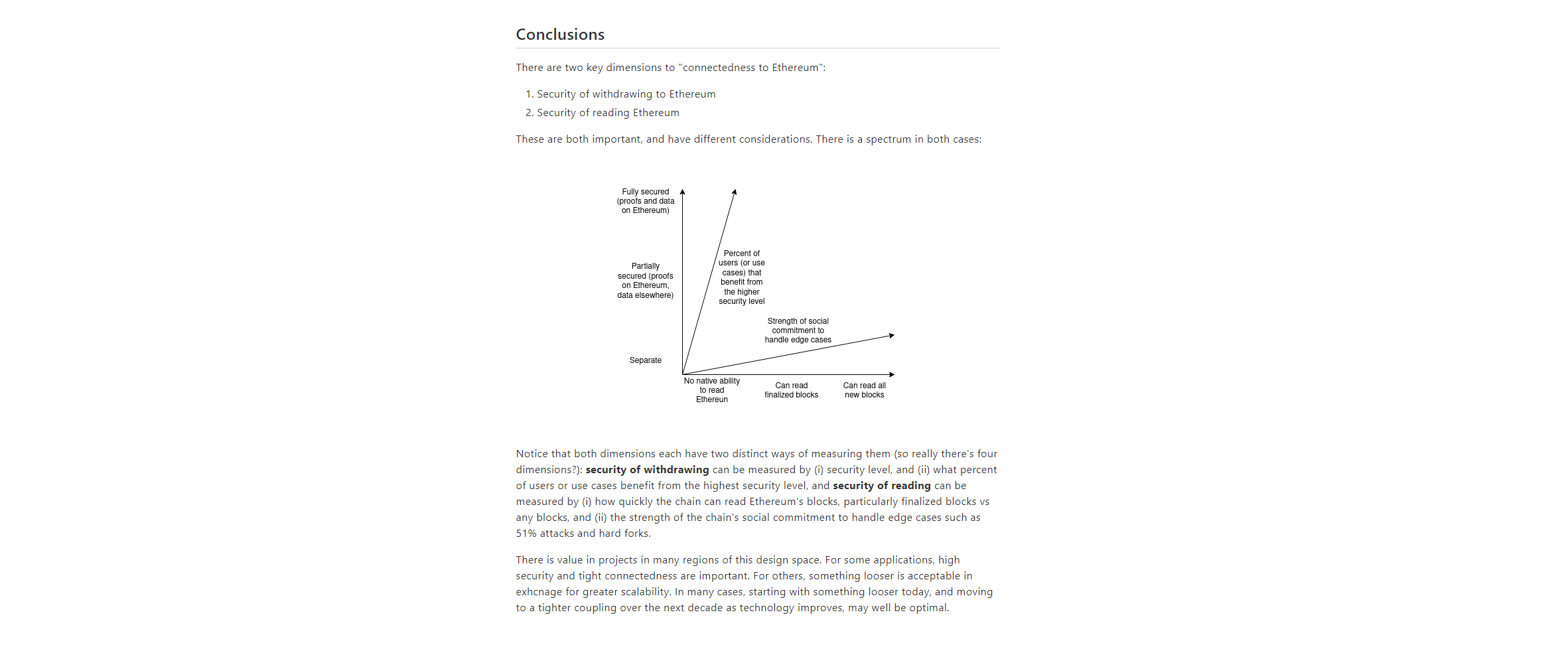 An excerpt from Buterin’s latest blog post on the Ethereum ecosystem titled “Different types of layer 2s.” Source: vitalik.eth.limo
The Ethereum co-founder then explores the trade-offs between various rollup solutions and systems that provide differing scaling capabilities to the ecosystem. The “connectedness” to Ethereum depends on the security of withdrawals to Ethereum from L2s and the security of accessing data from the Ethereum blockchain.
Related: Ethereum’s proto-danksharding to make rollups 10x cheaper — Consensys zkEVM Linea head
Buterin notes that high security and strong connectedness are crucial for certain applications, while others may require a more relaxed approach in exchange for enhanced scalability:
In many cases, starting with something looser today, and moving to a tighter coupling over the next decade as technology improves, may well be optimal.”
Ethereum’s next scheduled hard fork is set to introduce EIP-4844, commonly referred to as “proto-dank sharding.” This EIP is expected to significantly increase the data availability of the network. Buterin also mentions that advancements in data compression allow for greater functionality.
Magazine: Ethereum restaking: Blockchain innovation or dangerous house of cards?
